The Sidney Kimmel Comprehensive Cancer Center at Johns Hopkins, Division of Pediatric Oncology, Baltimore, Maryland 21287, USA.
Russell H. Morgan Department of Radiology and Radiological Science, Johns Hopkins Medical Institutions, Baltimore, Maryland 21287, USA.
Cold Spring Harb Mol Case Stud. 2021 Aug 2;7(4). doi: 10.1101/mcs.a006064. Print 2021 Aug.
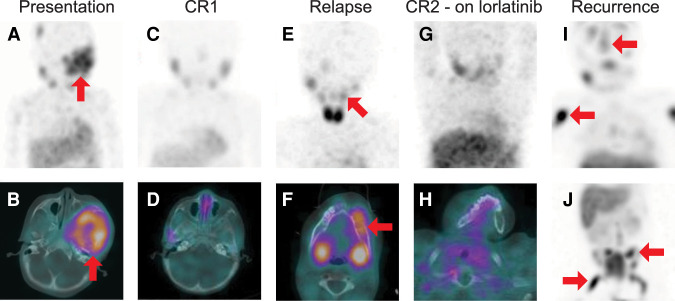
Treatment of high-risk neuroblastoma typically incorporates multiagent chemotherapy, surgery, radiation therapy, autologous stem cell transplantation, immunotherapy, and differentiation therapy. The discovery of activating mutations in ALK receptor tyrosine kinase () in ∼8% of neuroblastomas opens the possibility of further improving outcomes for this subset of patients with the addition of ALK inhibitors. ALK inhibitors have shown efficacy in tumors such as non-small-cell lung cancer and anaplastic large cell lymphoma in which wild-type ALK overexpression is driven by translocation events. In contrast, ALK mutations driving neuroblastomas are missense mutations in the tyrosine kinase domain yielding constitutive activation and differing sensitivity to available ALK inhibitors. We describe a case of a patient with relapsed, refractory, metastatic F1174L-mutated neuroblastoma who showed no response to the first-generation ALK inhibitor crizotinib but had a subsequent complete response to the ALK/ROS1 inhibitor lorlatinib. The patient's disease relapsed after 13 mo of treatment. Sequencing of cell-free DNA at the time of relapse pointed toward a potential mechanism of acquired lorlatinib resistance: amplification of and and a Q61K mutation. We review the literature regarding differing sensitivity of mutations found in neuroblastoma to current FDA-approved ALK inhibitors and known pathways of acquired resistance. Our report adds to the literature of important correlations between neuroblastoma mutation status and clinical responsiveness to ALK inhibitors. It also highlights the importance of understanding acquired mechanisms of resistance.
高危神经母细胞瘤的治疗通常包括多药化疗、手术、放射治疗、自体干细胞移植、免疫疗法和分化疗法。在约 8%的神经母细胞瘤中发现 ALK 受体酪氨酸激酶 () 的激活突变,为这部分患者进一步改善预后提供了可能,可添加 ALK 抑制剂。ALK 抑制剂在非小细胞肺癌和间变大细胞淋巴瘤等肿瘤中显示出疗效,这些肿瘤中野生型 ALK 过表达是由易位事件驱动的。相比之下,驱动神经母细胞瘤的 ALK 突变是酪氨酸激酶结构域的错义突变,导致组成性激活,对现有 ALK 抑制剂的敏感性不同。我们描述了一例复发、难治、转移性 F1174L 突变神经母细胞瘤患者的病例,该患者对第一代 ALK 抑制剂克唑替尼无反应,但对 ALK/ROS1 抑制剂劳拉替尼有后续完全反应。该患者在治疗 13 个月后疾病复发。在复发时进行的游离 DNA 测序表明存在潜在的获得性劳拉替尼耐药机制: 和 扩增以及 Q61K 突变。我们回顾了关于神经母细胞瘤中发现的 突变对目前 FDA 批准的 ALK 抑制剂的不同敏感性以及已知获得性耐药途径的文献。我们的报告增加了神经母细胞瘤 突变状态与 ALK 抑制剂临床反应之间的重要相关性的文献。它还强调了了解获得性耐药机制的重要性。