Department of Biomedical Engineering, The Chinese University of Hong Kong, Shatin, Hong Kong.
Department of Imaging and Interventional Radiology, The Chinese University of Hong Kong, Shatin, Hong Kong.
Neural Plast. 2021 Jun 9;2021:8866613. doi: 10.1155/2021/8866613. eCollection 2021.
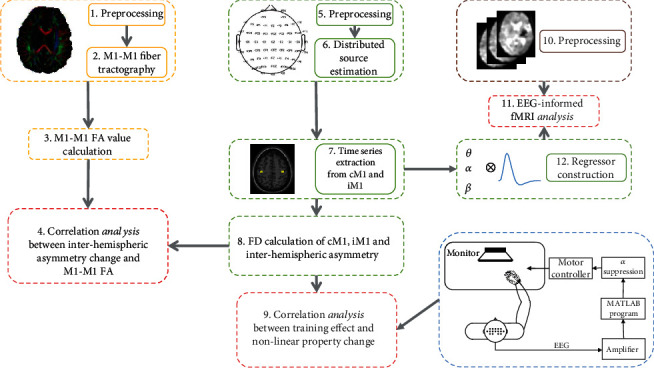
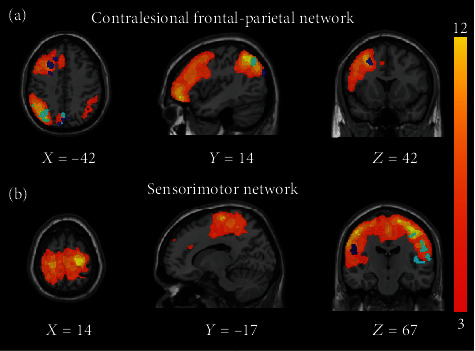
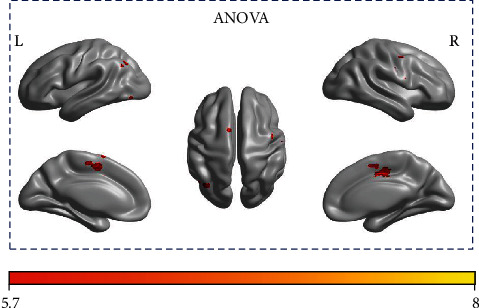
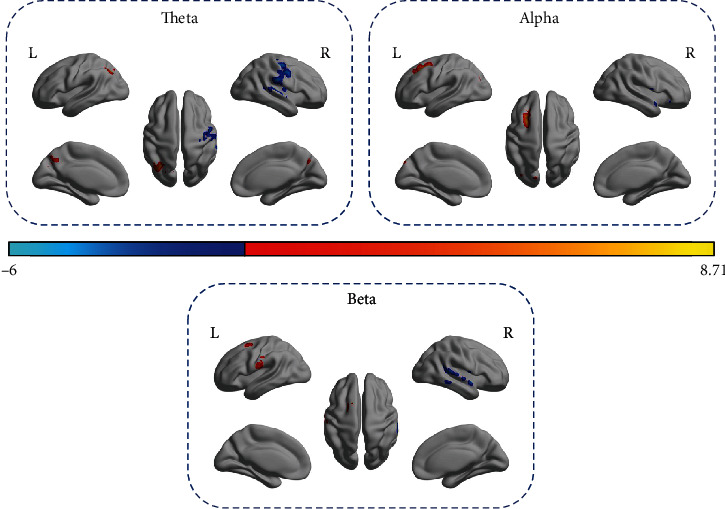
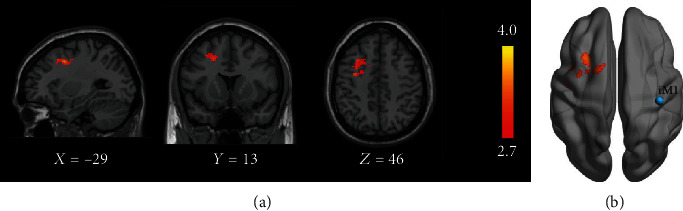
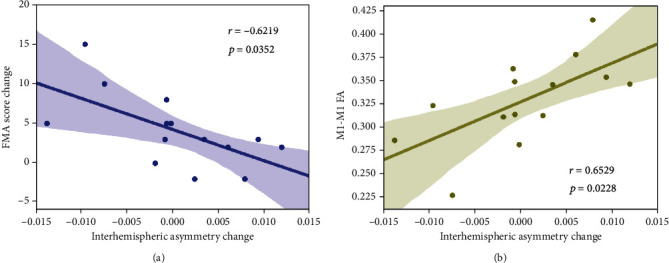
Stroke is a leading cause of motor disability worldwide, and robot-assisted therapies have been increasingly applied to facilitate the recovery process. However, the underlying mechanism and induced neuroplasticity change remain partially understood, and few studies have investigated this from a multimodality neuroimaging perspective. The current study adopted BCI-guided robot hand therapy as the training intervention and combined multiple neuroimaging modalities to comprehensively understand the potential association between motor function alteration and various neural correlates. We adopted EEG-informed fMRI technique to understand the functional regions sensitive to training intervention. Additionally, correlation analysis among training effects, nonlinear property change quantified by fractal dimension (FD), and integrity of M1-M1 (M1: primary motor cortex) anatomical connection were performed. EEG-informed fMRI analysis indicated that for iM1 (iM1: ipsilesional M1) regressors, regions with significantly increased partial correlation were mainly located in contralesional parietal, prefrontal, and sensorimotor areas and regions with significantly decreased partial correlation were mainly observed in the ipsilesional supramarginal gyrus and superior temporal gyrus. Pearson's correlations revealed that the interhemispheric asymmetry change significantly correlated with the training effect as well as the integrity of M1-M1 anatomical connection. In summary, our study suggested that multiple functional brain regions not limited to motor areas were involved during the recovery process from multimodality perspective. The correlation analyses suggested the essential role of interhemispheric interaction in motor rehabilitation. Besides, the underlying structural substrate of the bilateral M1-M1 connection might relate to the interhemispheric change. This study might give some insights in understanding the neuroplasticity induced by the integrated BCI-guided robot hand training intervention and further facilitate the design of therapies for chronic stroke patients.
中风是全球范围内导致运动障碍的主要原因,机器人辅助疗法已越来越多地应用于促进康复过程。然而,其潜在机制和诱导的神经可塑性变化仍部分未知,并且很少有研究从多模态神经影像学角度进行探讨。本研究采用基于脑机接口的机器人手训练作为干预措施,并结合多种神经影像学模式,全面了解运动功能改变与各种神经相关因素之间的潜在关联。我们采用基于脑电图的功能磁共振成像技术来了解对训练干预敏感的功能区域。此外,还对训练效果、分形维数(FD)量化的非线性特征变化以及 M1-M1(M1:初级运动皮层)解剖连接的完整性之间的相关性进行了分析。基于脑电图的功能磁共振成像分析表明,对于 iM1(iM1:对侧 M1)回归器,具有显著增加的部分相关性的区域主要位于对侧顶叶、前额叶和感觉运动区域,而具有显著降低的部分相关性的区域主要观察到同侧缘上回和颞上回。Pearson 相关性分析表明,大脑两半球间的不对称性改变与训练效果以及 M1-M1 解剖连接的完整性显著相关。总之,本研究从多模态角度表明,在康复过程中涉及到多个功能脑区,而不仅仅是运动区。相关性分析表明,大脑两半球间的相互作用在运动康复中起着重要作用。此外,双侧 M1-M1 连接的潜在结构基础可能与大脑两半球间的变化有关。这项研究可能为理解基于整合脑机接口的机器人手训练干预诱导的神经可塑性提供一些见解,并进一步促进慢性中风患者治疗方案的设计。