Rutgers School of Public Health (SPH), Department of Environmental and Occupational Health and Justice, Piscataway, NJ, USA.
NJ Safe Schools Program, Rutgers SPH, Piscataway, NJ, USA.
J Environ Public Health. 2021 Jun 7;2021:5580616. doi: 10.1155/2021/5580616. eCollection 2021.
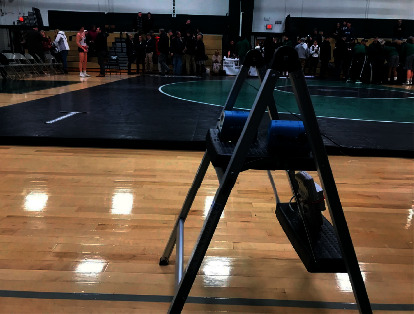
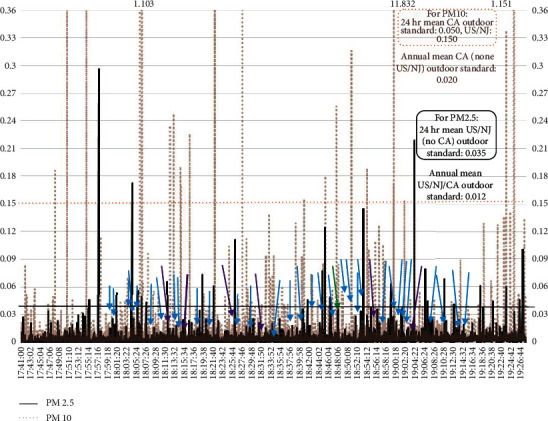
Despite positive health outcomes associated with physical activity as well as individual and team sports, poor indoor air and environmental quality can adversely affect human health, performance, and comfort. We conducted a 14-month field case study incorporating two winter sports regular seasons (12/2017-2/2019) including analyses of particulate matter (PMx) in air and in dust, carbon dioxide (CO), temperature, and relative humidity (RH%) during secondary or high school wrestling activities in southern New Jersey, USA. After planning and piloting methods during the first winter sports regular season (12/2017-2/2018), during the second winter sports regular season (1-2/2019), we conducted a purposeful simultaneous real-time sampling midgymnasium adjacent to the wrestling mats. Gymnasium occupancy ranged 100-500 people. Data collected included inhalable PM resuspended from floor mats, fine respirable PM, and indoor CO, temperature, and RH%. Short-term real-time elevated PM levels were directly compared with simultaneously documented wrestling match bouts, e.g., student-athlete takedowns and pins. PM and PM levels were compared with other known documented activities indoors (e.g., snack bar) and sources outdoors (e.g., adjacent parking lot and major freeway). To understand CO, temperature, and RH% data, we characterized the HS gym mechanical ventilation system-no doors or windows outdoors-and recorded occupancy during match hours. Indoor CO levels ranged ∼700-1000 ppm during match #1 on 1/23/2019 but ranged from ∼900 to 1900 ppm during match #2 on 1/30/2019, with >1000 ppm for the majority of the time (and throughout the entire varsity match when occupancy was at maximum). Future research should further characterize PM constituents in mat dust and indoor air with larger samples of schools and matches.
尽管体育活动以及个人和团队运动对健康有益,但室内空气质量和环境质量差会对人体健康、表现和舒适度产生不利影响。我们进行了一项为期 14 个月的现场案例研究,纳入了美国新泽西州南部的两个冬季运动常规赛(2017 年 12 月至 2019 年 2 月),分析了室内空气中和灰尘中的颗粒物(PMx)、二氧化碳(CO)、温度和相对湿度(RH%),这些分析是在中学或高中摔跤活动期间进行的。在第一个冬季运动常规赛(2017 年 12 月至 2018 年 2 月)期间进行了计划和试点方法后,在第二个冬季运动常规赛(2019 年 1 月至 2 月)期间,我们在紧邻摔跤垫的体育馆内进行了有针对性的实时同步采样。体育馆的占用率在 100-500 人之间。收集的数据包括从地板垫上重新悬浮的可吸入 PM、细颗粒物 PM 和室内 CO、温度和 RH%。短期实时的 PM 浓度升高水平与同时记录的摔跤比赛回合(例如学生运动员的摔倒和摔倒)进行了直接比较。PM 和 PM 浓度与室内其他已知记录的活动(例如小吃店)和室外来源(例如相邻停车场和主要高速公路)进行了比较。为了了解 CO、温度和 RH%数据,我们对 HS 体育馆的机械通风系统(没有室外门或窗户)进行了描述,并记录了比赛期间的占用情况。在 2019 年 1 月 23 日的第一场比赛中,室内 CO 水平在 700-1000 ppm 左右,但在 2019 年 1 月 30 日的第二场比赛中,CO 水平在 900-1900 ppm 左右,大部分时间(当占用率达到最大值时,整个Varsity 比赛期间)超过 1000 ppm。未来的研究应进一步对学校和比赛中更大样本的垫子灰尘和室内空气中的 PM 成分进行特征描述。