Potnis Aniruddha, VanMeter Susan, Stange Jan
Mallinckrodt Pharmaceuticals, Hampton, NJ, USA.
Int J Hepatol. 2021 Jun 8;2021:8542179. doi: 10.1155/2021/8542179. eCollection 2021.
Hepatic encephalopathy (HE), a complication of cirrhosis, is associated with increased healthcare resource utilization and mortality, and impaired quality of life. Information on the prevalence of HE in the US general population is limited.
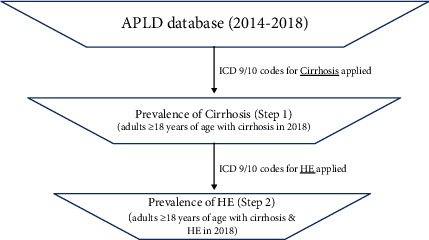
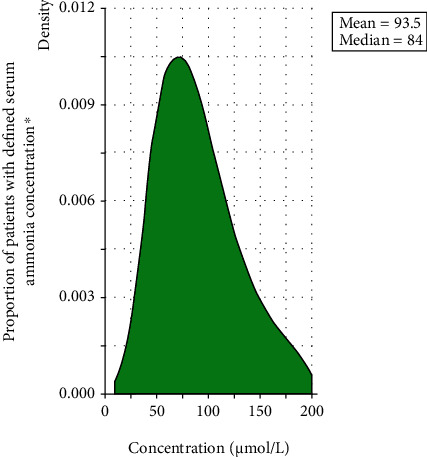
Prevalence of HE was estimated by sequential stepwise data analysis of the Symphony Health anonymized patient-level data (APLD) claims database. First, patients ≥ 18 years with International Classification of Diseases ninth/tenth edition, clinical modification (ICD-9/10-CM), and codes for cirrhosis from 2018 medical and hospital claims were used to estimate prevalence of cirrhosis within the data set and number of patients with cirrhosis in the US general population. Second, patients diagnosed with cirrhosis in the APLD data set from 2015-2016 with an HE ICD-9/10-CM code within 1 year of cirrhosis diagnosis were used to deduce the prevalence of HE within the data set and estimate the number of patients with HE in the US general population. Last, US DiagnosticSource data on serum ammonia level laboratory results measured within ±2 days of a confirmed HE event were merged with the APLD HE data set, then applied to the US general population.
Medical and hospital claims data were available for 272,256 patients with cirrhosis in 2018. An estimated 536,856 US adults had a diagnosis of cirrhosis (prevalence of 0.21%) in 2018. This proportion applied to the estimated number of patients with cirrhosis in the United States resulted in a prevalence estimate of 201,858 cirrhosis patients with HE in 2018. When factoring in serum ammonia data, prevalence was conservatively estimated as approximately 196,000 cirrhosis patients with HE and serum ammonia levels > 21 mol/L.
In this longitudinal cohort-based study, it was estimated that ≈202,000 patients had HE in the United States in 2018, representing a considerable burden to society and payers.
肝性脑病(HE)是肝硬化的一种并发症,与医疗资源利用增加、死亡率上升以及生活质量受损相关。关于美国普通人群中HE患病率的信息有限。
通过对Symphony Health匿名患者层面数据(APLD)索赔数据库进行逐步数据分析来估计HE的患病率。首先,使用2018年医疗和医院索赔中年龄≥18岁且患有国际疾病分类第九/十版临床修订版(ICD - 9/10 - CM)以及肝硬化编码的患者,来估计数据集中肝硬化的患病率以及美国普通人群中肝硬化患者的数量。其次,使用2015 - 2016年APLD数据集中在肝硬化诊断后1年内有HE的ICD - 9/10 - CM编码的肝硬化确诊患者,来推断数据集中HE的患病率并估计美国普通人群中HE患者的数量。最后,将确诊HE事件前后±2天内测量的血清氨水平实验室结果的美国DiagnosticSource数据与APLD的HE数据集合并,然后应用于美国普通人群。
2018年有272,256例肝硬化患者的医疗和医院索赔数据可用。估计2018年有536,856名美国成年人被诊断为肝硬化(患病率为0.21%)。将该比例应用于美国肝硬化患者的估计数量,得出2018年估计有201,858例肝硬化合并HE的患者。考虑血清氨数据后,患病率保守估计约为196,000例肝硬化合并HE且血清氨水平>21μmol/L的患者。
在这项基于纵向队列的研究中,估计2018年美国约有202,000例患者患有HE,这对社会和支付方来说是相当大的负担。