Laboratório de Diagnóstico e Controle de Doenças Infecciosas na Amazônia (DCDIA), Instituto Leônidas e Maria Deane (ILMD)-Fiocruz Amazônia, Manaus CEP 69.057-070, Brazil.
Fundação de Medicina Tropical Dr. Heitor Vieira Dourado, Instituto de Pesquisa Clínica Carlos Borborema, Manaus, Amazonas CEP 69040-000, Brazil.
Biomed Res Int. 2021 Jun 8;2021:5567332. doi: 10.1155/2021/5567332. eCollection 2021.
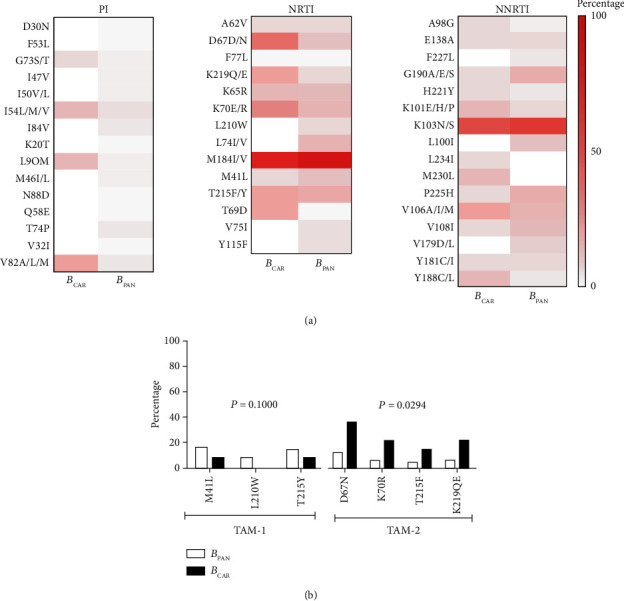
Virologic failure may occur because of poor treatment adherence and/or viral drug resistance mutations (DRM). In Brazil, the northern region exhibits the worst epidemiological scenarios for the human immunodeficiency virus (HIV). Thus, this study is aimed at investigating the genetic diversity of HIV-1 and DRM in Manaus. The cross-sectional study included people living with HIV on combined antiretroviral therapy and who had experienced virological failure during 2018-2019. Sequencing of the protease/reverse transcriptase (PR/RT) and C2V3 of the viral envelope gp120 () regions was analyzed to determine subtypes/variants of HIV-1, DRMs, and tropism. Ninety-two individuals were analyzed in the study. Approximately 72% of them were male and 74% self-declared as heterosexual. Phylogenetic inference (PR/RT-) showed that most sequences were subtype, followed by BF1 or mosaic genomes and few F1 and sequences. Among the variants of subtype at PR/RT, 84.3% were pandemic ( ), and 15.7% were Caribbean ( ). The DRMs most frequent were M184I/V (82.9%) for nucleoside reverse transcriptase inhibitors (NRTI), K103N/S (63.4%) for nonnucleoside reverse transcriptase inhibitor (NNRTI), and V82A/L/M (7.3%) for protease inhibitors (PI). DRM analysis depicted high levels of resistance for lamivudine and efavirenz in over 82.9% of individuals; although, low (7.7%) cross-resistance to etravirine was observed. A low level of resistance to protease inhibitors was found and included patients that take atazanavir/ritonavir (16.6%) and lopinavir (11.1%), which confirms that these antiretrovirals can be used-for most individuals. The thymidine analog mutations-2 (TAM-2) resistance pathway was higher in than in . Similar results from other Brazilian studies regarding HIV drug resistance were observed; however, we underscore a need for additional studies regarding subtype variants. Molecular epidemiology studies are an important tool for monitoring the prevalence of HIV drug resistance and can influence the public health policies.
病毒学失败可能是由于治疗依从性差和/或病毒耐药突变(DRM)引起的。在巴西,北部地区的人类免疫缺陷病毒(HIV)流行情况最为严峻。因此,本研究旨在调查马瑙斯 HIV-1 病毒的遗传多样性和 DRM。这项横断面研究纳入了 2018 年至 2019 年期间接受联合抗逆转录病毒治疗且病毒学失败的 HIV 感染者。对蛋白酶/逆转录酶(PR/RT)和病毒包膜 gp120 区的 C2V3 进行测序,以确定 HIV-1 的亚型/变体、DRMs 和嗜性。本研究共分析了 92 名患者。其中约 72%为男性,74%自报为异性恋。系统发育推断(PR/RT-)显示,大多数序列为 B 亚型,其次是 BF1 或 重组基因组,少数为 F1 和 重组基因组。在 PR/RT 中的 B 亚型变体中,84.3%为流行型( ),15.7%为加勒比型( )。最常见的 DRM 是核苷逆转录酶抑制剂(NRTI)中的 M184I/V(82.9%),非核苷逆转录酶抑制剂(NNRTI)中的 K103N/S(63.4%)和蛋白酶抑制剂(PI)中的 V82A/L/M(7.3%)。DRM 分析显示,超过 82.9%的个体对拉米夫定和依非韦伦高度耐药;然而,观察到对依曲韦林的交叉耐药性较低(7.7%)。发现对蛋白酶抑制剂的耐药水平较低,包括接受阿扎那韦/利托那韦(16.6%)和洛匹那韦(11.1%)治疗的患者,这表明这些抗逆转录病毒药物可用于大多数患者。在 中,胸腺嘧啶类似物突变-2(TAM-2)耐药途径高于 。观察到其他巴西研究中 HIV 药物耐药性的类似结果,但我们强调需要开展更多关于 B 亚型 变体的研究。分子流行病学研究是监测 HIV 药物耐药性流行的重要工具,可影响公共卫生政策。