Division of Medical Genetics, Fondazione IRCCS Ospedale Casa Sollievo Sofferenza, San Giovanni Rotondo, Foggia, Italy.
Lab of Endocrine and Metabolic Research, Department of Endocrine and Metabolic Diseases, IRCCS Istituto Auxologico Italiano, Milan, Italy.
J Endocrinol Invest. 2022 Jan;45(1):125-137. doi: 10.1007/s40618-021-01625-1. Epub 2021 Jul 2.
The study aimed to define the clinical, biochemical and genetic features of adult patients with osteopenia/osteoporosis and/or bone fragility and low serum alkaline phosphatase (sALP).
Twenty-two patients with at least two sALP values below the reference range were retrospectively enrolled after exclusion of secondary causes. Data about clinical features, mineral and bone markers, serum pyridoxal-5'-phosphate (PLP), urine phosphoethanolamine (PEA), lumbar and femur bone densitometry, and column X-ray were collected. Peripheral blood DNA of each participant was analyzed to detect ALPL gene anomalies.
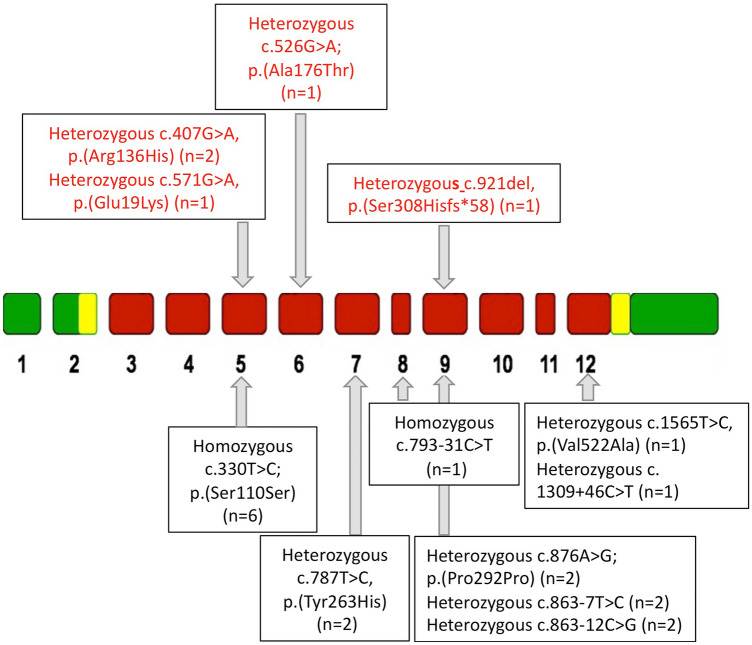
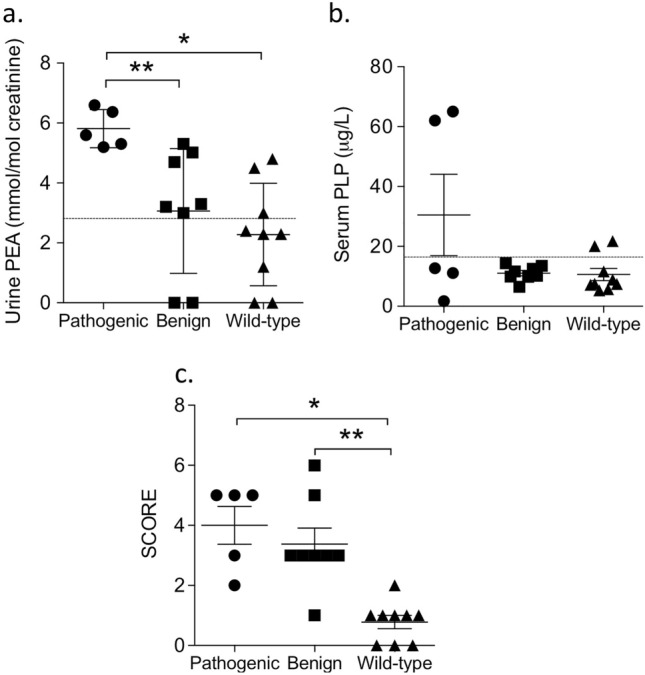
Pathogenic ALPL variants (pALPL) occurred in 23% and benign variants in 36% of patients (bALPL), while nine patients harbored wild-type alleles (wtALPL). Fragility fractures and dental anomalies were more frequent in patients harboring pALPL and bALPL than in wtALPL patients. Of note, wtALPL patients comprised women treated with tamoxifen for hormone-sensitive breast cancer. Mineral and bone markers were similar in the three groups. Mean urine PEA levels were significantly higher in patients harboring pALPL than those detected in patients harboring bALPL and wtALPL; by contrast, serum PLP levels were similar in the three groups. A 6-points score, considering clinical and biochemical features, was predictive of pALPL detection [P = 0.060, OR 1.92 (95% CI 0.972, 3.794)], and more significantly of pALPL or bALPL [P = 0.025, OR 14.33 (95% CI 1.401, 14.605)].
In osteopenic/osteoporotic patients, single clinical or biochemical factors did not distinguish hypophosphatasemic patients harboring pALPL or bALPL from those harboring wtALPL. Occurrence of multiple clinical and biochemical features is predictive of ALPL anomalies, and, therefore, they should be carefully identified. Tamoxifen emerged as a hypophosphatasemic drug.
本研究旨在定义血清碱性磷酸酶(sALP)水平降低的骨质疏松/骨量减少和/或脆性骨患者的临床、生化和遗传特征。
在排除了继发性原因后,回顾性纳入了 22 名至少有 2 个 sALP 值低于参考范围的患者。收集了患者的临床特征、矿物质和骨标志物、血清吡哆醛-5'-磷酸(PLP)、尿磷乙醇胺(PEA)、腰椎和股骨骨密度以及柱 X 射线的数据。对每位参与者的外周血 DNA 进行分析,以检测 ALPL 基因突变。
致病性 ALPL 变异(pALPL)在 23%的患者中发生,良性变异(bALPL)在 36%的患者中发生,而 9 名患者携带野生型等位基因(wtALPL)。pALPL 和 bALPL 患者的脆性骨折和牙齿异常发生率高于 wtALPL 患者。值得注意的是,wtALPL 患者包括接受他莫昔芬治疗激素敏感型乳腺癌的女性。三组患者的矿物质和骨标志物相似。pALPL 患者的尿 PEA 水平明显高于 bALPL 和 wtALPL 患者;相比之下,三组患者的血清 PLP 水平相似。考虑到临床和生化特征的 6 分评分对 pALPL 检测具有预测作用(P=0.060,OR 1.92(95%CI 0.972,3.794)),且对 pALPL 或 bALPL 的预测作用更为显著(P=0.025,OR 14.33(95%CI 1.401,14.605))。
在骨质疏松/骨量减少的患者中,单一的临床或生化因素不能区分携带 pALPL 或 bALPL 的低磷酸酶血症患者和携带 wtALPL 的患者。多个临床和生化特征的发生预测 ALPL 异常,因此应仔细识别。他莫昔芬成为一种低磷酸酶血症药物。