Hsieh Tsung-Jen, Lee Wei-Ju, Liao Yi-Chu, Hsu Chih-Cheng, Fang Yao-Hwei, Chen Tzu-Yu, Lin Yung-Shuan, Chang I-Shou, Wang Shuu-Jiun, Hsiung Chao A, Fuh Jong-Ling
Institute of Population Health Sciences, National Health Research Institutes, Miaoli, Taiwan.
School of Medicine, I-Shou University, Kaohsiung, Taiwan.
Aging (Albany NY). 2021 Jul 2;13(13):17237-17252. doi: 10.18632/aging.203204.
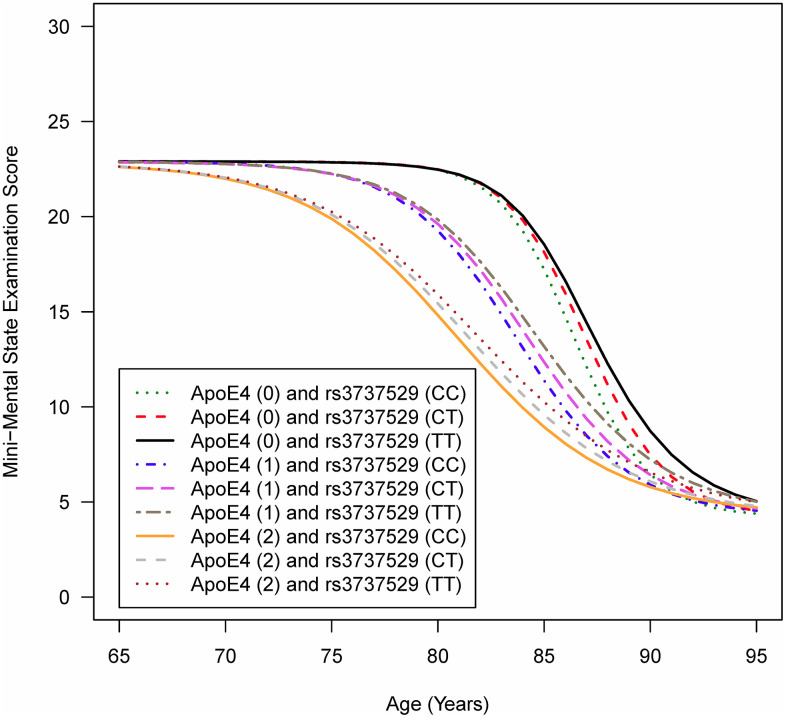
Genetic background has been considered one of the important contributors to the rate of cognitive decline among patients with Alzheimer's disease (AD). We conducted a 4-year longitudinal follow-up study, recruited 255 AD and 44 mild cognitive impairment (MCI) patients, and used a data-driven trajectory analysis to examine the influence of selected AD risk genes on the age for and the rate of cognitive decline in Han Chinese population. Genotyping of selected single-nucleotide polymorphisms in the , , , , , and genes was conducted, and a Bayesian hierarchical model was fitted to analyze the trajectories of cognitive decline among different genotypes. After adjusting for sex and education years, the ε4 allele was associated with an earlier mean change of -2.39 years in the age at midpoint of cognitive decline, the G allele in rs3764650 was associated with an earlier mean change of -1.75 years, and the T allele in rs3737529 was associated with a later mean change of 2.6 years. Additionally, the rate of cognitive decline was associated with the ε4 allele and rs3737529. In summary, and might be the most important genetic factors related to cognitive decline in Han Chinese population.
遗传背景被认为是阿尔茨海默病(AD)患者认知衰退速率的重要影响因素之一。我们开展了一项为期4年的纵向随访研究,招募了255例AD患者和44例轻度认知障碍(MCI)患者,并采用数据驱动的轨迹分析来研究特定AD风险基因对汉族人群认知衰退年龄和速率的影响。对淀粉样前体蛋白(APP)、早老素1(PSEN1)、早老素2(PSEN2)、载脂蛋白E(APOE)、跨膜蛋白106B(TMEM106B)和簇集蛋白(CLU)基因中选定的单核苷酸多态性进行基因分型,并拟合贝叶斯分层模型以分析不同基因型的认知衰退轨迹。在调整性别和受教育年限后,APOE ε4等位基因与认知衰退中点年龄的平均提前变化-2.39年相关,rs3764650位点的G等位基因与平均提前变化-1.75年相关,rs3737529位点的T等位基因与平均延迟变化2.6年相关。此外,认知衰退速率与APOE ε4等位基因和rs3737529相关。总之,APOE和TMEM106B可能是汉族人群中与认知衰退相关的最重要遗传因素。