Department of Chemical Sciences, Tata Institute of Fundamental Research, Colaba, Mumbai, India.
National Centre for Biological Sciences, Tata Institute of Fundamental Research, Bangalore, Karnataka, India.
Biophys J. 2021 Jul 20;120(14):2785-2792. doi: 10.1016/j.bpj.2021.06.017. Epub 2021 Jun 30.
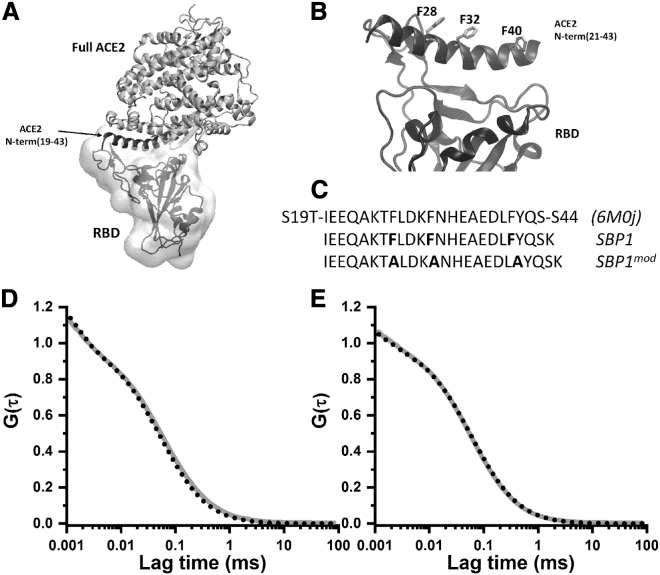
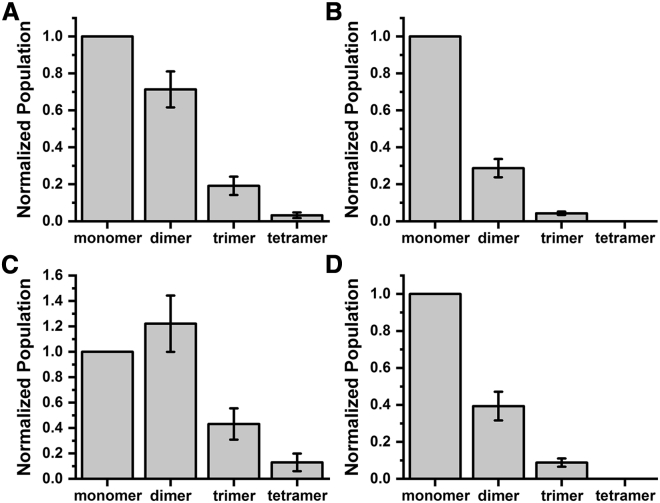
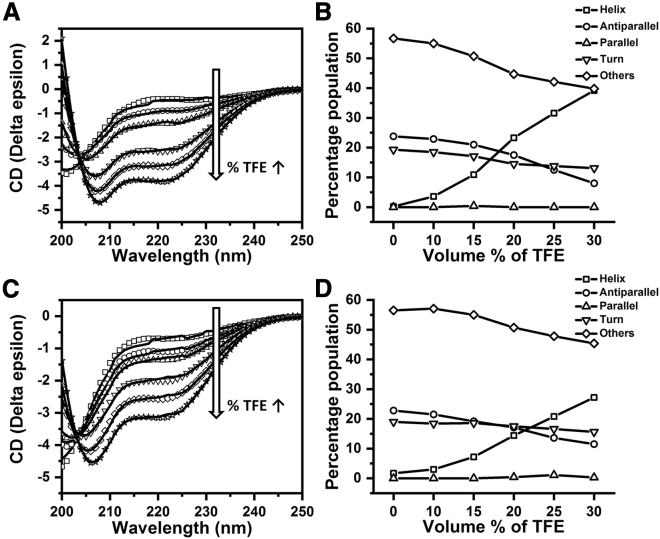
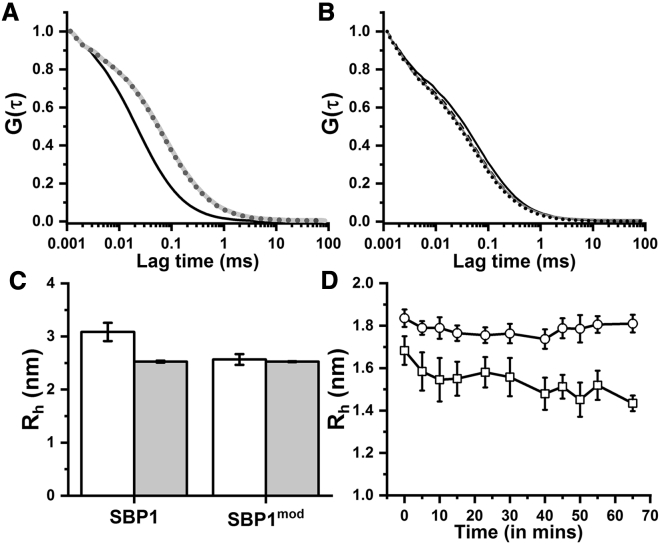
The entry of the severe acute respiratory syndrome coronavirus 2 virus in human cells is mediated by the binding of its surface spike protein to the human angiotensin-converting enzyme 2 (ACE2) receptor. A 23-residue long helical segment (SBP1) at the binding interface of human ACE2 interacts with viral spike protein and therefore has generated considerable interest as a recognition element for virus detection. Unfortunately, emerging reports indicate that the affinity of SBP1 to the receptor-binding domain of the spike protein is much lower than that of the ACE2 receptor itself. Here, we examine the biophysical properties of SBP1 to reveal factors leading to its low affinity for the spike protein. Whereas SBP1 shows good solubility (solubility > 0.8 mM), circular dichroism spectroscopy shows that it is mostly disordered with some antiparallel β-sheet content and no helicity. The helicity is substantial (>20%) only upon adding high concentrations (≥20% v/v) of 2,2,2-trifluoroethanol, a helix promoter. Fluorescence correlation spectroscopy and single-molecule photobleaching studies show that the peptide oligomerizes at concentrations >50 nM. We hypothesized that mutating the hydrophobic residues (F28, F32, and F40) of SBP1, which do not directly interact with the spike protein, to alanine would reduce peptide oligomerization without affecting its spike binding affinity. Whereas the mutant peptide (SBP1) shows substantially reduced oligomerization propensity, it does not show improved helicity. Our study shows that the failure of efforts, so far, to produce a short SBP1 mimic with a high affinity for the spike protein is not only due to the lack of helicity but is also due to the heretofore unrecognized problem of oligomerization.
严重急性呼吸综合征冠状病毒 2 病毒进入人体细胞是通过其表面刺突蛋白与人体血管紧张素转换酶 2(ACE2)受体结合介导的。人类 ACE2 结合界面上的一个 23 个残基长的螺旋片段(SBP1)与病毒刺突蛋白相互作用,因此作为病毒检测的识别元件引起了相当大的关注。不幸的是,新出现的报告表明,SBP1 与刺突蛋白的受体结合域的亲和力远低于 ACE2 受体本身。在这里,我们检查了 SBP1 的生物物理特性,以揭示导致其与刺突蛋白亲和力低的因素。尽管 SBP1 表现出良好的溶解性(溶解度>0.8 mM),但圆二色光谱表明它主要是无序的,具有一些反平行β-折叠含量,没有螺旋结构。仅当添加高浓度(≥20% v/v)的 2,2,2-三氟乙醇(一种螺旋促进剂)时,才会出现大量螺旋结构(>20%)。荧光相关光谱和单分子光漂白研究表明,该肽在浓度>50 nM 时会发生寡聚化。我们假设,将不直接与刺突蛋白相互作用的 SBP1 的疏水性残基(F28、F32 和 F40)突变为丙氨酸,将减少肽的寡聚化,而不会影响其与刺突蛋白的结合亲和力。虽然突变肽(SBP1)的寡聚化倾向显著降低,但它并没有表现出改善的螺旋结构。我们的研究表明,到目前为止,产生与刺突蛋白具有高亲和力的短 SBP1 模拟物的努力失败不仅是由于缺乏螺旋结构,还由于迄今为止尚未认识到的寡聚化问题。