Department of Molecular Medicine and Surgery, Karolinska Institute, Solna, Sweden.
Department of Vascular Surgery, Karolinska University Hospital, SE-171 76, Stockholm, Sweden.
Eur J Trauma Emerg Surg. 2022 Jun;48(3):2349-2357. doi: 10.1007/s00068-021-01735-8. Epub 2021 Jul 2.
Gun violence is a global health problem. Population-based research on firearm-related injuries has been relatively limited considering the burden of disease. The aim of this study was to analyze nationwide epidemiological trends of firearm injuries.
This is a retrospective nationwide epidemiological study including all patients with firearm injuries from the Swedish Trauma Registry (SweTrau) during the period 2011 and 2019. Registry data were merged with data from the Swedish National Council for Crime Prevention and the Swedish Police Authority.
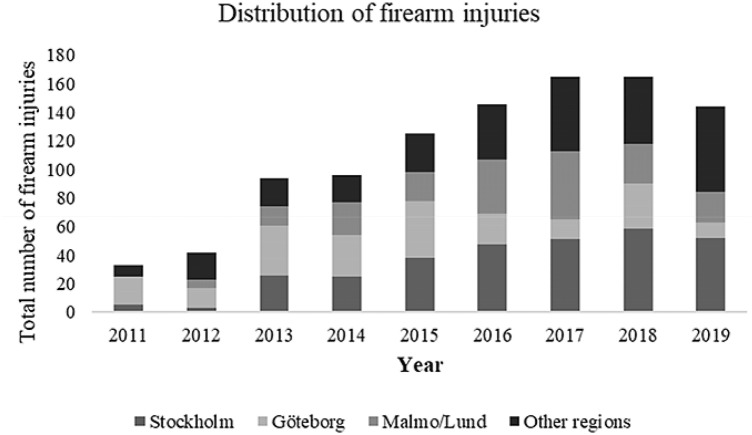
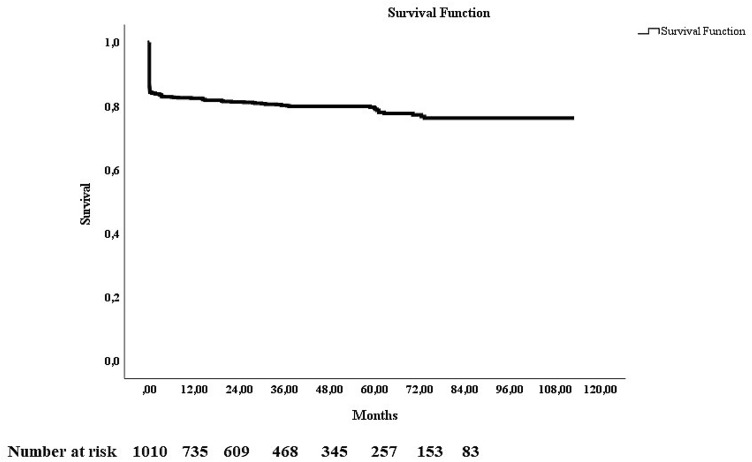
There were 1010 patients admitted with firearm injuries, 96.6% men and 3.4% women, median age 26.0 years [IQR 22.0-36.3]. The overall number of firearm injuries increased on a yearly basis (P < 0.001). The most common anatomical injury location was lower extremity (29.7%) followed by upper extremity (13.8%), abdomen (13.8%), and chest (12.5%). The head was the most severely injured body region with a median abbreviated injury scale (AIS) of 5 [IQR 3.2-5]. Vascular injuries were mainly located to the lower extremity (42%; 74/175). Majority of patients (51.3%) had more than one anatomic injury location. The median hospital length of stay was 3 days [IQR 2-8]. 154 patients (15.2%) died within 24 h of admission. The 30-day and 90-day mortality was 16.7% (169/1010) and 17.5% (177/1010), respectively. There was an association between 24-h mortality and emergency department systolic blood pressure < 90 mmHg [OR 30.3, 95% CI 16.1-56.9] as well as the following injuries with AIS ≥ 3; head [OR 11.8, 95% CI 7.5-18.5], chest [OR 2.3, 95% CI 1.3-4.1], and upper extremity [OR 3.6, CI 1.3-10.1].
This nationwide study shows an annual increase of firearm-related injuries and fatalities. Firearm injuries affect people of all ages but more frequently young males in major cities. One in six patients succumbed from their injuries within 30 days with most deaths occurring within 24 h of hospital admission. Given the impact of firearm-related injuries on society additional research on a national level is critical.
枪支暴力是一个全球性的健康问题。考虑到疾病负担,基于人群的枪支相关伤害研究相对有限。本研究旨在分析全国范围内枪支伤害的流行病学趋势。
这是一项回顾性的全国性流行病学研究,包括 2011 年至 2019 年期间瑞典创伤登记处(SweTrau)所有枪支伤害患者。登记处数据与瑞典国家预防犯罪委员会和瑞典警察局的数据合并。
共有 1010 名因枪支伤害住院的患者,其中 96.6%为男性,3.4%为女性,中位年龄为 26.0 岁[IQR 22.0-36.3]。枪支伤害的总数呈逐年增加趋势(P<0.001)。最常见的解剖伤部位是下肢(29.7%),其次是上肢(13.8%)、腹部(13.8%)和胸部(12.5%)。头部是受伤最严重的身体部位,简明损伤量表(AIS)中位数为 5[IQR 3.2-5]。血管损伤主要位于下肢(42%;74/175)。大多数患者(51.3%)有多个解剖伤部位。中位住院时间为 3 天[IQR 2-8]。154 名患者(15.2%)在入院后 24 小时内死亡。30 天和 90 天的死亡率分别为 16.7%(169/1010)和 17.5%(177/1010)。24 小时死亡率与急诊室收缩压<90mmHg之间存在关联[OR 30.3,95%CI 16.1-56.9],以及以下损伤的 AIS≥3 也与 24 小时死亡率相关:头部[OR 11.8,95%CI 7.5-18.5]、胸部[OR 2.3,95%CI 1.3-4.1]和上肢[OR 3.6,CI 1.3-10.1]。
这项全国性研究显示,枪支相关伤害和死亡人数呈逐年增加趋势。枪支伤害影响所有年龄段的人,但在大城市中更常见于年轻男性。六分之一的患者在 30 天内死于其伤害,大多数死亡发生在入院后 24 小时内。鉴于枪支相关伤害对社会的影响,在国家层面上进行更多的研究至关重要。