Doaré Elise, Robin François, Racapé Hélène, Le Mélédo Guillaume, Orione Charles, Guggenbuhl Pascal, Goupille Philippe, Gervais Elisabeth, Dernis Emmanuelle, Bouvard Béatrice, Marhadour Thierry, Coiffier Guillaume, Saraux Alain
Rheumatology Department, CHU, Centre de Référence Maladies Rares CERAINO, INSERM 1227, UBO, LabEx IGO, Brest CHU, Brest, France.
Rennes, Service de Rhumatologie, Institut NUMECAN (Nutrition Metabolisms and Cancer), Univ Rennes, INSERM, INRA, 35000, Rennes, France.
Rheumatol Ther. 2021 Sep;8(3):1241-1253. doi: 10.1007/s40744-021-00335-7. Epub 2021 Jul 4.
The usual treatments for crystal-associated arthritis are sometimes contraindicated; thus, new therapies against interleukin-1beta (IL-1) have been developed. We evaluated the characteristics of patients who received biological treatment for crystal-associated arthritis.
We conducted a multicentric retrospective observational study in six rheumatology units in western France. Patients receiving a biological treatment for crystal-associated arthritis between 1 January 2010 and 31 December 2018 were included. Improvement was defined as at least a 50% decrease in the count of synovitis and C-reactive protein level.
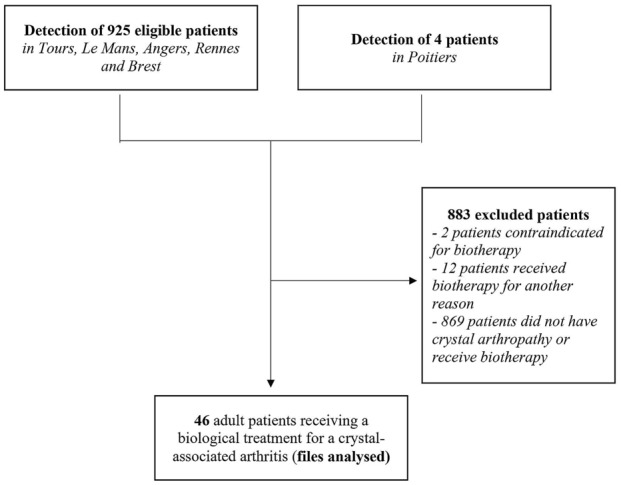
Forty-six patients were included: 31 (67.4%) were treated for gouty arthritis, and 15 (32.6%) for calcium pyrophosphate crystal deposition disease (CCPD). The first biotherapy used was anakinra for 14 patients (93.3%) with CCPD and 31 patients (100.0%) with gout. The first biotherapy course was more efficient in treating gout than in treating CCPD, with success in 28 patients (90.3%) and 5 patients (35.7%), respectively (p = 0.001). Six patients (42.9%) with CCPD stopped their first biotherapy course because of side effects. Among the patients with gout, urate-lowering therapy was more frequently used after (100%) than before the first biotherapy course (67.7%) (p = 0.002).
Anakinra was prescribed for cases of refractory crystal-associated arthritis or cases with contraindications for usual treatments. The efficacy of anakinra in treating CCPD was not obvious. Patients with CCPD had more side effects. The biotherapy was introduced with a long-term objective, while anti-IL-1 therapies are approved for acute crises only.
晶体相关性关节炎的常规治疗有时存在禁忌;因此,已研发出针对白细胞介素-1β(IL-1)的新疗法。我们评估了接受生物治疗的晶体相关性关节炎患者的特征。
我们在法国西部的六个风湿病科进行了一项多中心回顾性观察研究。纳入了2010年1月1日至2018年12月31日期间接受晶体相关性关节炎生物治疗的患者。病情改善定义为滑膜炎计数和C反应蛋白水平至少降低50%。
共纳入46例患者:31例(67.4%)接受痛风性关节炎治疗,15例(32.6%)接受焦磷酸钙晶体沉积病(CCPD)治疗。首次使用的生物疗法中,阿那白滞素用于14例(93.3%)CCPD患者和31例(100.0%)痛风患者。首个生物治疗疗程在治疗痛风方面比治疗CCPD更有效,分别有28例(90.3%)和5例(35.7%)取得成功(p = 0.001)。6例(42.9%)CCPD患者因副作用停止了首个生物治疗疗程。在痛风患者中,降尿酸治疗在首个生物治疗疗程后(100%)比疗程前(67.7%)使用更频繁(p = 0.002)。
阿那白滞素被用于难治性晶体相关性关节炎病例或常规治疗存在禁忌的病例。阿那白滞素治疗CCPD的疗效不明显。CCPD患者有更多副作用。引入生物治疗是出于长期目的,而抗IL-1疗法仅被批准用于急性发作期。