Mironova Irina, Pleshkov Alexey, Nigmatyanov Azat, Yarmukhamedova Elvira, Islamova Sofia
Federal State Budgetary Educational Establishment of Higher Education "Bashkir State Agrarian University", Ufa, Russia.
Federal State Budgetary Educational Institution of Higher Education Ufa State Petroleum Technological University (USPTU), Ufa, Russia.
Vet World. 2021 May;14(5):1303-1310. doi: 10.14202/vetworld.2021.1303-1310. Epub 2021 May 25.
This study aimed to analyze the efficiency of carbohydrate-enriched rations fed to pasture and stall-housed cows.
Forty Holstein cows were divided into four groups of 10 animals each. The experiment lasted 305 days. All animals were kept under the same conditions, except for the amount of energy-carbohydrate rations fed. The control cows were on a standard diet. Experimental groups 1, 2, and 3 received a ration enriched with energy-carbohydrate components at 250, 500, and 700 g/head/day, respectively. Feed intake was measured on 2 consecutive days each month. During the balance trial, when young animals reached 13 months, feed intake was examined daily. Fodder, its residues, feces, and urine collected during the balance trial were used to determine nutrient digestibility and nitrogen exchange.
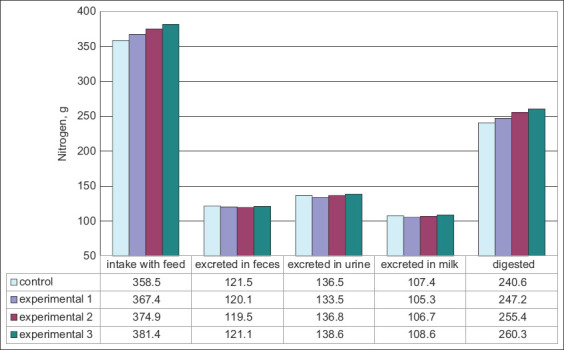
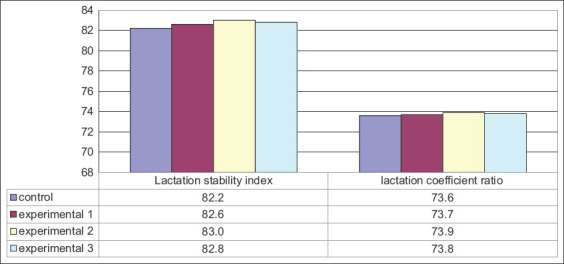
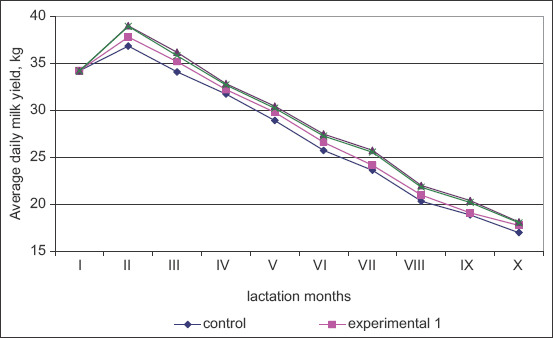
Nitrogen balance was positive in all experimental animals. Cows in Group 3 made better use of the digested nitrogen. A biochemical blood test showed higher total protein content in the serum of the experimental cows than in the control by 1.47-3.49% (p≤0.05-0.001) in winter and 0.24-0.98% (p≤0.01) in summer. In winter, the serum protein level increased due to changed feeding routines and shorter exercise times, but did not exceed physiological requirements. The alpha- and gammα-globulins levels increased to 0.2-0.5 g/L in winter and 0.3-0.6 g/L in summer, and 0.5-1.4 g/L in winter and 0.1-0.2 g/L in summer, respectively. Beta-globulins decreased. The supplement had a positive effect on milk output, which increased by 67.1-137.3 kg (1.93-3.95%; p≤0.05-0.001) in the first 100 lactation days, then by 198.2-458.8 kg (2.39-5.53%; p≤0.05-0.001) for the remaining days. All animals had a high milk yield coefficient, with the experimental groups having 0.64-2.64% more milk yield than the control. The lactation curves showed that the average daily milk yield of all experimental cows increased, then gradually decreased along the physiological trajectory from the 3 month until the end of lactation. Milk quality analysis in the experimental groups indicated an increase in the dry matter content by 0.17-0.27% (p≤0.001) in summer and 0.16-0.27% (p≤0.001) in winter; higher protein levels by 0.04-0.06% in summer and 0.03-0.07% (p≤0.05) in winter; increased fat by 0.09-0.14% (p≤0.05-0.001) in summer and 0.09-0.13% (p≤0.05-0.001) in winter; increased density by 0.47-0.61°A (p≤0.05) in summer and 0.17-0.27°A in winter; and increased energy by 1.70-2.63% (p≤0.001) in summer and 1.57-2.54% (p≤0.01-0.001) in winter.
The energy-carbohydrate feed "Tanrem" can provide the required energy intake of Holstein cows. The maximum biological and economic effect wads attained at 500 g per animal.
本研究旨在分析给牧场饲养和牛舍饲养的奶牛投喂富含碳水化合物日粮的效率。
40头荷斯坦奶牛被分为四组,每组10头。实验持续305天。除投喂的能量 - 碳水化合物日粮量不同外,所有动物均在相同条件下饲养。对照组奶牛采用标准日粮。实验组1、2和3分别按每头每天250、500和700克的量投喂富含能量 - 碳水化合物成分的日粮。每月连续两天测量采食量。在平衡试验期间,当幼畜达到13个月时,每天检查采食量。平衡试验期间收集的饲料、其残余物、粪便和尿液用于测定养分消化率和氮交换。
所有实验动物的氮平衡均为正值。第3组奶牛对消化氮的利用更好。生化血液检测显示,冬季实验奶牛血清中的总蛋白含量比对照组高1.47 - 3.49%(p≤0.05 - 0.001),夏季高0.24 - 0.98%(p≤0.01)。在冬季,由于饲养程序改变和运动时间缩短,血清蛋白水平有所升高,但未超过生理需求。α - 和γ - 球蛋白水平在冬季分别升至0.2 - 0.5克/升和夏季升至0.3 - 0.6克/升,β - 球蛋白水平在冬季为0.5 - 1.4克/升,夏季为0.1 - 0.2克/升。β - 球蛋白减少。该补充剂对产奶量有积极影响,在泌乳的前100天产奶量增加了67.1 - 137.3千克(1.93 - 3.95%;p≤0.05 - 0.001),在剩余天数增加了198.2 - 458.8千克(2.39 - 5.53%;p≤0.05 - 0.001)。所有动物的产奶量系数都很高,实验组的产奶量比对照组高0.64 - 2.64%。泌乳曲线表明,所有实验奶牛的日均产奶量均先增加,然后从第3个月到泌乳结束沿生理轨迹逐渐下降。实验组的牛奶质量分析表明夏季干物质含量增加了0.17 - 0.27%(p≤0.001),冬季增加了0.16 - 0.27%(p≤0.001);夏季蛋白质水平提高了0.04 - 0.06%,冬季提高了0.03 - 0.07%(p≤0.05);夏季脂肪增加了0.09 - 0.14%(p≤0.05 - 0.001),冬季增加了0.09 - 0.13%(p≤0.05 - 0.001);夏季密度增加了0.47 - 0.61°A(p≤0.05),冬季增加了0.17 - 0.27°A;夏季能量增加了1.70 - 2.63%(p≤0.001),冬季增加了1.57 - 2.54%(p≤0.01 - 0.001)。
能量 - 碳水化合物饲料“坦热姆”可以提供荷斯坦奶牛所需的能量摄入量。每头动物500克时可获得最大的生物学和经济效益。