Payne Shelby A, Joens Matthew S, Chung Heather, Skigen Natalie, Frank Adam, Gattani Sonali, Vaughn Kya, Schwed Allison, Nester Matt, Bhattacharyya Atri, Iyer Guhan, Davis Bethany, Carlquist Jason, Patel Honey, Fitzpatrick James A J, Rutherford Mark A
Department of Otolaryngology, Washington University School of Medicine, St. Louis, MO, United States.
Center for Cellular Imaging, Washington University in St. Louis, St. Louis, MO, United States.
Front Synaptic Neurosci. 2021 Jun 17;13:678575. doi: 10.3389/fnsyn.2021.678575. eCollection 2021.
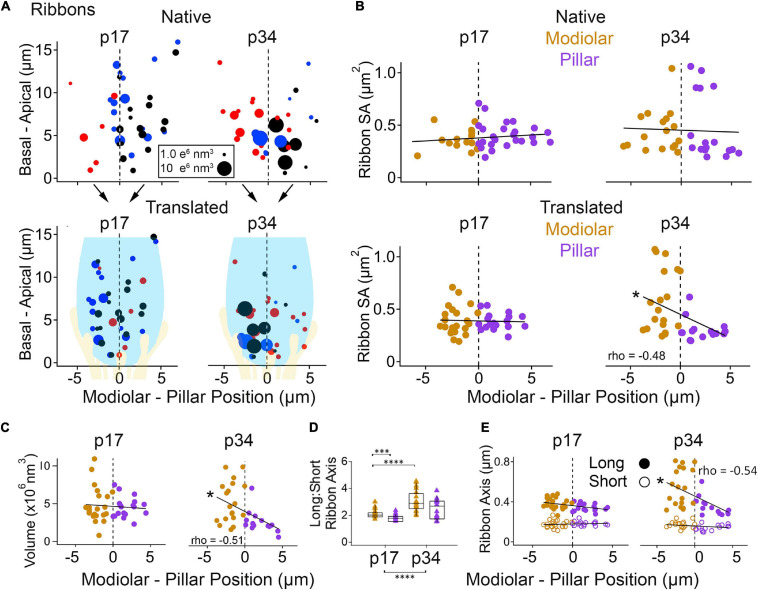
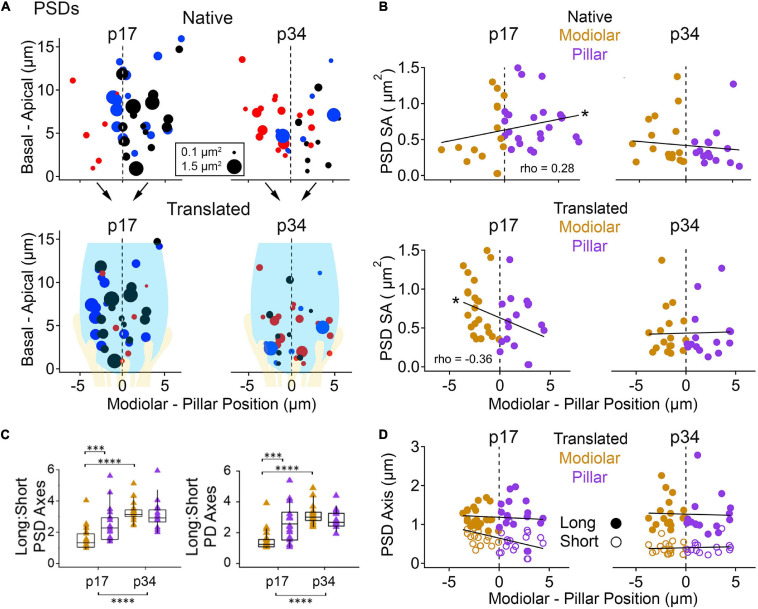
Auditory nerve fibers (ANFs) innervating the same inner hair cell (IHC) may have identical frequency tuning but different sound response properties. In cat and guinea pig, ANF response properties correlate with afferent synapse morphology and position on the IHC, suggesting a causal structure-function relationship. In mice, this relationship has not been fully characterized. Here we measured the emergence of synaptic morphological heterogeneities during maturation of the C57BL/6J mouse cochlea by comparing postnatal day 17 (p17, ∼3 days after hearing onset) with p34, when the mouse cochlea is mature. Using serial block face scanning electron microscopy and three-dimensional reconstruction we measured the size, shape, vesicle content, and position of 70 ribbon synapses from the mid-cochlea. Several features matured over late postnatal development. From p17 to p34, presynaptic densities (PDs) and post-synaptic densities (PSDs) became smaller on average (PDs: 0.75 to 0.33; PSDs: 0.58 to 0.31 μm) and less round as their short axes shortened predominantly on the modiolar side, from 770 to 360 nm. Membrane-associated synaptic vesicles decreased in number from 53 to 30 per synapse from p17 to p34. Anatomical coupling, measured as PSD to ribbon distance, tightened predominantly on the pillar side. Ribbons became less spherical as long-axes lengthened only on the modiolar side of the IHC, from 372 to 541 nm. A decreasing gradient of synaptic ribbon size along the modiolar-pillar axis was detected only at p34 after aligning synapses of adjacent IHCs to a common reference frame (median volumes in nm × 10: modiolar 4.87; pillar 2.38). The number of ribbon-associated synaptic vesicles scaled with ribbon size (range 67 to 346 per synapse at p34), thus acquiring a modiolar-pillar gradient at p34, but overall medians were similar at p17 (120) and p34 (127), like ribbon surface area (0.36 vs. 0.34 μm). PD and PSD morphologies were tightly correlated to each other at individual synapses, more so at p34 than p17, but not to ribbon morphology. These observations suggest that PDs and PSDs mature according to different cues than ribbons, and that ribbon size may be more influenced by cues from the IHC than the surrounding tissue.
支配同一个内毛细胞(IHC)的听神经纤维(ANF)可能具有相同的频率调谐,但声音反应特性不同。在猫和豚鼠中,ANF的反应特性与传入突触形态以及在IHC上的位置相关,这表明存在因果结构-功能关系。在小鼠中,这种关系尚未得到充分表征。在这里,我们通过比较出生后第17天(p17,约在听力开始后3天)和p34(此时小鼠耳蜗已成熟)时C57BL/6J小鼠耳蜗成熟过程中突触形态异质性的出现情况。使用连续块面扫描电子显微镜和三维重建技术,我们测量了来自耳蜗中部的70个带状突触的大小、形状、囊泡含量和位置。在出生后后期发育过程中,几个特征逐渐成熟。从p17到p34,突触前密度(PDs)和突触后密度(PSDs)平均变小(PDs:从0.75变为0.33;PSDs:从0.58变为0.31μm),并且随着短轴主要在蜗轴侧缩短,形状变得不那么圆,从770nm缩短到360nm。从p17到p34,每个突触中与膜相关的突触囊泡数量从53个减少到30个。以PSD到带状物的距离衡量的解剖学耦合主要在支柱侧收紧。仅在将相邻IHC的突触对齐到一个共同参考框架后,在p34时才检测到沿蜗轴-支柱轴的突触带状物大小的递减梯度(以nm×10为单位的中位数体积:蜗轴4.87;支柱2.38)。与带状物相关的突触囊泡数量与带状物大小成比例(p34时每个突触的范围为67至346个),因此在p34时获得了蜗轴-支柱梯度,但在p17(120)和p34(127)时总体中位数相似,带状物表面积也是如此(0.36对0.34μm)。在单个突触处,PD和PSD形态彼此紧密相关,在p34时比p17时更紧密,但与带状物形态无关。这些观察结果表明,PDs和PSDs根据与带状物不同的线索成熟,并且带状物大小可能比周围组织更受来自IHC的线索影响。