Population Health Sciences Institute, Newcastle University, Newcastle upon Tyne, United Kingdom.
Health and Performance Nutrition, Arla Foods Ingredients Group P/S, Viby J., Denmark.
Front Endocrinol (Lausanne). 2021 Jun 18;12:696977. doi: 10.3389/fendo.2021.696977. eCollection 2021.
Elevated postprandial glycaemia [PPG] increases the risk of cardiometabolic complications in insulin-resistant, centrally obese individuals. Therefore, strategies that improve PPG are of importance for this population. Consuming large doses of whey protein [WP] before meals reduces PPG by delaying gastric emptying and stimulating the secretion of the incretin peptides, glucose-dependent insulinotropic polypeptide [GIP] and glucagon-like peptide 1 [GLP-1]. It is unclear if these effects are observed after smaller amounts of WP and what impact central adiposity has on these gastrointestinal processes.
In a randomised-crossover design, 12 lean and 12 centrally obese adult males performed two 240 min mixed-meal tests, ~5-10 d apart. After an overnight fast, participants consumed a novel, ready-to-drink WP shot (15 g) or volume-matched water (100 ml; PLA) 10 min before a mixed-nutrient meal. Gastric emptying was estimated by oral acetaminophen absorbance. Interval blood samples were collected to measure glucose, insulin, GIP, GLP-1, and acetaminophen.
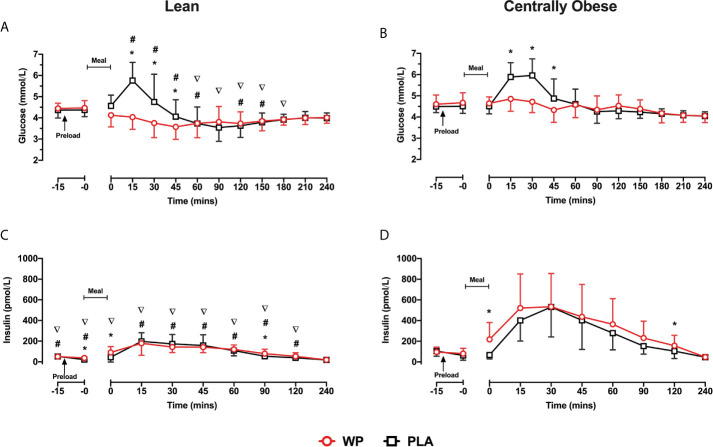
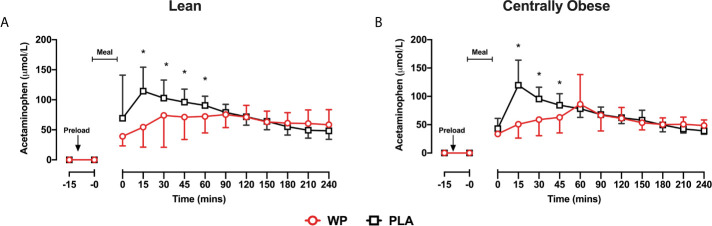
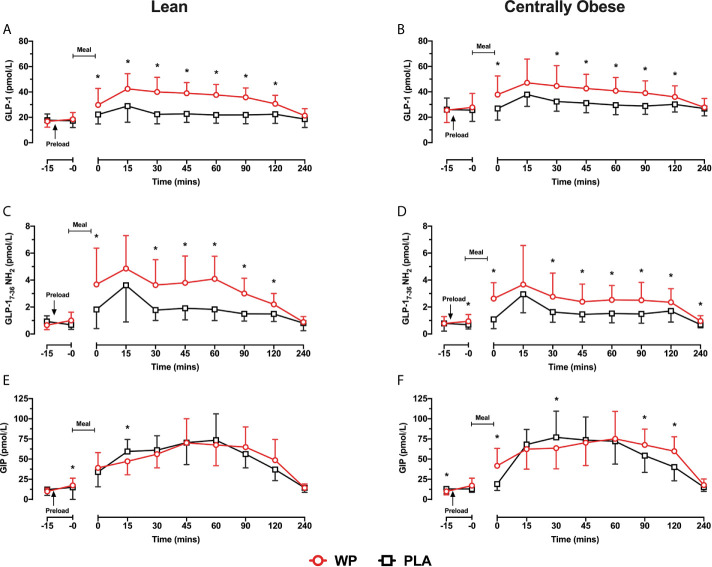
WP reduced PPG area under the curve [AUC] by 13 and 18.2% in the centrally obese and lean cohorts, respectively (both p <0.001). In both groups, the reduction in PPG was accompanied by a two-three-fold increase in GLP-1 and delayed gastric emptying. Despite similar GLP-1 responses during PLA, GLP-1 secretion during the WP trial was ~27% lower in centrally obese individuals compared to lean (p = 0.001). In lean participants, WP increased the GLP-1 ratio comparative to PLA (p = 0.004), indicative of reduced GLP-1 degradation. Conversely, no treatment effects for GLP-1 were seen in obese subjects.
Pre-meal ingestion of a novel, ready-to-drink WP shot containing just 15 g of dietary protein reduced PPG in lean and centrally obese males. However, an attenuated GLP-1 response to mealtime WP and increased incretin degradation might impact the efficacy of nutritional strategies utilising the actions of GLP-1 to regulate PPG in centrally obese populations. Whether these defects are caused by an individual's insulin resistance, their obese state, or other obesity-related ailments needs further investigation.
ISRCTN.com, identifier [ISRCTN95281775]. https://www.isrctn.com/.
餐后高血糖(PPG)会增加胰岛素抵抗、中心性肥胖个体患心脏代谢并发症的风险。因此,改善 PPG 的策略对这类人群非常重要。在饭前摄入大量乳清蛋白(WP)可以通过延缓胃排空和刺激肠促胰岛素肽,即葡萄糖依赖性胰岛素释放肽(GIP)和胰高血糖素样肽 1(GLP-1)的分泌来降低 PPG。目前尚不清楚在较小剂量 WP 后是否会观察到这些效果,以及中心性肥胖对这些胃肠过程有何影响。
采用随机交叉设计,12 名瘦人和 12 名中心性肥胖成年男性在 5-10 天内进行两次 240 分钟的混合餐测试。禁食一夜后,参与者在混合营养餐后 10 分钟内口服 15 克新型即饮 WP 制剂或等容量水(100 毫升;PLA)。通过口服对乙酰氨基酚吸收来估计胃排空情况。间隔采集血样以测量血糖、胰岛素、GIP、GLP-1 和对乙酰氨基酚。
WP 分别使中心性肥胖和瘦人群组的 PPG 曲线下面积(AUC)减少了 13%和 18.2%(均<0.001)。在两组中,PPG 的降低伴随着 GLP-1 的两三倍增加和胃排空延迟。尽管在 PLA 期间 GLP-1 反应相似,但与瘦人群组相比,WP 试验中 GLP-1 的分泌在中心性肥胖个体中低了约 27%(p=0.001)。在瘦人群组中,WP 增加了 GLP-1 与 PLA 的比值(p=0.004),表明 GLP-1 降解减少。相反,肥胖人群组没有观察到 GLP-1 的治疗效果。
在饭前摄入含有 15 克膳食蛋白的新型即饮 WP 制剂可降低瘦和中心性肥胖男性的 PPG。然而,进餐时 WP 引起的 GLP-1 反应减弱和肠促胰岛素降解增加可能会影响利用 GLP-1 调节 PPG 的营养策略在中心性肥胖人群中的疗效。这些缺陷是由个体的胰岛素抵抗、肥胖状态还是其他肥胖相关疾病引起的,还需要进一步研究。
ISRCTN.com,标识符 [ISRCTN82212566]。https://www.isrctn.com/。