Liu Chunjuan, Gong Xiangwei, Zhao Guan, Soe Htet Maw Ni, Jia Zhiyong, Yan Zongke, Liu Lili, Zhai Qinghua, Huang Ting, Deng Xiping, Feng Baili
College of Life Sciences, Northwest A&F University, Yangling, China.
College of Agronomy, State Key Laboratory of Crop Stress Biology in Arid Areas/Northwest A&F University, Yangling, China.
Front Microbiol. 2021 Jun 17;12:618458. doi: 10.3389/fmicb.2021.618458. eCollection 2021.
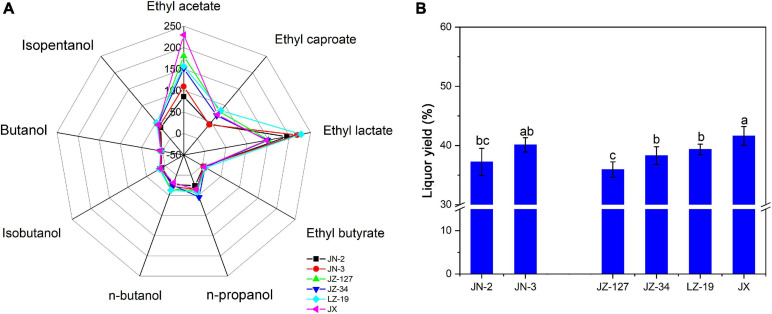
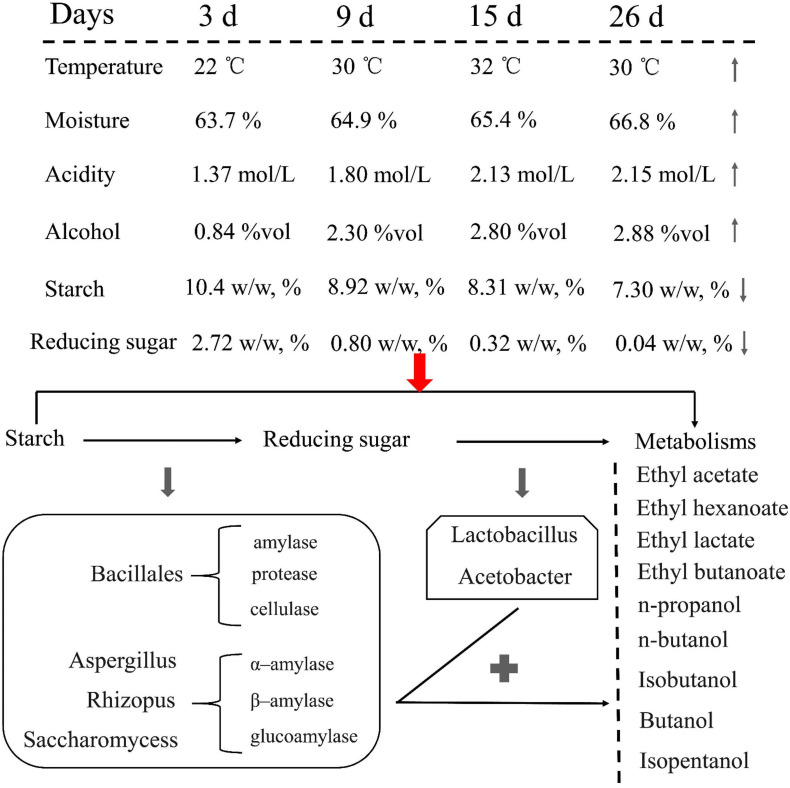
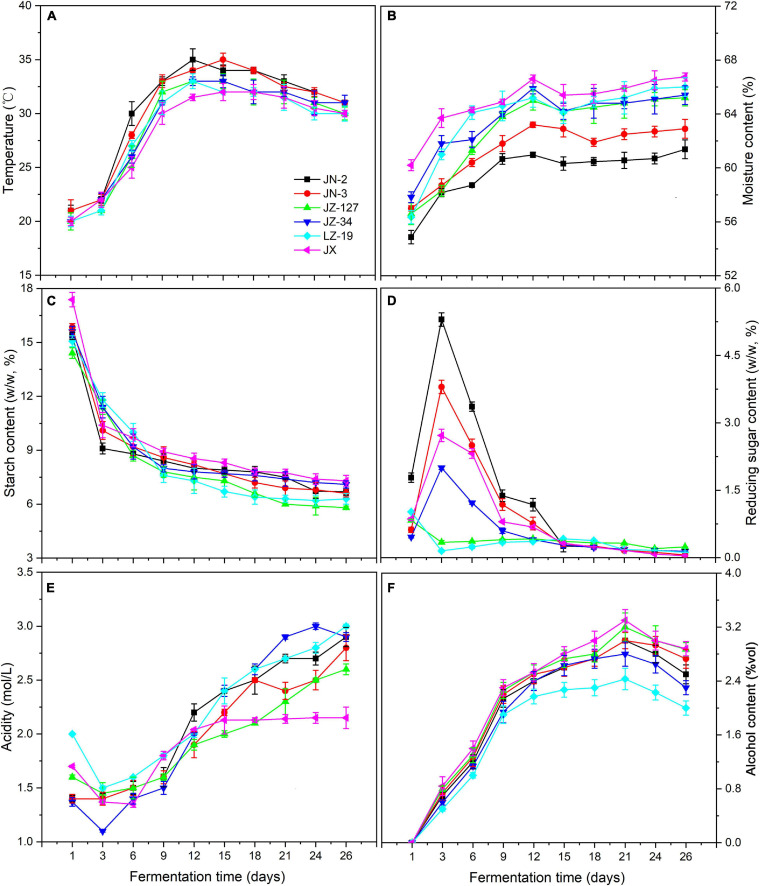
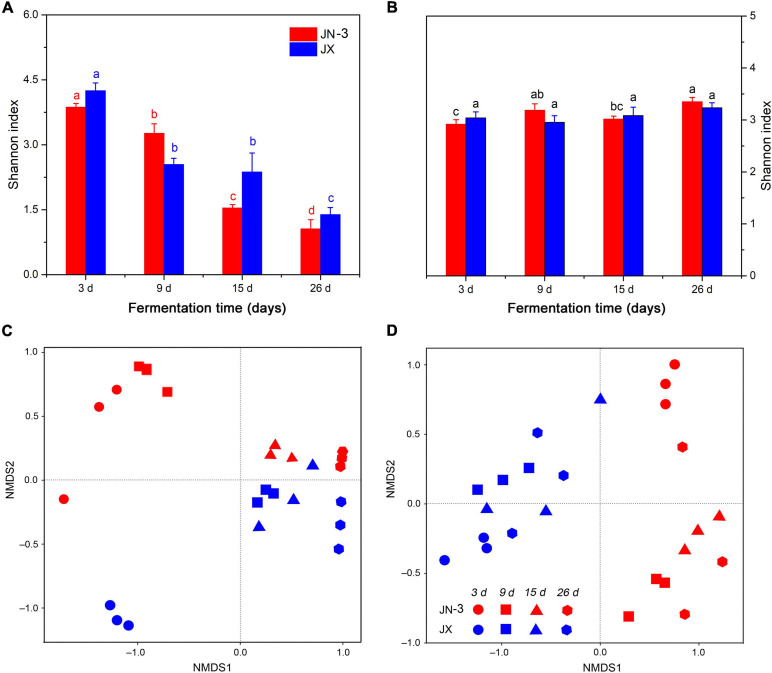
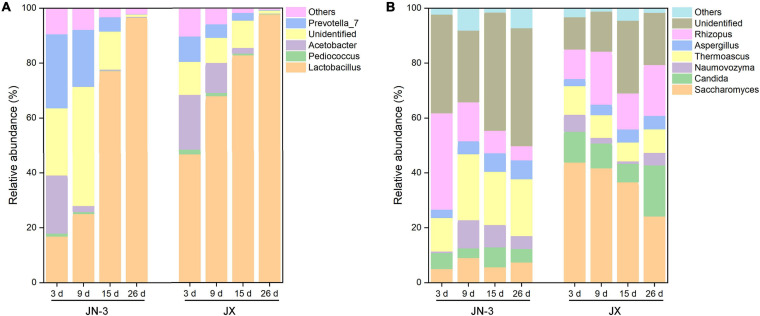
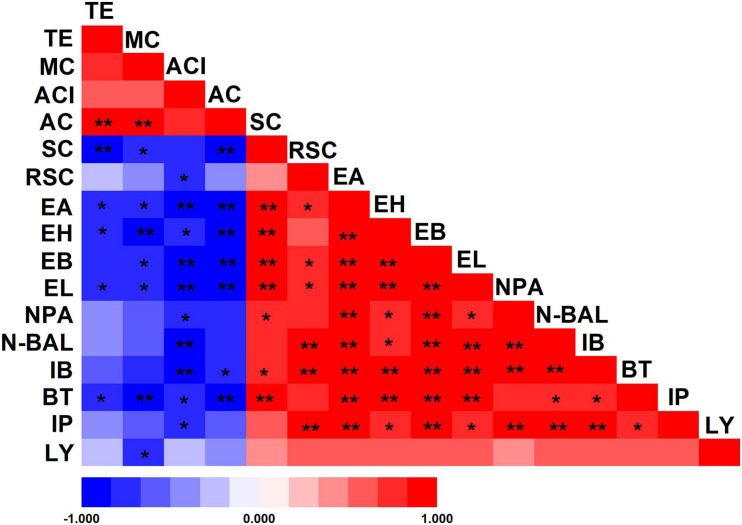
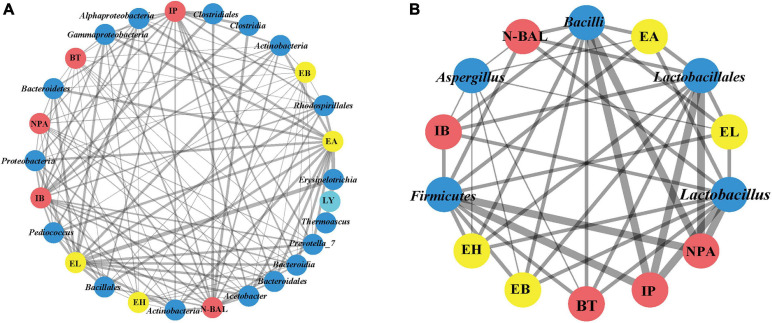
The fermentation process of Chinese Xifeng liquor involves numerous microbes. However, the sources of microbes in fermented grain and the link between liquor flavour and physicochemical properties and microbial diversity during fermentation still remain unknown. Herein, two waxy (JiNiang 2 [JN-2] and JinNuo 3 [JN-3]) and four non-waxy (JiZa 127 [JZ-127], JinZa 34 [JZ-34], LiaoZa 19 [LZ-19], and JiaXian [JX]) sorghum varieties were selected for the comprehensive analysis of the relationship between liquor flavour and the physicochemical properties and microbial diversity of fermented grains. Results showed that ethyl acetate was the main flavour component of JZ-127, JZ-34, and JX, whereas ethyl lactate was mainly detected in JN-2, JN-3, and LZ-19. Ethyl lactate accounted for half of the ethyl acetate content, and JX exhibited a higher liquor yield than the other sorghum varieties. The fermented grains of waxy sorghum presented higher temperature and reducing sugar contents but lower moisture and starch contents than their non-waxy counterparts during fermentation. We selected JN-3 and JX sorghum varieties to further investigate the microbial changes in the fermented grains. The bacterial diversity gradually reduced, whereas the fungal diversity showed nearly no change in either JN-3 or JX. was the most abundant bacterial genus, and its level rapidly increased during fermentation. The abundance of accounted for the total proportion of bacteria in JX, and it was higher than that in JN-3. was the most abundant fungal genus in JX, but its abundance accounted for a small proportion of fungi in JN-3. Four esters and five alcohols were significantly positively related to Proteobacteria, Bacteroidetes, and Actinobacteria; Alphaproteobacteria, Actinobacteria, and Bacteroidia; Bacillales, Bacteroidales, and Rhodospirillales; and , , and . This positive relation is in contrast with that observed for Firmicutes, Bacilli, Lactobacillales, and . Meanwhile, was the only fungal microorganism that showed a significantly negative relation with such compounds (except for butanol and isopentanol). These findings will help in understanding the fermentation mechanism and flavour formation of fermented Xifeng liquor.
中国西凤酒的发酵过程涉及众多微生物。然而,发酵粮醅中微生物的来源以及发酵过程中酒的风味与理化性质和微生物多样性之间的联系仍不清楚。在此,选择了两个糯性高粱品种(吉酿2号[JN-2]和晋糯3号[JN-3])和四个非糯性高粱品种(冀杂127[JZ-127]、晋杂34[JZ-34]、辽杂19[LZ-19]和佳县[JX]),对酒的风味与发酵粮醅的理化性质和微生物多样性之间的关系进行综合分析。结果表明,乙酸乙酯是JZ-127、JZ-34和JX的主要风味成分,而乳酸乙酯主要在JN-2、JN-3和LZ-19中检测到。乳酸乙酯含量占乙酸乙酯含量的一半,且JX的出酒率高于其他高粱品种。在发酵过程中,糯性高粱的发酵粮醅比非糯性高粱的发酵粮醅温度和还原糖含量更高,但水分和淀粉含量更低。我们选择JN-3和JX高粱品种进一步研究发酵粮醅中的微生物变化。在JN-3和JX中,细菌多样性逐渐降低,而真菌多样性几乎没有变化。 是最丰富的细菌属,其水平在发酵过程中迅速增加。 在JX中占细菌总数的比例,且高于JN-3。 是JX中最丰富的真菌属,但其丰度在JN-3中占真菌的比例较小。四种酯类和五种醇类与变形菌门、拟杆菌门和放线菌门;α-变形菌纲、放线菌纲和拟杆菌纲;芽孢杆菌目、拟杆菌目和红螺菌目;以及 、 和 呈显著正相关。这种正相关与厚壁菌门、芽孢杆菌属、乳杆菌目和 的情况相反。同时, 是唯一与这些化合物(除丁醇和异戊醇外)呈显著负相关关系的真菌微生物。这些发现将有助于理解西凤酒发酵机理和风味形成。