Puti Erny, Rasyid Haerani, Tandean Pendrik, Sanusi Himawan, Kasim Hasyim, Bakri Syakib, Aman Makbul, Seweng Arifin
Division of Nephrology, Faculty of Public Health, Hasanuddin University, Makassar, South Sulawesi, Indonesia.
Division of Cardiology, Faculty of Public Health, Hasanuddin University, Makassar, South Sulawesi, Indonesia.
Caspian J Intern Med. 2021 Apr;12(3):323-326. doi: 10.22088/cjim.12.3.323.
Both clinical and experimental evidence have been published over the past few decades supporting the existence of a close relationship between the elevated levels of serum uric acid with cardiovascular events and acute kidney injury (AKI). This study aimed to determine the effect of serum uric acid levels on the incidence of AKI in acute coronary syndrome (ACS) patients.
A retrospective cohort study with a cross sectional design was performed. The research was conducted at Dr. Wahidin Sudirohusodo Hospital from October 2019 to December 2019. Nonrandom sampling was employed in the medical records. All patients who met the inclusion criteria were at > 18 years old and diagnosed with ACS with AKI. The demographic data of age, sex and serum uric acid levels were recorded. The data obtained were analyzed using the SPSS (Statistical Package for Social Sciences).
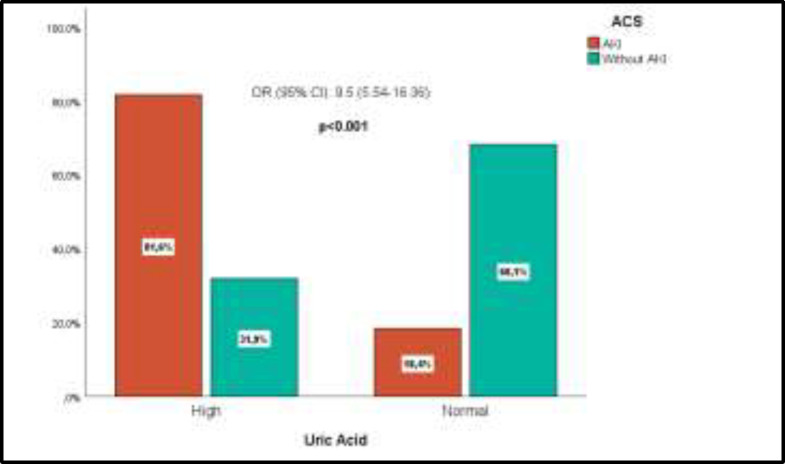
There were 158 subjects of ACS patients with AKI and 135 without AKI. There was a significant correlation between high uric acid levels with the incidence of AKI in ACS (p<0.001). Patients with high serum uric acid levels were 9.5 times at risk of developing AKI compared to those with normal serum uric acid levels.
High uric acid level is one of the risk factors for AKI in ACS and indicates 9.5 times at risk of developing AKI compared to normal serum uric acid level. Therefore, it is necessary to monitor serum uric acid level and kidney function in ACS patients.
在过去几十年中,已有临床和实验证据支持血清尿酸水平升高与心血管事件及急性肾损伤(AKI)之间存在密切关系。本研究旨在确定血清尿酸水平对急性冠状动脉综合征(ACS)患者发生AKI的影响。
进行了一项采用横断面设计的回顾性队列研究。该研究于2019年10月至2019年12月在瓦希丁·苏迪罗胡索多博士医院开展。病历采用非随机抽样。所有符合纳入标准的患者年龄均大于18岁,且被诊断为患有AKI的ACS患者。记录年龄、性别和血清尿酸水平等人口统计学数据。使用SPSS(社会科学统计软件包)对获得的数据进行分析。
有158例患有AKI的ACS患者和135例未患AKI的ACS患者。高尿酸水平与ACS患者发生AKI之间存在显著相关性(p<0.001)。与血清尿酸水平正常的患者相比,血清尿酸水平高的患者发生AKI的风险高9.5倍。
高尿酸水平是ACS患者发生AKI的危险因素之一,与正常血清尿酸水平相比,发生AKI的风险高9.5倍。因此,有必要对ACS患者监测血清尿酸水平和肾功能。