Cheungpasitporn Wisit, Thongprayoon Charat, Harrison Andrew M, Erickson Stephen B
Division of Nephrology and Hypertension, Department of Medicine , Mayo Clinic , Rochester, MA , USA.
Division of Nephrology and Hypertension, Department of Medicine, Mayo Clinic, Rochester, MA, USA; Department of Anesthesiology, Mayo Clinic, Rochester, MA, USA.
Clin Kidney J. 2016 Feb;9(1):51-6. doi: 10.1093/ckj/sfv086. Epub 2015 Sep 9.
The association between elevated admission serum uric acid (SUA) and risk of in-hospital acute kidney injury (AKI) is limited. The aim of this study was to assess the risk of developing AKI in all hospitalized patients with various admission SUA levels.
This is a single-center retrospective study conducted at a tertiary referral hospital. All hospitalized adult patients who had admission SUA available from January 2011 through December 2013 were analyzed in this study. Admission SUA was categorized based on its distribution into six groups (<3.4, 3.4-4.5, 4.5-5.8, 5.8-7.6, 7.6-9.4 and >9.4 mg/dL). The primary outcome was in-hospital AKI occurring after hospital admission. Logistic regression analysis was performed to obtain the odds ratio (OR) of AKI of various admission SUA levels using the most common SUA level range (5.8-7.6 mg/dL) as the reference group.
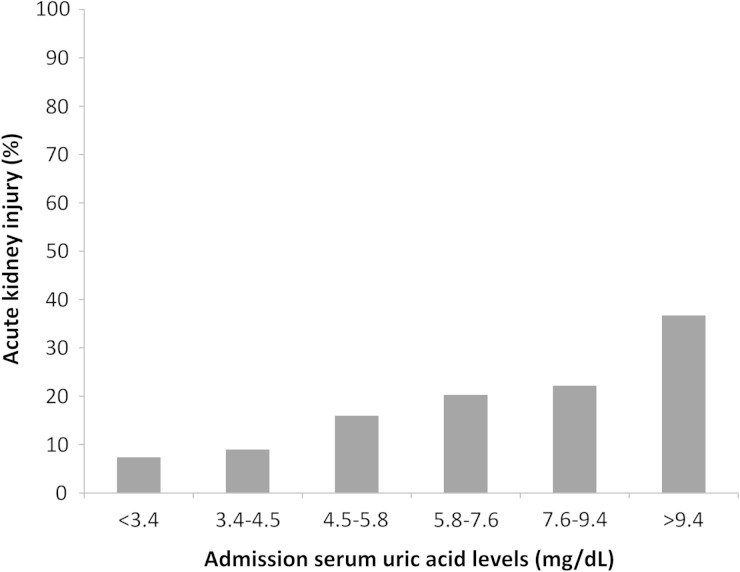
Of 1435 patients enrolled, AKI occurred in 263 patients (18%). The incidence of AKI and need for dialysis was increased in patients with higher admission SUA levels. After adjusting for potential confounders, SUA >9.4 mg/dL was associated with an increased risk of developing AKI, with ORs of 1.79 [95% confidence interval (CI) 1.13-2.82]. Conversely, admission SUA <3.4 and 3.4-4.5 mg/dL were associated with a decreased risk of developing AKI, with ORs of 0.38 (95% CI 0.17-0.75) and 0.50 (95% CI 0.28-0.87), respectively.
Elevated admission SUA was associated with an increased risk for in-hospital AKI.
入院时血清尿酸(SUA)升高与院内急性肾损伤(AKI)风险之间的关联尚不明确。本研究旨在评估不同入院SUA水平的所有住院患者发生AKI的风险。
这是一项在三级转诊医院进行的单中心回顾性研究。本研究分析了2011年1月至2013年12月期间所有有入院SUA数据的住院成年患者。根据SUA分布将入院SUA分为六组(<3.4、3.4 - 4.5、4.5 - 5.8、5.8 - 7.6、7.6 - 9.4和>9.4mg/dL)。主要结局是入院后发生的院内AKI。采用logistic回归分析,以最常见的SUA水平范围(5.8 - 7.6mg/dL)作为参照组,计算不同入院SUA水平AKI的比值比(OR)。
在纳入的1435例患者中,263例(18%)发生了AKI。入院SUA水平较高的患者AKI发生率及透析需求增加。在调整潜在混杂因素后,SUA>9.4mg/dL与发生AKI的风险增加相关,OR为1.79[95%置信区间(CI)1.13 - 2.82]。相反,入院SUA<3.4和3.4 - 4.5mg/dL与发生AKI的风险降低相关,OR分别为0.38(95%CI 0.17 - 0.75)和0.50(95%CI 0.28 - 0.87)。
入院时SUA升高与院内AKI风险增加相关。