Weir Matthew R, Slee April, Sun Tao, Balis Dainius, Oh Richard, de Zeeuw Dick, Perkovic Vlado
Division of Nephrology, Department of Medicine, University of Maryland School of Medicine, Baltimore, MD, USA.
Axio Research, Seattle, WA, USA.
Clin Kidney J. 2020 Sep 2;14(5):1396-1402. doi: 10.1093/ckj/sfaa133. eCollection 2021 May.
The sodium-glucose cotransporter 2 inhibitor canagliflozin has been shown to reduce the risk of cardiovascular and renal events in patients with Type 2 diabetes mellitus and high risk. Pooled analyses of data from early studies and interim data from the CANagliflozin cardioVascular Assessment Study (CANVAS) suggested that canagliflozin might lead to increases in serum potassium, particularly the 300 mg dose in patients with renal impairment, which is important because high serum potassium is associated with increased cardiovascular and renal risk. We examined the effect of canagliflozin on serum potassium levels and hyperkalemia rates in the completed CANVAS Program.
The CANVAS Program ( = 10,142) was comprised of two comparable double-blind, randomized, placebo-controlled trials (CANVAS and CANVAS-Renal). Participants received canagliflozin 100 or 300 mg or placebo. Serum potassium measurements were performed in a central laboratory0 and assessed at ∼6-month intervals.
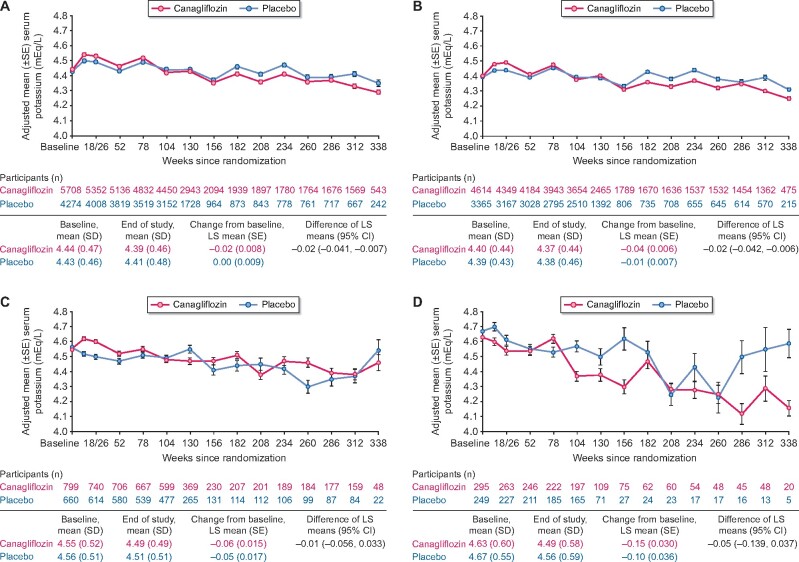
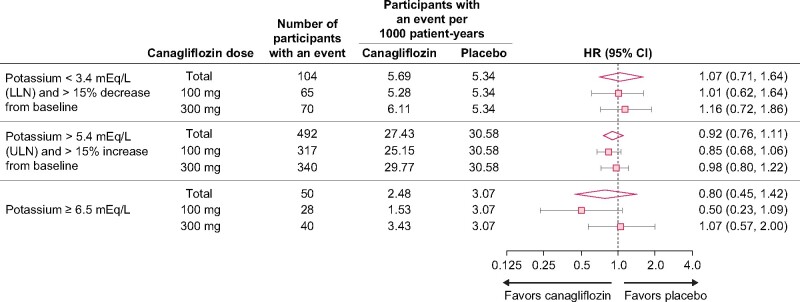
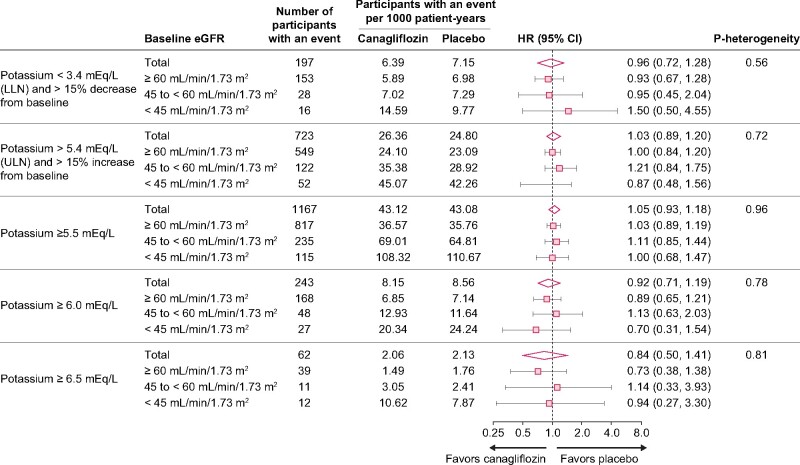
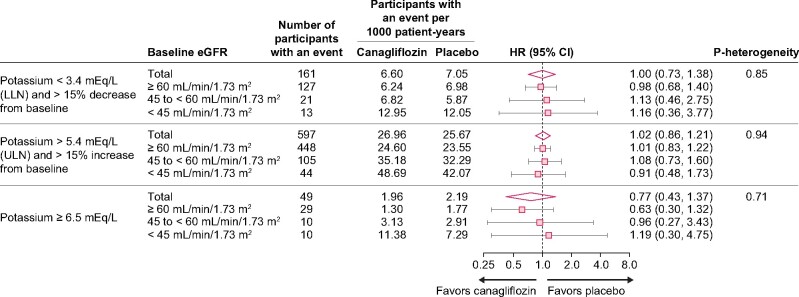
In the CANVAS Program, mean potassium levels were generally consistent with canagliflozin and placebo, overall and by baseline estimated glomerular filtration rate (eGFR; ≥60, 45 to<60 and <45 mL/min/1.73 m). The risk of increased or decreased potassium was similar with canagliflozin and placebo overall and by baseline eGFR (all P-heterogeneity ≥0.56) or use of renin-angiotensin-aldosterone system inhibitors (all P-heterogeneity ≥0.71); levels did not appear different by canagliflozin dose. Hyperkalemia {hazard ratio (HR) [95% confidence interval (CI)] 1.60 (0.92-2.81)} and serious hyperkalemia [HR (95% CI) 0.75 (0.27-2.11)] adverse events were not different across groups.
In the CANVAS Program, there were no meaningful effects of canagliflozin on serum potassium in the overall population or key subgroups. Hyperkalemia adverse events were uncommon and occurred at comparable rates with canagliflozin and placebo.
钠-葡萄糖协同转运蛋白2抑制剂卡格列净已被证明可降低2型糖尿病高危患者发生心血管和肾脏事件的风险。对早期研究数据和卡格列净心血管评估研究(CANVAS)中期数据的汇总分析表明,卡格列净可能导致血清钾升高,尤其是在肾功能不全患者中300mg剂量时,这一点很重要,因为高血清钾与心血管和肾脏风险增加相关。我们在完成的CANVAS项目中研究了卡格列净对血清钾水平和高钾血症发生率的影响。
CANVAS项目(n = 10142)由两项可比的双盲、随机、安慰剂对照试验(CANVAS和CANVAS-肾脏)组成。参与者接受100或300mg卡格列净或安慰剂。血清钾测量在中央实验室进行,并每隔约6个月评估一次。
在CANVAS项目中,总体上以及根据基线估计肾小球滤过率(eGFR;≥60、45至<60和<45 mL/min/1.73 m²),平均钾水平与卡格列净和安慰剂组总体一致。卡格列净和安慰剂组总体上以及根据基线eGFR(所有P异质性≥0.56)或肾素-血管紧张素-醛固酮系统抑制剂的使用情况(所有P异质性≥0.71),钾升高或降低的风险相似;各剂量卡格列净组的水平似乎无差异。高钾血症{风险比(HR)[95%置信区间(CI)]1.60(0.92 -
2.81)}和严重高钾血症[HR(95%CI)0.75(0.27 - 2.11)]不良事件在各组之间无差异。
在CANVAS项目中,卡格列净对总体人群或关键亚组的血清钾没有显著影响。高钾血症不良事件不常见,且卡格列净组和安慰剂组的发生率相当。