Li Tingting, Shen Kaiyuan, Li Jiawei, Leung Susan W S, Zhu Tongyu, Shi Yi
Key Laboratory of Organ Transplantation, Zhongshan Hospital, Fudan University, Shanghai, China.
Institute of Clinical Science, Zhongshan Hospital, Fudan University, Shanghai, China.
Front Med (Lausanne). 2021 Jun 18;8:655639. doi: 10.3389/fmed.2021.655639. eCollection 2021.
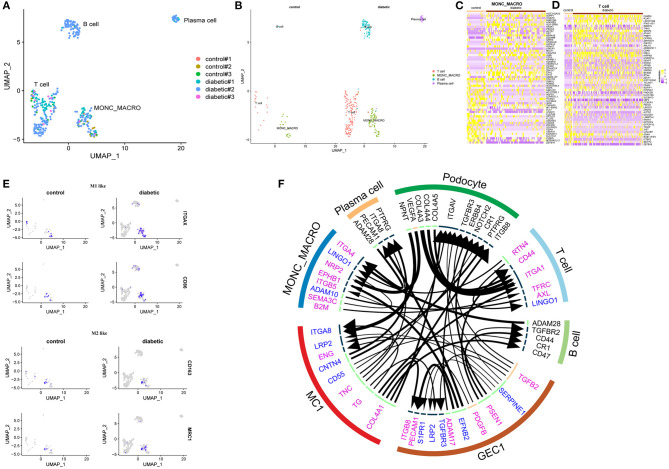
The prevalence of diabetes is consistently rising worldwide. Diabetic nephropathy is a leading cause of chronic renal failure. The present study aimed to explore the crosstalk among the different cell types inside diabetic glomeruli, including glomerular endothelial cells, mesangial cells, podocytes, and immune cells, by analyzing an online single-cell RNA profile (GSE131882) of patients with diabetic nephropathy. Differentially expressed genes in the glomeruli were processed by gene enrichment and protein-protein interactions analysis. Glomerular endothelial cells, as well as podocytes, play a critical role in diabetic nephropathy. A subgroup of glomerular endothelial cells possesses characteristic angiogenesis genes, indicating that angiogenesis takes place in the progress of diabetic nephropathy. Immune cells such as macrophages, T lymphocytes, B lymphocytes, and plasma cells also contribute to the disease progression. By using iTALK, the present study reports complicated cellular crosstalk inside glomeruli. Dysfunction of glomerular endothelial cells and immature angiogenesis result from the activation of both paracrine and autocrine signals. The present study reinforces the importance of glomerular endothelial cells in the development of diabetic nephropathy. The exploration of the signaling pathways involved in aberrant angiogenesis reported in the present study shed light on potential therapeutic target(s) for diabetic nephropathy.
全球范围内,糖尿病的患病率持续上升。糖尿病肾病是慢性肾衰竭的主要病因。本研究旨在通过分析糖尿病肾病患者的在线单细胞RNA图谱(GSE131882),探究糖尿病肾小球内不同细胞类型(包括肾小球内皮细胞、系膜细胞、足细胞和免疫细胞)之间的相互作用。通过基因富集和蛋白质-蛋白质相互作用分析,对肾小球中差异表达的基因进行处理。肾小球内皮细胞以及足细胞在糖尿病肾病中起关键作用。一部分肾小球内皮细胞拥有特征性的血管生成基因,这表明糖尿病肾病进展过程中发生了血管生成。巨噬细胞、T淋巴细胞、B淋巴细胞和浆细胞等免疫细胞也促进了疾病进展。通过使用iTALK,本研究报道了肾小球内复杂的细胞间相互作用。旁分泌和自分泌信号的激活导致肾小球内皮细胞功能障碍和血管生成不成熟。本研究强化了肾小球内皮细胞在糖尿病肾病发生发展中的重要性。本研究中对异常血管生成所涉及信号通路的探索,为糖尿病肾病潜在治疗靶点提供了线索。