Bojic Marija, Koller Lorenz, Cejka Daniel, Niessner Alexander, Bielesz Bernhard
Division of Nephrology and Dialysis, Department of Medicine III, Medical University of Vienna, Vienna, Austria.
Division of Cardiology, Department of Medicine II, Medical University of Vienna, Vienna, Austria.
Front Med (Lausanne). 2021 Jun 18;8:672348. doi: 10.3389/fmed.2021.672348. eCollection 2021.
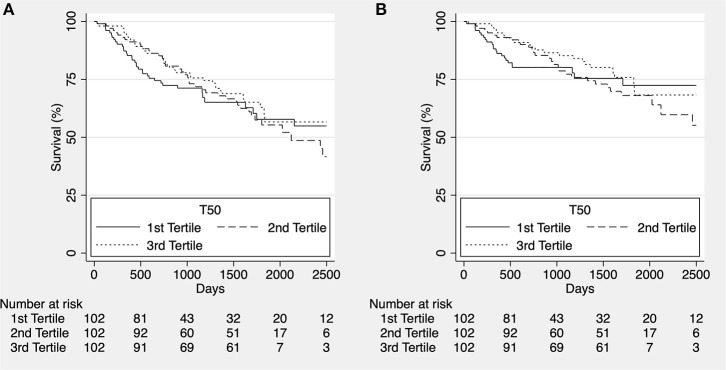
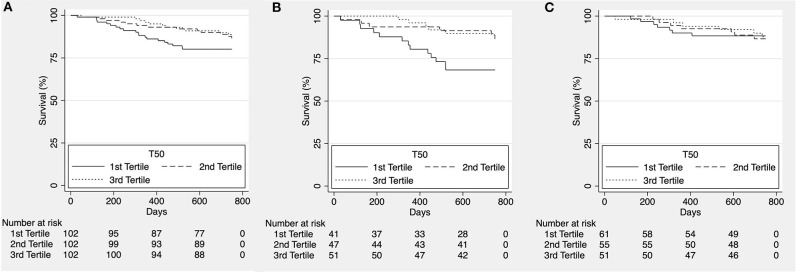
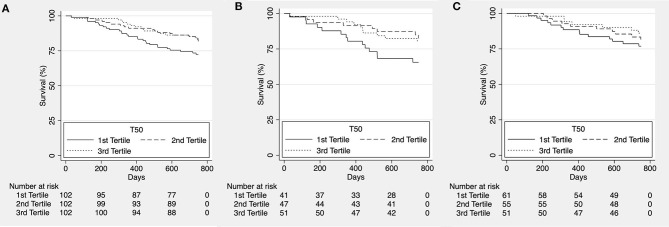
The propensity of serum to calcify, as assessed by the T-test, associates with mortality in patients with chronic kidney disease. In chronic heart failure, phosphate and fibroblast growth factor-23 (FGF-23), which are important components of the vascular calcification pathway, have been linked to patient survival. Here, we investigated whether T associates with overall and cardiovascular survival in patients with chronic heart failure with reduced ejection fraction (HFrEF). We measured T, intact and c-terminal FGF-23 levels in a cohort of 306 HFrEF patients. Associations with overall and cardiovascular mortality were analyzed in survival analysis and Cox-regression models. After a median follow-up time of 3.2 years (25th-75th percentile: 2.0-4.9 years), 114 patients (37.3%) died due to any cause and 76 patients (24.8%) died due to cardiovascular causes. 139 patients (45.4%) had ischemic and 167 patients (54.6%) had non-ischemic HFrEF. Patients with ischemic HFrEF in the lowest T-tertile had significantly greater 2-year cardiovascular mortality compared to patients in higher tertiles ( = 0.011). In ischemic but not in non-ischemic HFrEF, T was significantly associated with cardiovascular mortality in univariate ( = 0.041) and fully adjusted ( = 0.046) Cox regression analysis. Significant associations of intact and c-terminal FGF-23 with all-cause and cardiovascular mortality in univariate Cox regression analysis did not remain significant after adjustment for confounding factors. T is associated with 2-year cardiovascular mortality in patients with ischemic HFrEF but not in non-ischemic HFrEF. More research on the role of T measurements in coronary artery disease is warranted.
通过T检验评估的血清钙化倾向与慢性肾病患者的死亡率相关。在慢性心力衰竭中,作为血管钙化途径重要组成部分的磷酸盐和成纤维细胞生长因子23(FGF - 23)与患者生存率相关。在此,我们研究了T与射血分数降低的慢性心力衰竭(HFrEF)患者的总体生存率和心血管生存率是否相关。我们测量了306例HFrEF患者队列中的T、完整型和C末端FGF - 23水平。在生存分析和Cox回归模型中分析了与总体死亡率和心血管死亡率的相关性。中位随访时间为3.2年(第25 - 75百分位数:2.0 - 4.9年)后,114例患者(37.3%)因任何原因死亡,76例患者(24.8%)因心血管原因死亡。139例患者(45.4%)患有缺血性HFrEF,167例患者(54.6%)患有非缺血性HFrEF。与处于较高三分位数的患者相比,处于最低T三分位数的缺血性HFrEF患者2年心血管死亡率显著更高(P = 0.011)。在缺血性而非非缺血性HFrEF中,在单因素(P = 0.041)和完全调整(P = 0.046)的Cox回归分析中,T与心血管死亡率显著相关。在调整混杂因素后,单因素Cox回归分析中完整型和C末端FGF - 23与全因死亡率和心血管死亡率的显著相关性不再显著。T与缺血性HFrEF患者的2年心血管死亡率相关,但与非缺血性HFrEF患者无关。有必要对T测量在冠状动脉疾病中的作用进行更多研究。