• 文献检索
  • 文档翻译
  • 深度研究
  • 学术资讯
  • Suppr Zotero 插件Zotero 插件
  • 邀请有礼
  • 套餐&价格
  • 历史记录
应用&插件
Suppr Zotero 插件Zotero 插件浏览器插件Mac 客户端Windows 客户端微信小程序
定价
高级版会员购买积分包购买API积分包
服务
文献检索文档翻译深度研究API 文档MCP 服务
关于我们
关于 Suppr公司介绍联系我们用户协议隐私条款
关注我们

Suppr 超能文献

核心技术专利:CN118964589B侵权必究
粤ICP备2023148730 号-1Suppr @ 2026

文献检索

告别复杂PubMed语法,用中文像聊天一样搜索,搜遍4000万医学文献。AI智能推荐,让科研检索更轻松。

立即免费搜索

文件翻译

保留排版,准确专业,支持PDF/Word/PPT等文件格式,支持 12+语言互译。

免费翻译文档

深度研究

AI帮你快速写综述,25分钟生成高质量综述,智能提取关键信息,辅助科研写作。

立即免费体验

肯尼亚隐性避孕措施使用的流行情况及其相关因素:一项横断面研究。

Prevalence and factors associated with covert contraceptive use in Kenya: a cross-sectional study.

机构信息

Institute of Tropical and Infectious Diseases, University of Nairobi, Nairobi, Kenya.

School of Public Health, University of Nairobi, Nairobi, Kenya.

出版信息

BMC Public Health. 2021 Jul 5;21(1):1316. doi: 10.1186/s12889-021-11375-7.

DOI:10.1186/s12889-021-11375-7
PMID:34225673
原文链接:https://pmc.ncbi.nlm.nih.gov/articles/PMC8256600/
Abstract

BACKGROUND

Family planning (FP) is a key intervention for preventing unplanned pregnancies, unsafe abortions, and maternal death. Involvement of both women and their partners promotes contraceptive acceptance, uptake and continuation, couple communication and gender-equitable attitude. Partner involvement is a key strategy for addressing about 17.5% of the unmet needs in FP in Kenya. This study assessed the prevalence and factors associated with covert contraceptive use (CCU) in Kenya.

METHODS

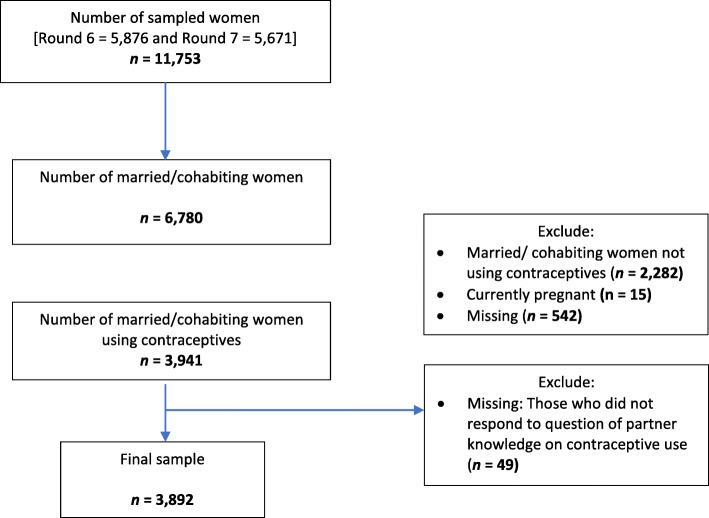
We used data from the sixth and seventh rounds of the performance monitoring for accountability surveys. We defined CCU as "the use of contraceptives without a partner's knowledge". We used frequencies and percentages to describe the sample characteristics and the prevalence of CCU and assessed the associated factors using bivariate and multivariable logistic regressions.

RESULTS

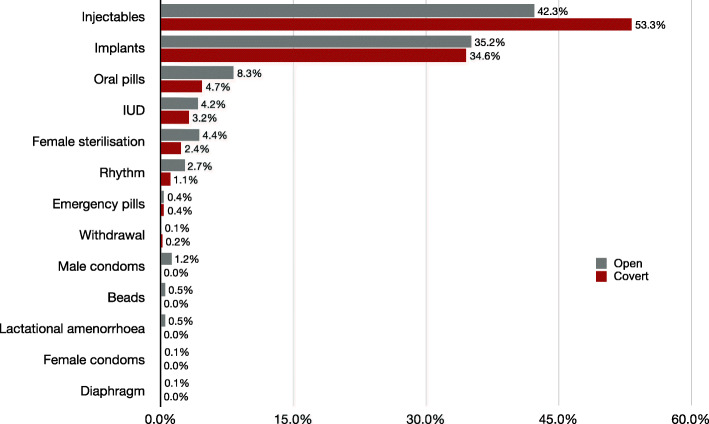
The prevalence of CCU was 12.2% (95% CI: 10.4-14.2%); highest among uneducated (22.3%) poorest (18.2%) and 35-49 years-old (12.8%) women. Injectables (53.3%) and implants (34.6%) were the commonest methods among women who practice CCU. In the bivariate analysis, Siaya county, rural residence, education, wealth, and age at sexual debut were associated with CCU. On adjusting for covariates, the odds of CCU were increased among uneducated women (aOR 3.79, 95% CI 1.73-8.31), women with primary education (aOR 1.86, 95% CI 1.06-3.29) and those from the poorest (aOR 2.67, 95% CI 1.61-4.45), poorer (aOR 1.79, 95% CI 1.05-3.04), and middle (aOR 2.40, 95% CI 1.52-3.78) household wealth quintiles and were reduced among those with 2-3 (aOR 0.49, 95% CI 0.33-0.72) and ≥ 4 children (aOR 0.62, 95% CI 0.40-0.96). Age at sexual debut (aOR 0.94, 95% CI 0.89-0.99) reduced the odds of CCU.

CONCLUSION

About one in 10 married women in Kenya use contraceptives covertly, with injectables and implants being the preferred methods. Our study highlights a gap in partner involvement in FP and calls for efforts to strengthen their involvement to increase contraceptive use in Kenya while acknowledging women's right to make independent choices.

摘要

背景

计划生育(FP)是预防非计划怀孕、不安全堕胎和孕产妇死亡的关键干预措施。妇女及其伴侣的参与促进了避孕措施的接受、采用和持续使用、夫妻沟通和性别平等态度。伴侣参与是解决肯尼亚约 17.5%计划生育未满足需求的关键策略。本研究评估了肯尼亚隐性避孕(CCU)的流行情况和相关因素。

方法

我们使用了绩效监测问责调查第六轮和第七轮的数据。我们将 CCU 定义为“在伴侣不知情的情况下使用避孕药具”。我们使用频率和百分比来描述样本特征和 CCU 的流行情况,并使用双变量和多变量逻辑回归评估相关因素。

结果

CCU 的流行率为 12.2%(95%CI:10.4-14.2%);在未受过教育的(22.3%)、最贫穷的(18.2%)和 35-49 岁的女性中最高。注射剂(53.3%)和植入物(34.6%)是 CCU 女性最常使用的方法。在单变量分析中,锡亚县、农村居民、教育、财富和性初潮年龄与 CCU 相关。在调整了混杂因素后,未受过教育的女性(aOR 3.79,95%CI 1.73-8.31)、接受过小学教育的女性(aOR 1.86,95%CI 1.06-3.29)和来自最贫穷(aOR 2.67,95%CI 1.61-4.45)、较贫穷(aOR 1.79,95%CI 1.05-3.04)和中等(aOR 2.40,95%CI 1.52-3.78)家庭财富五分位数的女性,以及生育 2-3 个(aOR 0.49,95%CI 0.33-0.72)和≥4 个孩子(aOR 0.62,95%CI 0.40-0.96)的女性,其 CCU 的几率降低。性初潮年龄(aOR 0.94,95%CI 0.89-0.99)降低了 CCU 的几率。

结论

肯尼亚约十分之一的已婚女性隐性使用避孕药具,注射剂和植入物是首选方法。我们的研究突出了在计划生育伴侣参与方面的差距,并呼吁努力加强他们的参与,以增加肯尼亚的避孕措施使用,同时承认妇女做出独立选择的权利。
https://cdn.ncbi.nlm.nih.gov/pmc/blobs/9516/8256600/8c22e4a724d8/12889_2021_11375_Fig2_HTML.jpg
https://cdn.ncbi.nlm.nih.gov/pmc/blobs/9516/8256600/af76be77d111/12889_2021_11375_Fig1_HTML.jpg
https://cdn.ncbi.nlm.nih.gov/pmc/blobs/9516/8256600/8c22e4a724d8/12889_2021_11375_Fig2_HTML.jpg
https://cdn.ncbi.nlm.nih.gov/pmc/blobs/9516/8256600/af76be77d111/12889_2021_11375_Fig1_HTML.jpg
https://cdn.ncbi.nlm.nih.gov/pmc/blobs/9516/8256600/8c22e4a724d8/12889_2021_11375_Fig2_HTML.jpg

相似文献

1
Prevalence and factors associated with covert contraceptive use in Kenya: a cross-sectional study.肯尼亚隐性避孕措施使用的流行情况及其相关因素:一项横断面研究。
BMC Public Health. 2021 Jul 5;21(1):1316. doi: 10.1186/s12889-021-11375-7.
2
Covert use of reversible contraceptive methods and its association with husband's egalitarian gender attitude in India.印度暗中使用可逆避孕方法及其与丈夫平等性别态度的关联。
BMC Public Health. 2022 Mar 7;22(1):460. doi: 10.1186/s12889-022-12882-x.
3
"It is my business": A Mixed-Methods Analysis of Covert Contraceptive Use among Women in Rakai, Uganda.“这是我的事”:乌干达拉凯妇女隐性避孕方法的混合方法分析。
Contraception. 2018 Jul;98(1):41-46. doi: 10.1016/j.contraception.2018.02.017. Epub 2018 Mar 4.
4
Covert contraceptive use among women attending a reproductive health clinic in a municipality in Ghana.加纳某城市一家生殖健康诊所女性的隐蔽避孕行为
BMC Womens Health. 2016 Jun 6;16:31. doi: 10.1186/s12905-016-0310-x.
5
Factors Associated With the Utilisation and Unmet Need for Modern Contraceptives Among Urban Women in Kenya: A Cross-Sectional Study.肯尼亚城市女性现代避孕方法的使用情况及未满足需求的相关因素:一项横断面研究
Front Glob Womens Health. 2021 Dec 16;2:669760. doi: 10.3389/fgwh.2021.669760. eCollection 2021.
6
Coverage and determinants of modern contraceptive use in sub-Saharan Africa: further analysis of demographic and health surveys.撒哈拉以南非洲地区现代避孕方法的使用情况及决定因素:人口与健康调查的进一步分析。
Reprod Health. 2022 Jan 21;19(1):18. doi: 10.1186/s12978-022-01332-x.
7
Factors associated with use of long-acting reversible and permanent contraceptives among married women in rural Kenya: A community-based cross-sectional study in Kisii and Kilifi counties.肯尼亚农村已婚妇女使用长效可逆和永久性避孕措施的相关因素:基西和基利菲县基于社区的横断面研究。
PLoS One. 2022 Oct 6;17(10):e0275575. doi: 10.1371/journal.pone.0275575. eCollection 2022.
8
Contextual factors associated with contraceptive utilization and unmet need among sexually active unmarried women in Kenya: A multilevel regression analysis.肯尼亚性行为活跃的未婚女性中与避孕措施使用和未满足需求相关的情境因素:多层次回归分析。
PLoS One. 2022 Jun 30;17(6):e0270516. doi: 10.1371/journal.pone.0270516. eCollection 2022.
9
Consistent condom use among highly effective contraceptive users in an HIV-endemic area in rural Kenya.肯尼亚农村一个艾滋病毒流行地区高效避孕方法使用者中坚持使用避孕套。
PLoS One. 2019 May 6;14(5):e0216208. doi: 10.1371/journal.pone.0216208. eCollection 2019.
10
Use of contraceptives, high risk births and under-five mortality in Sub Saharan Africa: evidence from Kenyan (2014) and Zimbabwean (2011) demographic health surveys.撒哈拉以南非洲地区避孕药具的使用、高危分娩与五岁以下儿童死亡率:来自肯尼亚(2014年)和津巴布韦(2011年)人口与健康调查的证据
BMC Womens Health. 2018 Oct 24;18(1):173. doi: 10.1186/s12905-018-0666-1.

引用本文的文献

1
Measurement and conceptualization of male involvement in family planning: a bibliometric analysis of Africa-based studies.男性参与计划生育的衡量与概念化:基于非洲研究的文献计量分析
Contracept Reprod Med. 2024 Jun 13;9(1):29. doi: 10.1186/s40834-024-00293-9.
2
Demographic, Sociocultural, and Behavioral Predictors of Modern Contraceptive Uptake Among Couples in Northern Ghana.加纳北部夫妇现代避孕措施采用情况的人口统计学、社会文化和行为预测因素
Open Access J Contracept. 2024 Mar 11;15:23-40. doi: 10.2147/OAJC.S430288. eCollection 2024.
3
Barriers to contraceptive use in humanitarian settings: Experiences of South Sudanese refugee women living in Adjumani district, Uganda; an exploratory qualitative study.

本文引用的文献

1
A qualitative exploration of contraceptive use and discontinuation among women with an unmet need for modern contraception in Kenya.肯尼亚未满足现代避孕需求的女性中避孕方法的使用和停止使用的定性探索。
Reprod Health. 2021 Feb 9;18(1):33. doi: 10.1186/s12978-021-01094-y.
2
From non-use to covert and overt use of contraception: Identifying community and individual factors informing Nigerian women's degree of contraceptive empowerment.从不使用到秘密和公开使用避孕措施:确定社区和个人因素,告知尼日利亚妇女获得避孕自主权的程度。
PLoS One. 2020 Nov 18;15(11):e0242345. doi: 10.1371/journal.pone.0242345. eCollection 2020.
3
Exploring contraception myths and misconceptions among young men and women in Kwale County, Kenya.
在人道主义环境下使用避孕药具的障碍:居住在乌干达阿朱马尼区的南苏丹难民妇女的经历;一项探索性定性研究。
PLoS One. 2024 Mar 1;19(3):e0278731. doi: 10.1371/journal.pone.0278731. eCollection 2024.
4
Why do most young women not take up contraceptives after post-abortion care? An ethnographic study on the effectiveness and quality of contraceptive counselling after PAC in Kilifi County, Kenya.为什么大多数年轻女性在流产后护理后不使用避孕药具?肯尼亚基利菲县流产后护理中避孕咨询效果和质量的民族志研究。
Sex Reprod Health Matters. 2023 Dec;31(1):2264688. doi: 10.1080/26410397.2023.2264688. Epub 2023 Nov 8.
5
Differential discontinuation by covert use status in Kenya.肯尼亚按秘密使用状况进行的差异停药情况。
Contracept X. 2023 Oct 16;5:100102. doi: 10.1016/j.conx.2023.100102. eCollection 2023.
6
What do outlet's and provider's characteristics mean for family planning consumers? A comparative study of Kenya, Nigeria and Uganda.对于计划生育消费者而言,渠道和提供者的特点意味着什么?肯尼亚、尼日利亚和乌干达的比较研究。
BMC Womens Health. 2023 Oct 16;23(1):537. doi: 10.1186/s12905-023-02699-0.
7
More than Measurement Error: Discrepant Reporting of Contraceptive Use and the Role of Wives' and Husbands' Educational Attainment.不止是测量误差:避孕药具使用情况的差异报告及妻子和丈夫教育程度的作用。
Stud Fam Plann. 2023 Sep;54(3):445-465. doi: 10.1111/sifp.12249. Epub 2023 Jul 22.
8
Covert Contraceptive Use amongst the urban poor in Accra, Ghana: experiences of health providers.加纳阿克拉市贫困人群中的隐性避孕措施使用情况:卫生服务提供者的经验。
Reprod Health. 2022 Nov 4;19(1):205. doi: 10.1186/s12978-022-01516-5.
9
Factors associated with use of long-acting reversible and permanent contraceptives among married women in rural Kenya: A community-based cross-sectional study in Kisii and Kilifi counties.肯尼亚农村已婚妇女使用长效可逆和永久性避孕措施的相关因素:基西和基利菲县基于社区的横断面研究。
PLoS One. 2022 Oct 6;17(10):e0275575. doi: 10.1371/journal.pone.0275575. eCollection 2022.
10
Acceptability of an intravaginal ring for simultaneously preventing HIV infection and pregnancy: Qualitative findings of the Kisumu Combined Ring Study, 2019.阴道环同时预防艾滋病毒感染和怀孕的可接受性:2019 年基苏木联合环研究的定性发现。
Contemp Clin Trials. 2022 Nov;122:106935. doi: 10.1016/j.cct.2022.106935. Epub 2022 Sep 23.
探索肯尼亚夸勒县青年男女对避孕的误解和错误观念。
BMC Public Health. 2020 Nov 11;20(1):1694. doi: 10.1186/s12889-020-09849-1.
4
Performance monitoring and accountability: The Agile Project's protocol, record and experience.绩效监测与问责制:敏捷项目的方案、记录与经验
Gates Open Res. 2020 Aug 20;4:30. doi: 10.12688/gatesopenres.13119.2. eCollection 2020.
5
Covert use of contraception in three sub-Saharan African countries: a qualitative exploration of motivations and challenges.撒哈拉以南非洲三国的隐形避孕措施使用情况:动机与挑战的定性探索
BMC Public Health. 2020 Jun 5;20(1):865. doi: 10.1186/s12889-020-08977-y.
6
Associations of reproductive coercion and intimate partner violence with overt and covert family planning use among married adolescent girls in Niger.尼日尔已婚少女中生殖胁迫及亲密伴侣暴力与公开和秘密使用计划生育方法之间的关联。
EClinicalMedicine. 2020 May 3;22:100359. doi: 10.1016/j.eclinm.2020.100359. eCollection 2020 May.
7
Contraceptive use among adolescent and young women in North and South Kivu, Democratic Republic of the Congo: A cross-sectional population-based survey.刚果民主共和国南北基伍省青少年和年轻女性的避孕措施使用情况:一项基于人群的横断面调查。
PLoS Med. 2020 Mar 31;17(3):e1003086. doi: 10.1371/journal.pmed.1003086. eCollection 2020 Mar.
8
How Much Education Is Needed to Delay Women's Age at Marriage and First Pregnancy?延迟女性结婚和首次怀孕年龄需要多少教育?
Front Public Health. 2020 Jan 9;7:396. doi: 10.3389/fpubh.2019.00396. eCollection 2019.
9
Male partner influence on family planning and contraceptive use: perspectives from community members and healthcare providers in KwaZulu-Natal, South Africa.南非夸祖鲁-纳塔尔省社区成员和医疗保健提供者对男性伴侣在计划生育和避孕措施使用方面的影响:观点。
Reprod Health. 2019 Jun 25;16(1):89. doi: 10.1186/s12978-019-0749-y.
10
Understanding 'missed appointments' for pills and injectables: a mixed methods study in Senegal.理解口服药和注射剂的“漏诊预约”:塞内加尔的一项混合方法研究。
BMJ Glob Health. 2018 Dec 30;3(6):e000975. doi: 10.1136/bmjgh-2018-000975. eCollection 2018.