Department of Mechanical Engineering, National Cheng Kung University, No. 1 University Road, Tainan, 701, Taiwan.
Department of Radiology, Shuang-Ho Hospital, Taipei Medical University, New Taipei City, 235, Taiwan.
Sci Rep. 2021 Jul 5;11(1):13801. doi: 10.1038/s41598-021-93078-y.
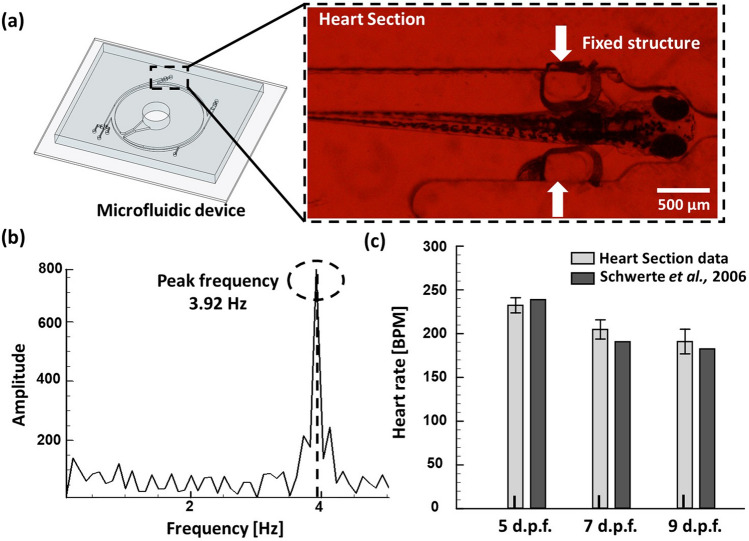
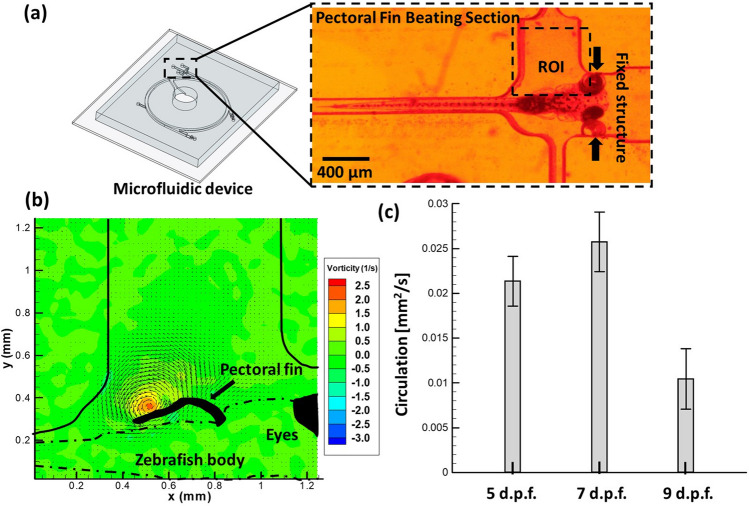
This study proposed a new experimental approach for the vascular and phenotype evaluation of the non-anesthetized zebrafish with representative imaging orientations for heart, pectoral fin beating, and vasculature views by means of the designed microfluidic device through inducing the optomotor response and hydrodynamic pressure control. In order to provide the visual cues for better positioning of zebrafish, computer-animated moving grids were generated by an in-house control interface which was powered by the larval optomotor response, in conjunction with the pressure suction control. The presented platform provided a comprehensive evaluation of internal circulation and the linked external behaviors of zebrafish in response to the cardiovascular parameter changes. The insights from these imaging sections was extended to identify the linkage between the cardiac parameters and behavioral endpoints. In addition, selected chemicals such as ethanol and caffeine were employed for the treatment of zebrafish. The obtained findings can be applicable for future investigation in behavioral drug screening serving as the forefront in psychopharmacological and cognition research.
本研究提出了一种新的实验方法,用于通过设计的微流控装置,通过诱导光感受器反应和流体动力学压力控制,以代表性的心脏、胸鳍跳动和血管视图成像方向,对非麻醉斑马鱼的血管和表型进行评估。为了提供更好定位斑马鱼的视觉线索,通过内部控制接口生成了计算机动画移动网格,该接口由幼虫光感受器反应和压力抽吸控制联合提供动力。所提出的平台提供了对内部循环和斑马鱼对心血管参数变化的外部行为的综合评估。这些成像部分的见解扩展到识别心脏参数与行为终点之间的联系。此外,还使用了乙醇和咖啡因等选定化学物质对斑马鱼进行处理。获得的发现可适用于未来作为精神药理学和认知研究前沿的行为药物筛选的研究。