Department of Physiology and Biophysics, University of California, Irvine, Irvine, CA.
Chao Family Comprehensive Cancer Center, University of California, Irvine, Irvine, CA.
J Gen Physiol. 2021 Sep 6;153(9). doi: 10.1085/jgp.202012832. Epub 2021 Jul 6.
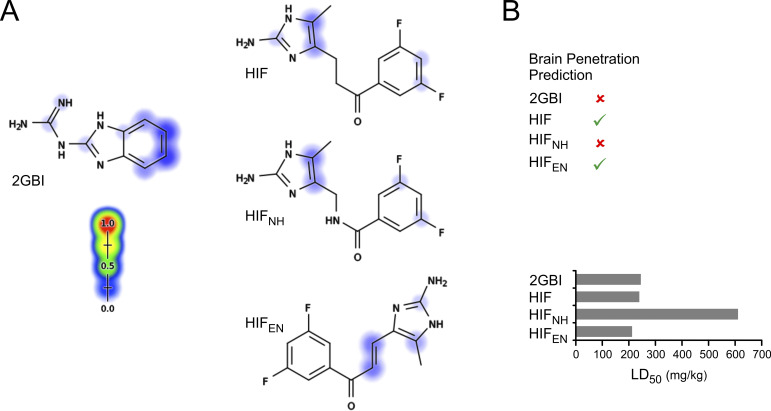
The human voltage-gated proton channel Hv1 is a drug target for cancer, ischemic stroke, and neuroinflammation. It resides on the plasma membrane and endocytic compartments of a variety of cell types, where it mediates outward proton movement and regulates the activity of NOX enzymes. Its voltage-sensing domain (VSD) contains a gated and proton-selective conduction pathway, which can be blocked by aromatic guanidine derivatives such as 2-guanidinobenzimidazole (2GBI). Mutation of Hv1 residue F150 to alanine (F150A) was previously found to increase 2GBI apparent binding affinity more than two orders of magnitude. Here, we explore the contribution of aromatic interactions between the inhibitor and the channel in the presence and absence of the F150A mutation, using a combination of electrophysiological recordings, classic mutagenesis, and site-specific incorporation of fluorinated phenylalanines via nonsense suppression methodology. Our data suggest that the increase in apparent binding affinity is due to a rearrangement of the binding site allowed by the smaller residue at position 150. We used this information to design new arginine mimics with improved affinity for the nonrearranged binding site of the wild-type channel. The new compounds, named "Hv1 Inhibitor Flexibles" (HIFs), consist of two "prongs," an aminoimidazole ring, and an aromatic group connected by extended flexible linkers. Some HIF compounds display inhibitory properties that are superior to those of 2GBI, thus providing a promising scaffold for further development of high-affinity Hv1 inhibitors.
人电压门控质子通道 Hv1 是癌症、缺血性中风和神经炎症的药物靶点。它位于多种细胞类型的质膜和内吞隔室中,在那里介导质子的外向运动,并调节 NOX 酶的活性。其电压感应结构域(VSD)包含一个门控的质子选择性传导途径,可被芳族胍衍生物如 2-胍基苯并咪唑(2GBI)阻断。先前发现 Hv1 残基 F150 突变为丙氨酸(F150A)会使 2GBI 的表观结合亲和力增加两个数量级以上。在这里,我们使用电生理记录、经典突变和通过无意义抑制方法在位置特异性掺入氟化苯丙氨酸的组合,在存在和不存在 F150A 突变的情况下,探讨抑制剂与通道之间的芳族相互作用的贡献。我们的数据表明,表观结合亲和力的增加是由于较小的 150 位残基允许结合位点重新排列。我们利用这些信息设计了新的精氨酸类似物,这些类似物对野生型通道的非重排结合位点具有改善的亲和力。这些新化合物称为“Hv1 抑制剂灵活物”(HIFs),由两个“叉头”、一个氨基咪唑环和一个通过扩展的柔性接头连接的芳族基团组成。一些 HIF 化合物表现出优于 2GBI 的抑制特性,从而为进一步开发高亲和力 Hv1 抑制剂提供了有前途的支架。