International School of Public Health, Mohammed VI University of Health Sciences, Casablanca, Morocco.
National School of Public Health, Rabat, Morocco.
BMC Public Health. 2021 Jul 6;21(1):1325. doi: 10.1186/s12889-021-11296-5.
Breast cancer patients in sub-Saharan Africa experience long time intervals between their first presentation to a health care facility and the start of cancer treatment. The role of the health system in the increasing treatment time intervals has not been widely investigated. This review aimed to identify existing information on health system factors that influence diagnostic and treatment intervals in women with breast cancer in sub-Saharan Africa to contribute to the reorientation of health policies in the region.
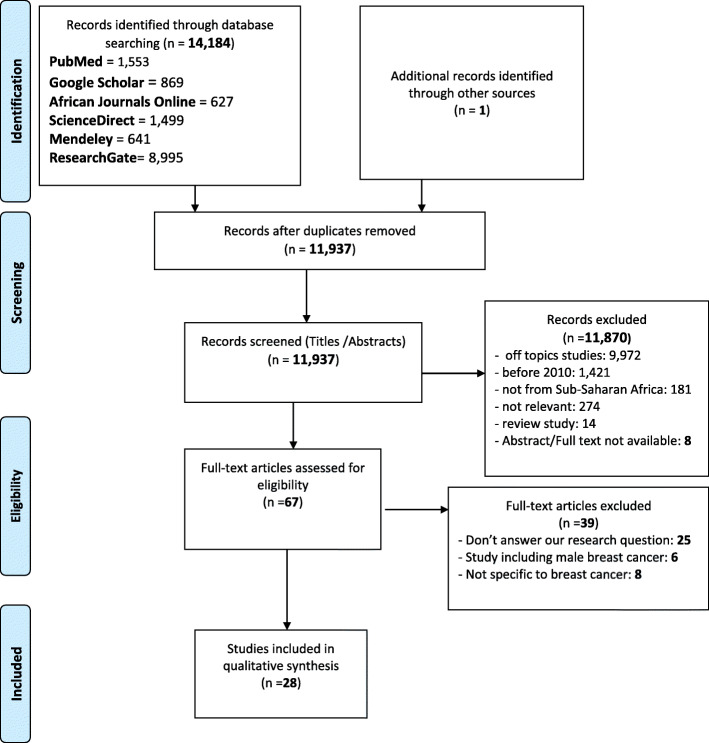
PubMed, ScienceDirect, African Journals Online, Mendeley, ResearchGate and Google Scholar were searched to identify relevant studies published between 2010 and July 2020. We performed a qualitative synthesis in accordance with the Preferred Reporting Items for Systematic Reviews and Meta-Analyses (PRISMA) statement. Related health system factors were extracted and classified according to the World Health Organization's six health system building blocks. The quality of qualitative and quantitative studies was assessed by using the Critical Appraisal Skills Program Quality-Assessment Tool and the National Institute of Health Quality Assessment Tool, respectively. In addition, we used the Confidence in the Evidence from Reviews of Qualitative Research tool to assess the evidence for each qualitative finding.
From 14,184 identified studies, this systematic review included 28 articles. We identified a total of 36 barriers and 8 facilitators that may influence diagnostic and treatment intervals in women with breast cancer. The principal health system factors identified were mainly related to human resources and service delivery, particularly difficulty accessing health care, diagnostic errors, poor management, and treatment cost.
The present review shows that diagnostic and treatment intervals among women with breast cancer in sub-Saharan Africa are influenced by many related health system factors. Policy makers in sub-Saharan Africa need to tackle the financial accessibility to breast cancer treatment by adequate universal health coverage policies and reinforce the clinical competencies for health workers to ensure timely diagnosis and appropriate care for women with breast cancer in this region.
撒哈拉以南非洲的乳腺癌患者从首次到医疗机构就诊到开始癌症治疗之间的时间间隔较长。卫生系统在增加治疗时间间隔方面的作用尚未得到广泛研究。本综述旨在确定现有关于影响撒哈拉以南非洲乳腺癌女性诊断和治疗间隔的卫生系统因素的信息,为该地区卫生政策的重新定位做出贡献。
在 2010 年至 2020 年 7 月期间,我们在 PubMed、ScienceDirect、African Journals Online、Mendeley、ResearchGate 和 Google Scholar 上搜索了相关研究。我们根据系统评价和荟萃分析的首选报告项目(PRISMA)声明进行了定性综合。根据世界卫生组织的六个卫生系统构建模块提取和分类相关卫生系统因素。使用批判性评估技能计划质量评估工具和国家卫生研究院质量评估工具分别评估定性和定量研究的质量。此外,我们使用来自定性研究证据的信心评估工具来评估每个定性发现的证据。
从 14184 篇确定的研究中,本系统综述纳入了 28 篇文章。我们共确定了 36 个障碍和 8 个促进因素,这些因素可能会影响乳腺癌女性的诊断和治疗间隔。确定的主要卫生系统因素主要与人力资源和服务提供有关,特别是难以获得医疗保健、诊断错误、管理不善和治疗费用。
本综述表明,撒哈拉以南非洲乳腺癌女性的诊断和治疗间隔受到许多相关卫生系统因素的影响。撒哈拉以南非洲的政策制定者需要通过适当的全民健康覆盖政策解决乳腺癌治疗的财务可及性问题,并加强卫生工作者的临床能力,以确保该地区乳腺癌女性的及时诊断和适当护理。