School of Public Health, Sun Yat-sen University, Guangzhou, 510080, China.
Chronic Noncommunicable Disease Prevention and Control Department, Guangzhou Center for Disease Control and Prevention, No.1 Qide Road, Baiyun District, Guangzhou, 510403, China.
BMC Med. 2021 Jul 7;19(1):158. doi: 10.1186/s12916-021-02024-2.
Adherence to a healthy lifestyle could reduce the cancer mortality in the western population. We conducted a city-wide prospective study in China investigating the association of a healthy lifestyle score with all-cause mortality and the life expectancy in cancer survivors.
This prospective cohort study included 46,120 surviving patients who were firstly diagnosed with cancer in Guangzhou. Five low-risk lifestyle factors including never smoking, never alcohol use, regular physical activity (≥ 2 h/week), sufficient sleep (≥ 6 h/day), and normal or high BMI (≥ 18.5 kg/m) were assessed and a lifestyle score (0-5, a higher score indicates healthier lifestyle) was generated. Hazard ratios (HRs) of all-cause mortality and the life expectancy by levels of the lifestyle scores were estimated.
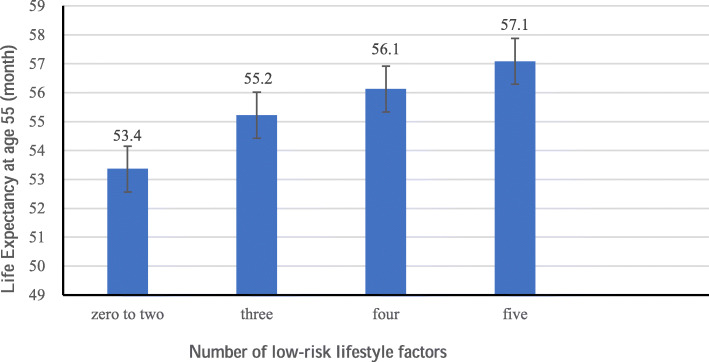
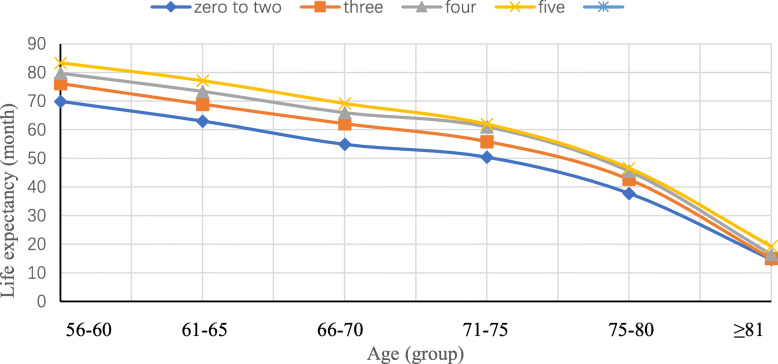
Of 46,120 cancer survivors registered from 2010 to 2017, during an average follow-up of 4.3 years (200,285 person-years), 15,209 deaths were recorded. Adjusted HRs for mortality in cancer survivors with lifestyle score of 0-2, versus 5, were 2.59 (95% confidence interval (CI): 2.03-3.30) in women, 1.91 (95%CI 1.77-2.05) in men, 2.28 (95%CI 2.03-2.55) in those aged <65 years, and 1.90 (95%CI 1.75, 2.05) in those aged ≥ 65 years. Life expectancy at age 55 for those with a score of 0-2 and 5 was 53.4 and 57.1 months, respectively. We also found that cancer survivors with healthy lifestyle scores of 5 showed 59.9 months of life expectancy on average, which was longer than those with a score of 0-2.
Adopting a healthy lifestyle was associated with a substantially lower risk of all-cause mortality and longer life expectancy in cancer survivors. Our findings should be useful for health education and health promotion in primary care and clinical practice.
在西方人群中,坚持健康的生活方式可以降低癌症死亡率。我们在中国进行了一项全市范围的前瞻性研究,调查了健康生活方式评分与所有原因死亡率和癌症幸存者预期寿命的关系。
这项前瞻性队列研究纳入了首次在广州诊断为癌症的 46120 名存活患者。评估了 5 个低风险生活方式因素,包括从不吸烟、从不饮酒、定期体育锻炼(≥2 小时/周)、充足睡眠(≥6 小时/天)和正常或高 BMI(≥18.5kg/m),并生成了生活方式评分(0-5,得分越高表示生活方式越健康)。根据生活方式评分水平估计全因死亡率和预期寿命的风险比(HRs)。
在 2010 年至 2017 年期间登记的 46120 名癌症幸存者中,平均随访 4.3 年(200285 人年),记录了 15209 例死亡。与生活方式评分为 5 的患者相比,评分为 0-2 的患者的死亡率调整 HR 为:女性 2.59(95%置信区间(CI):2.03-3.30)、男性 1.91(95%CI 1.77-2.05)、<65 岁者 2.28(95%CI 2.03-2.55)和≥65 岁者 1.90(95%CI 1.75, 2.05)。对于评分在 0-2 和 5 的患者,55 岁时的预期寿命分别为 53.4 和 57.1 个月。我们还发现,生活方式评分 5 的癌症幸存者的平均预期寿命为 59.9 个月,高于评分 0-2 的患者。
采用健康的生活方式与癌症幸存者全因死亡率显著降低和预期寿命延长有关。我们的研究结果对于初级保健和临床实践中的健康教育和健康促进应该是有用的。