Hefei National Laboratory for Physical Sciences at Microscale, the CAS Key Laboratory of Innate Immunity and Chronic Disease, School of Basic Medical Sciences, Division of Life Sciences and Medicine, University of Science and Technology of China, Hefei, Anhui, 230027, P. R. China.
Institute of Immunology, University of Science and Technology of China, Hefei, Anhui, 230027, P. R. China.
Cancer Commun (Lond). 2021 Jan;41(1):51-61. doi: 10.1002/cac2.12121. Epub 2021 Jan 1.
The interaction between activating receptor NKp30 and its major tumor ligand B7-H6 is important for NK cell-mediated tumor rejection. However, the regulation of B7-H6 by tumor therapeutics remains largely unknown. In this study, we investigated the regulation of B7-H6 by all-trans retinoic acid (atRA), a terminal differentiation inducer of tumor cells that is extensively used for clinical leukemia therapy.
We investigated the role of NKp30:B7-H6 axis in NK cell-mediated tumor lysis against leukemia cells and the influence of atRA treatment on the cytotoxicity of NK cells using NK cell lines (NK92 and NKG) and leukemia cell lines (U-937 and THP-1). We evaluated the effect of atRA treatment on the expression of B7-H6 using real-time PCR, flow cytometry and western blotting. We used CRISPR/Cas9 to knockdown B7-H6 expression and siRNA to knockdown c-Myc in U-937 cells to evaluate the role of B7-H6 and c-Myc in atRA-induced tumor resistance against NK cells.
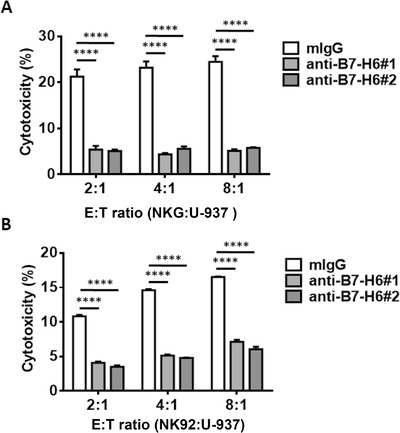
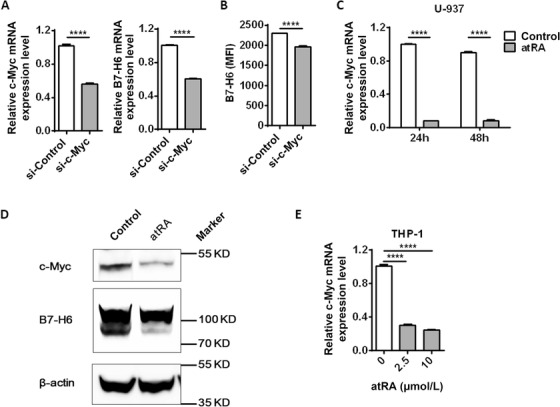
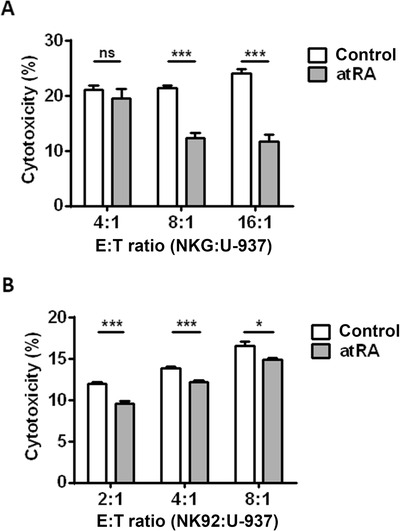
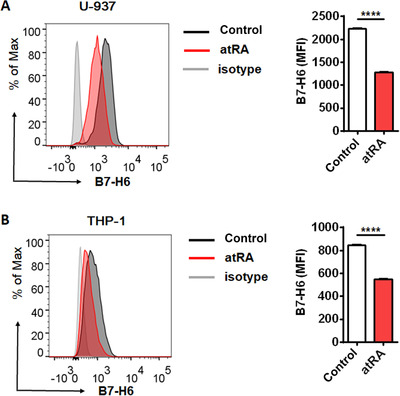
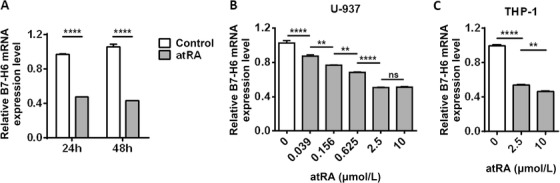
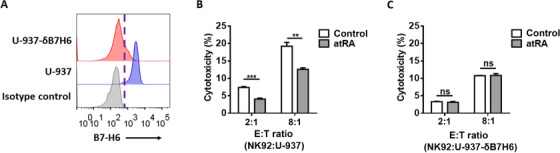
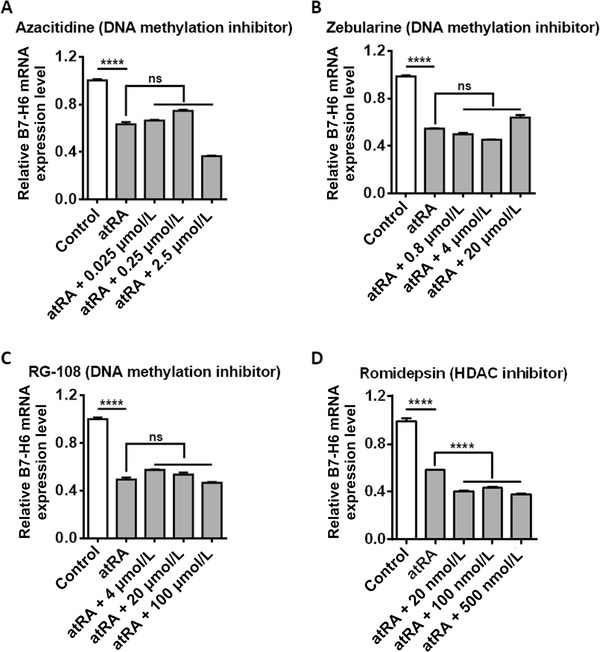
NK cell-mediated U-937 cell lysis was mainly dependent on NKp30/B7-H6 interaction. Blockade of B7-H6 by monoclonal antibody significantly impaired NK cytotoxicity. atRA treatment induced U-937 resistance to NK cell cytotoxicity by reducing B7-H6 expression, and showed no effect on NK cytotoxicity against B7-H6 knockdown U-937 cells. Epigenetic modifications, such as DNA methylation and histone deacetylase (HDAC), were not responsible for atRA-mediated B7-H6 down-regulation as inhibitors of these pathways could not restore B7-H6 mRNA expression. On the other hand, atRA treatment reduced c-Myc expression, which in turn inhibited the transcription of B7-H6 on leukemia cells.
atRA treatment promotes tumor cell resistance against NK cell-mediated lysis by down-regulating B7-H6 expression via the c-Myc signaling pathway, suggesting that more attention needs to be paid to the immunological adverse effects in the clinical use of atRA treatment.
激活受体 NKp30 与其主要肿瘤配体 B7-H6 之间的相互作用对于 NK 细胞介导的肿瘤排斥反应很重要。然而,肿瘤治疗对 B7-H6 的调节在很大程度上仍是未知的。在这项研究中,我们研究了全反式视黄酸(atRA)对 B7-H6 的调节作用,atRA 是一种广泛用于临床白血病治疗的肿瘤细胞终末分化诱导剂。
我们使用 NK 细胞系(NK92 和 NKG)和白血病细胞系(U-937 和 THP-1),研究了 NKp30:B7-H6 轴在 NK 细胞介导的肿瘤溶解作用对抗白血病细胞中的作用,以及 atRA 处理对 NK 细胞细胞毒性的影响。我们使用实时 PCR、流式细胞术和 Western blot 评估了 atRA 处理对 B7-H6 表达的影响。我们使用 CRISPR/Cas9 敲低 U-937 细胞中的 B7-H6 表达,并用 siRNA 敲低 c-Myc,以评估 B7-H6 和 c-Myc 在 atRA 诱导的肿瘤抵抗对 NK 细胞中的作用。
NK 细胞介导的 U-937 细胞溶解主要依赖于 NKp30/B7-H6 相互作用。单克隆抗体阻断 B7-H6 显著削弱了 NK 细胞的细胞毒性。atRA 处理通过降低 B7-H6 表达诱导 U-937 对 NK 细胞细胞毒性的抗性,并且对 B7-H6 敲低的 U-937 细胞的 NK 细胞细胞毒性没有影响。表观遗传修饰,如 DNA 甲基化和组蛋白去乙酰化(HDAC),不是 atRA 介导的 B7-H6 下调的原因,因为这些途径的抑制剂不能恢复 B7-H6 mRNA 表达。另一方面,atRA 处理降低了 c-Myc 的表达,进而抑制了白血病细胞中 B7-H6 的转录。
atRA 处理通过 c-Myc 信号通路下调 B7-H6 表达,促进肿瘤细胞对 NK 细胞介导的溶解的抵抗,这表明在临床使用 atRA 治疗时需要更加注意其免疫不良作用。