GlaxoSmithKline, Collegeville, PA, USA.
GlaxoSmithKline, Dubai, UAE.
Lupus. 2021 Oct;30(11):1705-1721. doi: 10.1177/09612033211028653. Epub 2021 Jul 8.
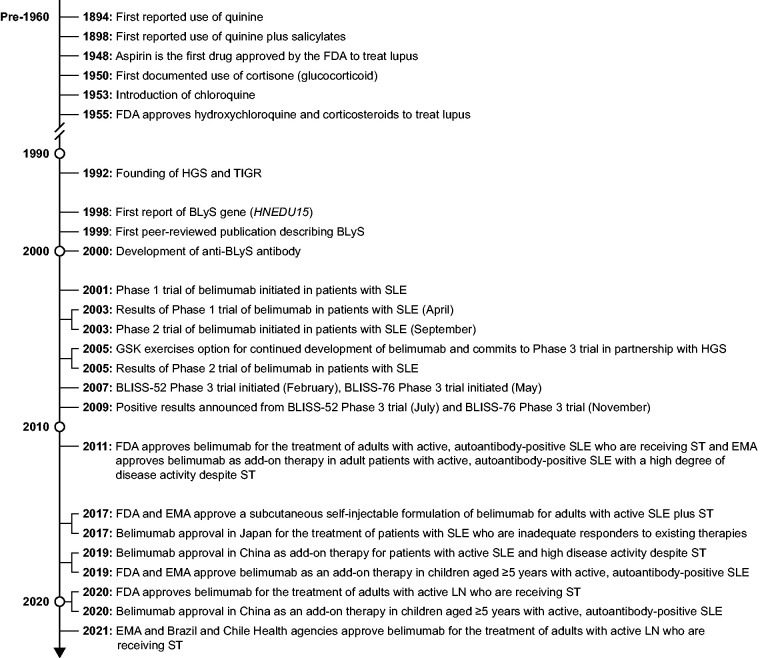
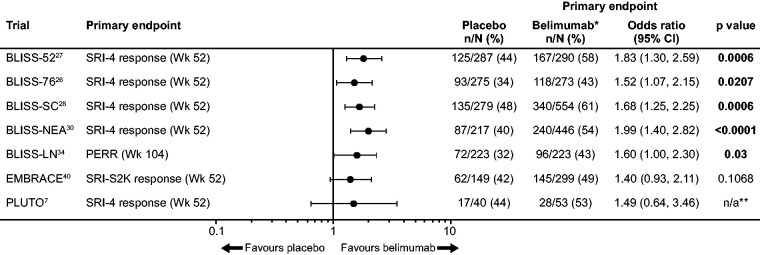
Systemic lupus erythematosus (SLE) is a chronic autoimmune inflammatory disease affecting both adults and children. Belimumab is the only biologic approved for SLE, and the first in a class of drugs known as B-lymphocyte stimulator-specific inhibitors. The introduction of intravenous belimumab in 2011 was a major advance, being the first new therapy approved for SLE in over 50 years. As of April 2021, more than 7200 people with SLE have received belimumab in clinical studies, and it is approved in over 75 countries for the treatment of adults with SLE. A subcutaneous, self-injectable belimumab formulation was licensed in 2017 by both the US Food and Drug Administration (FDA) and European Medicines Agency (EMA). Belimumab was then approved for use in children in Europe, the USA and Japan in 2019, and China and Brazil in 2020. Recently, belimumab became the first FDA-approved drug for the treatment of adults with active lupus nephritis (LN), the most-common severe manifestation of SLE.Over the past 10 years, belimumab has established its position as a disease modifier in the SLE treatment paradigms. Robust evidence from randomised clinical studies and observational, real-world studies has demonstrated the tolerability and efficacy of belimumab for reducing disease activity and the risk of new, severe SLE flares. This enables patients to taper their glucocorticoid use, which limits damage accumulation. Significantly more patients with active LN met the criteria for renal responses and were at less risk of a renal-related event or death after receiving belimumab plus standard therapy, compared with standard therapy on top of mandatory steroid reduction. Ongoing clinical studies are evaluating belimumab's effectiveness in various indications beyond SLE. Post-marketing and registry studies are gathering additional data on key areas such as pregnancy outcomes after belimumab exposure and belimumab co-administration with other biologics.
系统性红斑狼疮(SLE)是一种影响成人和儿童的慢性自身免疫性炎症性疾病。贝利尤单抗是唯一获批用于 SLE 的生物制剂,也是首个获批用于治疗 B 淋巴细胞刺激因子的药物。2011 年静脉注射贝利尤单抗的问世是一个重大进展,是 50 多年来首个获批用于治疗 SLE 的新疗法。截至 2021 年 4 月,已有超过 7200 名 SLE 患者在临床研究中接受了贝利尤单抗治疗,该药已在 75 个以上国家获批用于成人 SLE 的治疗。2017 年,美国食品药品监督管理局(FDA)和欧洲药品管理局(EMA)均批准了贝利尤单抗皮下注射制剂。随后,贝利尤单抗于 2019 年在欧洲、美国和日本获批用于儿童,2020 年在中国和巴西获批用于儿童。最近,贝利尤单抗成为首个获 FDA 批准用于治疗成人活动性狼疮肾炎(LN)的药物,LN 是 SLE 最常见的严重表现。在过去的 10 年中,贝利尤单抗已确立其在 SLE 治疗方案中的疾病修饰地位。来自随机对照临床试验和观察性真实世界研究的有力证据表明,贝利尤单抗具有降低疾病活动度和新发、严重 SLE 发作风险的疗效和耐受性。这使患者能够减少糖皮质激素的使用,从而限制了累积损伤。与标准治疗联合强制性激素减量相比,接受贝利尤单抗联合标准治疗的活动性 LN 患者有更多的患者达到了肾脏缓解标准,发生肾脏相关事件或死亡的风险更低。正在进行的临床研究正在评估贝利尤单抗在 SLE 以外的各种适应证中的有效性。上市后和登记研究正在收集更多关于贝利尤单抗暴露后妊娠结局和与其他生物制剂联合使用等关键领域的数据。