Emergency Department, Jiangsu Province Hospital and Nanjing Medical University First Affiliated Hospital, Nanjing, 210029, China.
Scand J Trauma Resusc Emerg Med. 2021 Jul 8;29(1):90. doi: 10.1186/s13049-021-00902-5.
Temporary circulatory support is a bridge between acute circulatory failure and definitive treatment or recovery. Currently, venoarterial extracorporeal membrane oxygenation (VA-ECMO) is considered to be one of the effective circulatory support methods, although cardiac function monitoring during the treatment still needs further investigation. Inflection point of arterial oxygen partial pressure (IPPaO2) may occur at an early stage in part of patients with a good prognosis after VA-ECMO treatment, and the relationship between time of IPPaO2 (tIPPaO2) and recovery of cardiac function or prognosis remains unclear.
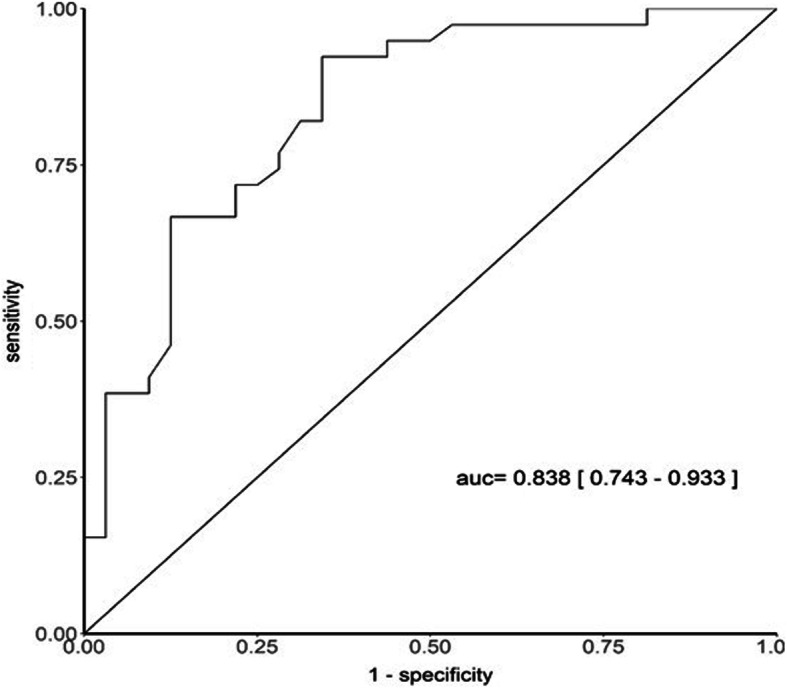
To investigate this relationship, we retrospectively analyzed the clinical data of 71 patients with different conditions after treatment with VA-ECMO in the emergency center of Jiangsu Province Hospital between May 2015 and July 2020. Spearman's correlation analysis was used for the correlation between tIPPaO and quantitative data, and ROC curve for the predictive effect of tIPPaO on the 28-day mortality.
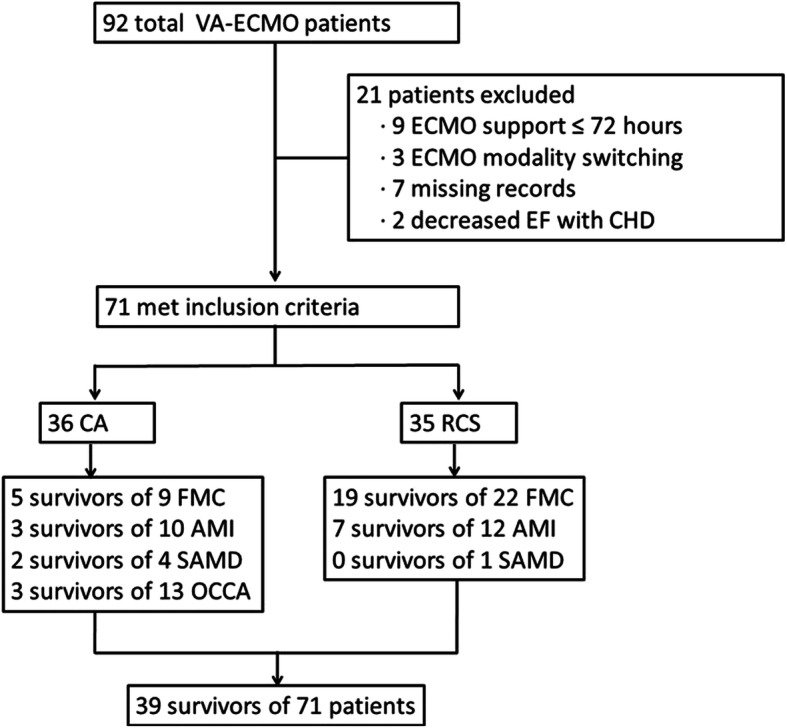
Thirty-five patients were admitted because of refractory cardiogenic shock (26 of 35 survived) and the remaining 36 patients due to cardiac arrest (13 of 36 survived). The overall survival rate was 54.9% (39 of 71 survived). Acute physiology and chronic health evaluation II, ECMO time, tIPPaO2, continuous renal replacement therapy time, mechanical ventilation time, and bleeding complications in the survival group were lower than those in the non-survival group, with length of stay, intensive care unit stay, and platelet levels were being higher. The tIPPaO was negatively correlated with ejection fraction, and the shorter tIPPaO2 resulted in a higher 28-day survival probability, higher predictive value for acute myocardial infarction and fulminant myocarditis.
Therefore, tIPPaO2 could be a reliable qualitative indicator of cardiac function in patients treated with VA-ECMO, which can reveal appropriate timing for adjusting VA-ECMO flow or weaning.
ChiCTR1900026105 .
临时循环支持是急性循环衰竭与明确治疗或恢复之间的桥梁。目前,静脉-动脉体外膜肺氧合(VA-ECMO)被认为是有效的循环支持方法之一,尽管在治疗过程中心脏功能监测仍需要进一步研究。部分预后良好的 VA-ECMO 治疗后患者可能会较早出现动脉氧分压拐点(IPPaO2),tIPPaO2 与心功能恢复或预后的关系尚不清楚。
为了研究这种关系,我们回顾性分析了 2015 年 5 月至 2020 年 7 月江苏省医院急诊科不同条件下接受 VA-ECMO 治疗的 71 例患者的临床资料。Spearman 相关分析用于 tIPPaO 与定量数据的相关性,ROC 曲线用于 tIPPaO 对 28 天死亡率的预测效果。
35 例因难治性心源性休克(35 例中有 26 例存活),其余 36 例因心脏骤停(36 例中有 13 例存活)入院。总生存率为 54.9%(71 例中有 39 例存活)。存活组急性生理学和慢性健康评估 II、ECMO 时间、tIPPaO2、持续肾脏替代治疗时间、机械通气时间和出血并发症低于非存活组,而住院时间、重症监护病房停留时间和血小板水平较高。tIPPaO 与射血分数呈负相关,tIPPaO2 越短,28 天生存率越高,对急性心肌梗死和暴发性心肌炎的预测价值越高。
因此,tIPPaO2 可能是 VA-ECMO 治疗患者心功能的可靠定性指标,可以揭示调整 VA-ECMO 流量或脱机的合适时机。
ChiCTR1900026105。