Division of Drug Discovery and Safety, Leiden Academic Centre for Drug Research, Einsteinweg 55, 2333 CC, Leiden, The Netherlands.
Department of Cell and Molecular Biology and Science for Life Laboratory, Uppsala University, Box 596, 751 24, Biomedical CenterUppsala, Sweden.
Sci Rep. 2021 Jul 8;11(1):14171. doi: 10.1038/s41598-021-93419-x.
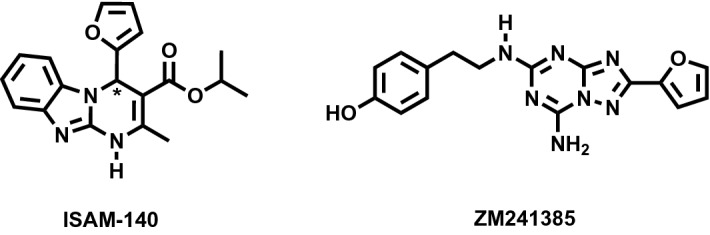
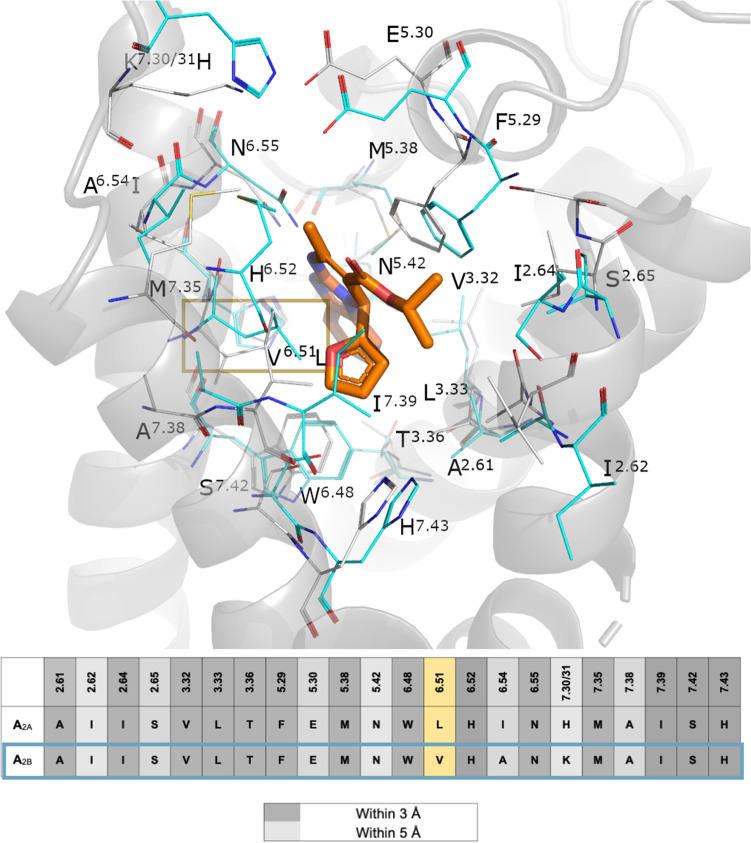
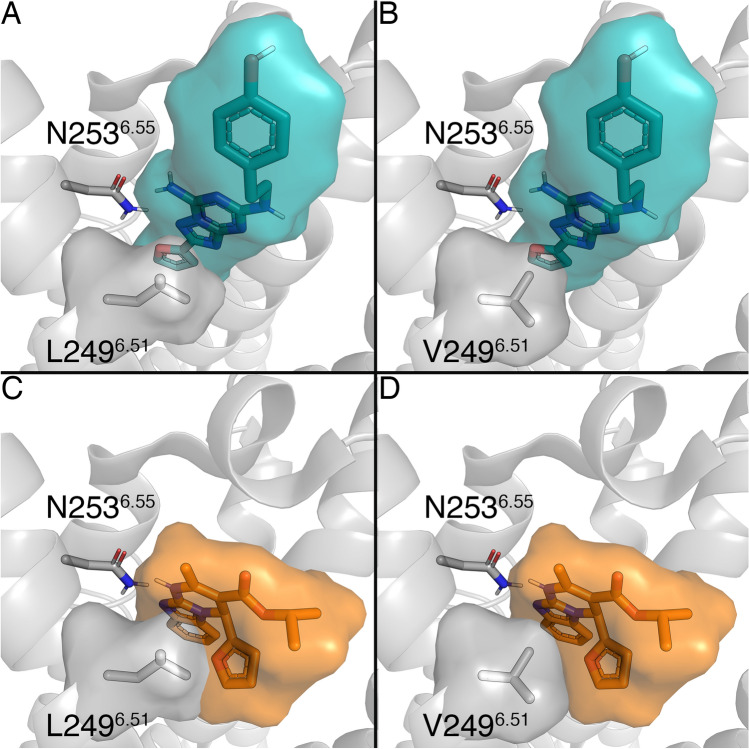
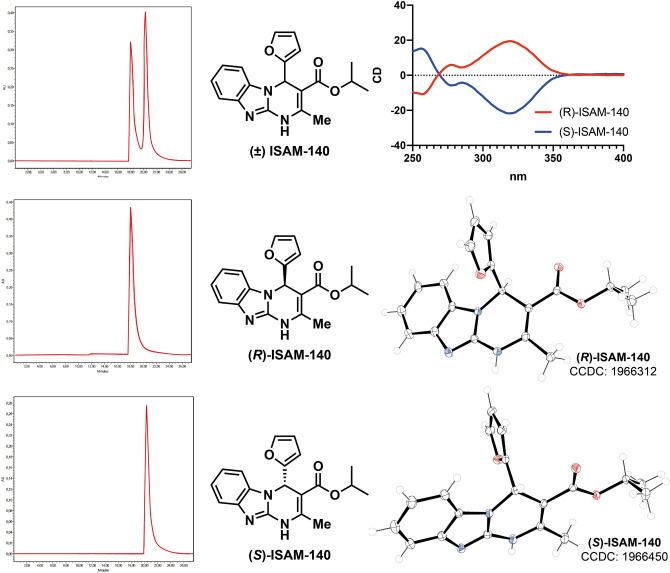
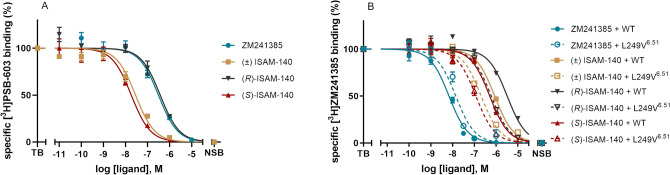
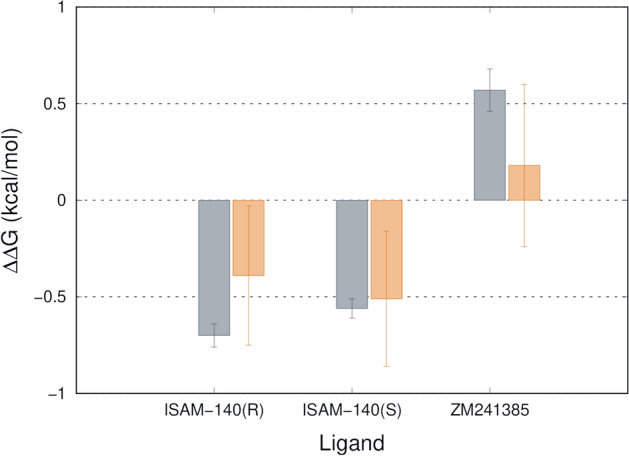
The four adenosine receptors (ARs) AAR, AAR, AAR and AAR are G protein-coupled receptors (GPCRs) for which an exceptional amount of experimental and structural data is available. Still, limited success has been achieved in getting new chemical modulators on the market. As such, there is a clear interest in the design of novel selective chemical entities for this family of receptors. In this work, we investigate the selective recognition of ISAM-140, a recently reported AAR reference antagonist. A combination of semipreparative chiral HPLC, circular dichroism and X-ray crystallography was used to separate and unequivocally assign the configuration of each enantiomer. Subsequently affinity evaluation for both A and A receptors demonstrate the stereospecific and selective recognition of (S)-ISAM140 to the AAR. The molecular modeling suggested that the structural determinants of this selectivity profile would be residue V250 in AAR, which is a leucine in all other ARs including the closely related AAR. This was herein confirmed by radioligand binding assays and rigorous free energy perturbation (FEP) calculations performed on the L249V mutant AAR receptor. Taken together, this study provides further insights in the binding mode of these AAR antagonists, paving the way for future ligand optimization.
四种腺苷受体(ARs)A1AR、A2AR、A2BAR 和 A3AR 是 G 蛋白偶联受体(GPCRs),已经有大量的实验和结构数据。然而,在将新的化学调节剂推向市场方面,取得的成功有限。因此,人们对设计这种受体家族的新型选择性化学实体有着明确的兴趣。在这项工作中,我们研究了最近报道的 A1AR 参考拮抗剂 ISAM-140 的选择性识别。使用半制备手性 HPLC、圆二色性和 X 射线晶体学的组合,对每个对映体进行分离和明确分配。随后对 A 和 A 受体的亲和力评估表明,(S)-ISAM140 对 A1AR 具有立体特异性和选择性识别。分子建模表明,这种选择性特征的结构决定因素将是 A1AR 中的残基 V250,而在包括密切相关的 A2AR 在内的所有其他 AR 中,该残基都是亮氨酸。这通过放射性配体结合测定和对 L249V 突变 A1AR 受体进行严格的自由能扰动(FEP)计算得到了证实。总之,这项研究为这些 A1AR 拮抗剂的结合模式提供了进一步的见解,为未来的配体优化铺平了道路。