Department of Cardiology, Nagoya University Hospital, Nagoya, Japan.
Department of Cardiology, Nagoya University Graduate School of Medicine, Nagoya, Japan.
Nagoya J Med Sci. 2021 May;83(2):321-330. doi: 10.18999/nagjms.83.2.321.
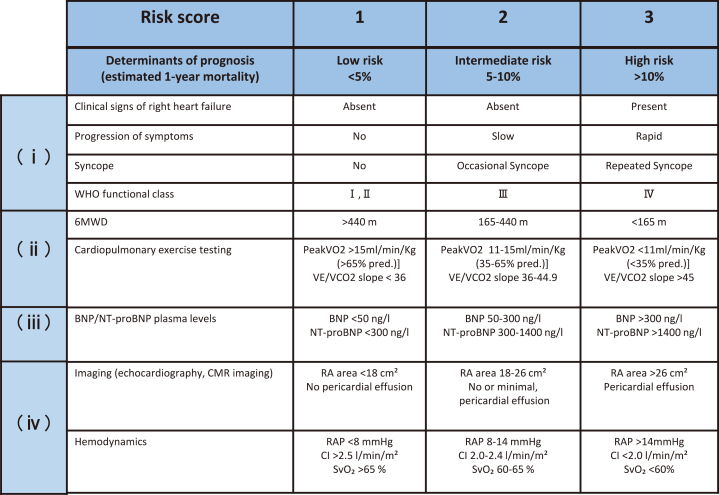
Risk stratification by ESC/ERS guideline is recommended to estimate the vital prognosis and select the treatment strategy in patients with idiopathic or heritable pulmonary arterial hypertension (IPAH/HPAH). However, we are not confident whether we can achieve low-risk status in the risk table at the follow-up shortly after combination therapy. Therefore, we aimed to verify the effects of combination therapy in IPAH/HPAH on each category of the risk table at diagnosis and at the first follow-up. We retrospectively analyzed 10 consecutive patients with IPAH/HPAH with no previous treatment history diagnosed at Nagoya University Hospital between October 2014 and January 2019. Four categories including symptoms, exercise tolerance, BNP levels and hemodynamics were validated both at baseline and at the first follow-up of right heart catheterization. Score of 1, 2 and 3 were assigned to the low risk, intermediate risk and high risk, respectively. In each category the highest score was adopted. The scores at diagnosis were compared with those at the first follow-up. The result shows that all patients were female, median age was 32 years old, and were treated with initial combination therapy. The median total risk score also was improved from 2.6 to 1.4 (p<0.01). However, the score in exercise tolerance was not improved (3 to 2.5 p=0.16). In conclusion, at the first follow up shortly after the initial combination therapy of IPAH/HPAH, the mean total risk score was significantly improved, however, even patients in the low-risk status may not achieve improvement in exercise tolerance.
风险分层推荐采用 ESC/ERS 指南,以估计特发性或遗传性肺动脉高压(IPAH/HPAH)患者的重要预后并选择治疗策略。然而,我们不确定在联合治疗后不久的随访中是否能够达到风险表中的低危状态。因此,我们旨在验证 IPAH/HPAH 患者在诊断和首次随访时对风险表中每个类别的联合治疗效果。我们回顾性分析了 2014 年 10 月至 2019 年 1 月期间在名古屋大学医院诊断的 10 例无既往治疗史的 IPAH/HPAH 连续患者。在基线和首次右心导管检查的第一次随访中验证了包括症状、运动耐量、BNP 水平和血液动力学在内的四个类别的情况。低危、中危和高危分别赋值 1、2 和 3 分。每个类别采用最高评分。比较诊断时和第一次随访时的评分。结果显示,所有患者均为女性,中位年龄为 32 岁,接受初始联合治疗。中位总风险评分也从 2.6 改善至 1.4(p<0.01)。然而,运动耐量评分没有改善(3 分改善至 2.5 分,p=0.16)。总之,在 IPAH/HPAH 初始联合治疗后的首次随访中,总风险评分的平均值显著改善,但即使处于低危状态的患者,运动耐量也可能无法改善。