Senevirathne Ilangasingha Gamlathge Nethmini Hansika, Abeysekera Walimuni Kanchana Subhashini Mendis, Abeysekera Walimuni Prabhashini Kaushalya Mendis, Jayanath Nileththi Yasendra, Galbada Arachchige Sirimal Premakumara, Wijewardana Danthasingha Chithra Mulacharige Susantha Indika
Department of Food Science and Technology, Faculty of Agriculture, University of Peradeniya, Peradeniya, Kandy, Sri Lanka.
Department of Agricultural Technology, Faculty of Technology, University of Colombo, Colombo, Sri Lanka.
Evid Based Complement Alternat Med. 2021 Jun 17;2021:5834915. doi: 10.1155/2021/5834915. eCollection 2021.
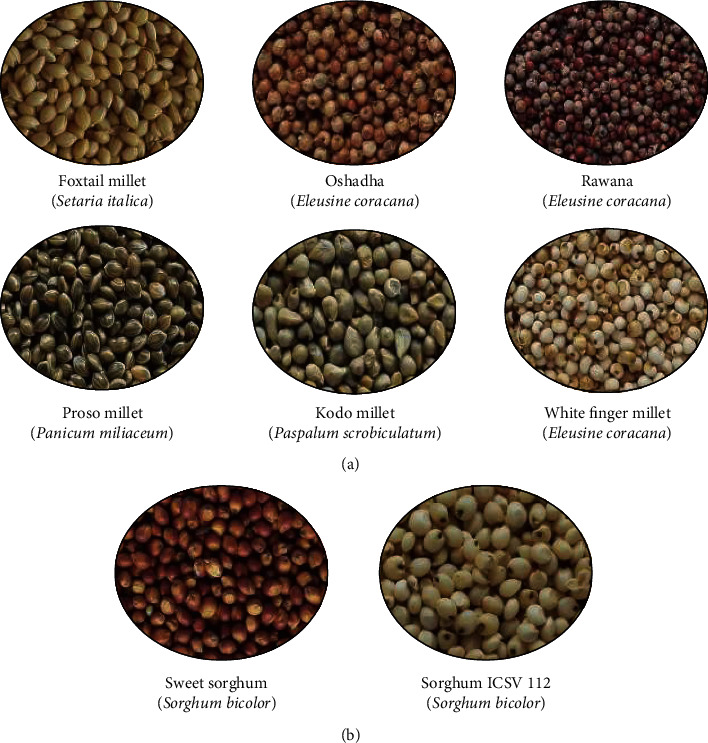
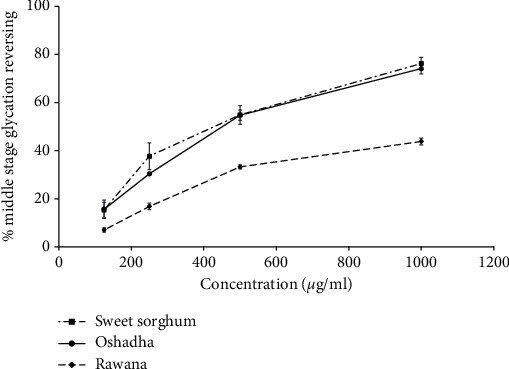
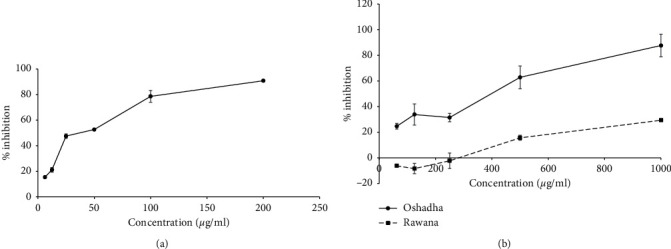
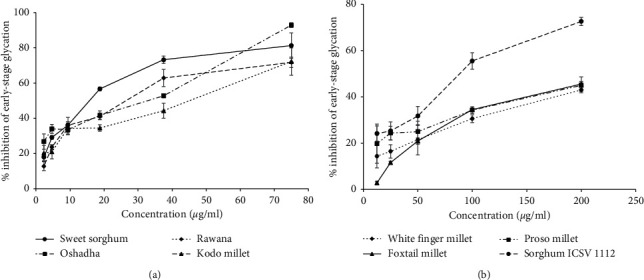
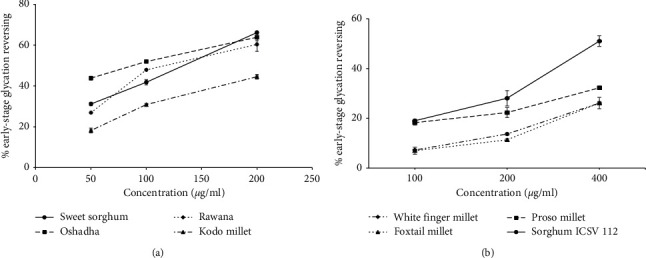
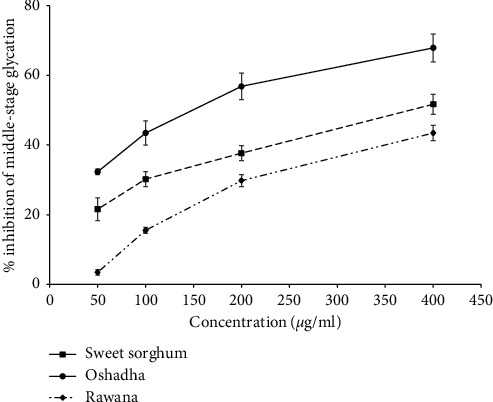
The present study evaluated a range of biological activities of selected millet types and sorghum varieties in Sri Lanka in relation to diabetes and its complications management. Five millet types, namely, proso millet, white finger millet, kodo millet, foxtail millet, and finger millet (Oshadha and Rawana), and two sorghum varieties, namely, sweet sorghum and sorghum ICSV 112, were used in this study. Methanolic extracts of whole grains were studied for antiamylase, antiglucosidase, and early- and middle-stage antiglycation and glycation reversing activities . Tested millets and sorghum showed significant ( < 0.05) and dose-dependent antiamylase (IC: 33.34 ± 1.11-1446.70 ± 54.10 g/ml), early-stage antiglycation (IC: 15.42 ± 0.50-270.03 ± 16.29 g/ml), middle-stage antiglycation (135.08 ± 12.95-614.54 ± 6.99 g/ml), early-stage glycation reversing (EC: 91.82 ± 6.56-783.20 ± 61.70 g/ml), and middle-stage glycation reversing (393.24 ± 8.68-1374.60 ± 129.30 g/ml) activities. However, none of the studied millet and sorghum showed antiglucosidase activity. Out of the samples studied, pigmented samples, namely, sweet sorghum, Oshadha, and Rawana, exhibited significantly high ( < 0.05) antiamylase and early- and middle-stage antiglycation and glycation reversing activities compared to other millet and sorghum samples. Interestingly, sweet sorghum exhibited nearly four times potent antiamylase activity compared to the standard drug acarbose (IC 111.98 ± 2.68 g/ml) and sweet sorghum, kodo millet, Oshadha, and Rawana showed comparable early-stage antiglycation activities in comparison to the reference standard Rutin (IC 21.88 ± 0.16 g/ml). Therefore, consumption of whole grains of pigmented millet and sorghum in Sri Lanka may play an important role in the prevention and management of diabetes and its complications. Interestingly, this is the 1 study to report all the tested biological activities for millet and sorghum in Sri Lanka and the 1 study to report both early- and middle-stage glycation reversing activities of millet and sorghum worldwide.
本研究评估了斯里兰卡选定的几种粟类和高粱品种在糖尿病及其并发症管理方面的一系列生物活性。本研究使用了五种粟类,即黍、白黍、鸭脚粟、粟和黍(奥沙达和拉瓦纳),以及两种高粱品种,即甜高粱和高粱ICSV 112。对全谷物的甲醇提取物进行了抗淀粉酶、抗葡萄糖苷酶以及早期和中期抗糖化及糖化逆转活性研究。测试的粟类和高粱显示出显著(<0.05)且剂量依赖性的抗淀粉酶活性(IC:33.34±1.11 - 1446.70±54.10μg/ml)、早期抗糖化活性(IC:15.42±0.50 - 270.03±16.29μg/ml)、中期抗糖化活性(135.08±12.95 - 614.54±6.99μg/ml)、早期糖化逆转活性(EC:91.82±6.56 - 783.20±61.70μg/ml)和中期糖化逆转活性(393.24±8.68 - 1374.60±129.30μg/ml)。然而,所研究的粟类和高粱均未显示出抗葡萄糖苷酶活性。在所研究的样本中,有色样本,即甜高粱、奥沙达和拉瓦纳,与其他粟类和高粱样本相比,表现出显著更高(<0.05)的抗淀粉酶、早期和中期抗糖化及糖化逆转活性。有趣的是,与标准药物阿卡波糖(IC 111.98±2.68μg/ml)相比,甜高粱的抗淀粉酶活性几乎强四倍,并且与参考标准芦丁(IC 21.88±0.16μg/ml)相比,甜高粱、鸭脚粟、奥沙达和拉瓦纳表现出相当的早期抗糖化活性。因此,在斯里兰卡食用有色粟类和高粱的全谷物可能在糖尿病及其并发症的预防和管理中发挥重要作用。有趣的是,这是第一项报道斯里兰卡粟类和高粱所有测试生物活性的研究,也是第一项在全球范围内报道粟类和高粱早期和中期糖化逆转活性的研究。