Tarao Kazuo, Nozaki Akito, Komatsu Hirokazu, Komatsu Tatsuji, Taguri Masataka, Tanaka Katsuaki, Yoshida Testuo, Koyasu Hideki, Chuma Makoto, Numata Kazushi, Maeda Shin
Tarao's Gastroenterological Clinic, Yokohama 241-0821, Japan.
Gastroenterological Center, Yokohama City University Medical Center, Yokohama 232-0024, Japan.
World J Hepatol. 2021 Jun 27;13(6):699-708. doi: 10.4254/wjh.v13.i6.699.
In hepatocellular carcinoma (HCC), detection and treatment prior to growth beyond 2 cm are important as a larger tumor size is more frequently associated with microvascular invasion and/or satellites. In the surveillance of very small HCC nodules (≤ 2 cm in maximum diameter, Barcelona clinical stage 0), we demonstrated that the tumor markers alpha-fetoprotein and PIVKA-Ⅱ are not so useful. Therefore, we must survey with imaging modalities. The superiority of magnetic resonance imaging (MRI) over ultrasound (US) to detect HCC was confirmed in many studies. Although enhanced MRI is now performed to accurately diagnose HCC, in conventional clinical practice for HCC surveillance in liver diseases, unenhanced MRI is widely performed throughout the world. While, MRI has made marked improvements in recent years.
To make a comparison of unenhanced MRI and US in detecting very small HCC that was examined in the last ten years in patients in whom MRI and US examinations were performed nearly simultaneously.
In 394 patients with very small HCC nodules, those who underwent MRI and US at nearly the same time (on the same day whenever possible or at least within 14 days of one another) at the first diagnosis of HCC were selected. The detection rate of HCC with unenhanced MRI was investigated and compared with that of unenhanced US.
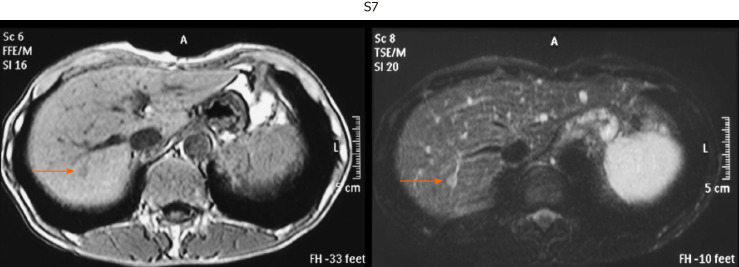
The sensitivity of unenhanced MRI for detecting very small HCC was 95.1% (97/102, 95% confidence interval: 90.9-99.3) and that of unenhanced US was 69.6% (71/102, 95% confidence interval: 60.7-78.5). The sensitivity of unenhanced MRI for detecting very small HCC was significantly higher than that of unenhanced US ( < 0.001). Regarding the location of HCC in the liver in patients in whom detection by US was unsuccessful, S was identified in 51.7%.
Currently, unenhanced MRI is a very useful tool for the surveillance of very small HCC in conventional clinical follow-up practice.
在肝细胞癌(HCC)中,在肿瘤生长超过2 cm之前进行检测和治疗很重要,因为更大的肿瘤尺寸更常与微血管侵犯和/或卫星灶相关。在监测非常小的HCC结节(最大直径≤2 cm,巴塞罗那临床分期0期)时,我们发现肿瘤标志物甲胎蛋白和异常凝血酶原不太有用。因此,我们必须采用影像学检查方法。许多研究证实了磁共振成像(MRI)在检测HCC方面优于超声(US)。尽管现在进行增强MRI以准确诊断HCC,但在肝病中HCC监测的传统临床实践中,全世界广泛进行的是平扫MRI。同时,近年来MRI有了显著改进。
比较平扫MRI和超声在检测过去十年中几乎同时进行MRI和超声检查的患者中非常小的HCC方面的差异。
在394例有非常小的HCC结节的患者中,选择首次诊断HCC时几乎同时(尽可能在同一天或至少在彼此14天内)接受MRI和超声检查的患者。研究平扫MRI检测HCC的检出率,并与平扫超声的检出率进行比较。
平扫MRI检测非常小的HCC的敏感性为95.1%(97/102,95%置信区间:90.9 - 99.3),平扫超声的敏感性为69.6%(71/102,95%置信区间:60.7 - 78.5)。平扫MRI检测非常小的HCC的敏感性显著高于平扫超声(<0.001)。对于超声检测未成功的患者,HCC在肝脏中的位置,S在51.7%中被识别。
目前,在传统临床随访实践中,平扫MRI是监测非常小的HCC的非常有用的工具。