Department of Population Health Sciences, School of Population Health and Environmental Sciences, King's College London, London, UK.
National Institute for Health Research Policy Research Unit in Health and Social Care Workforce, King's College London, London, UK.
Age Ageing. 2021 Nov 10;50(6):2079-2087. doi: 10.1093/ageing/afab140.
Stroke survivors living in care homes require high levels of support with everyday living. The aims of this study were to describe the survival, health status and care received by stroke survivors living in care homes at 1-year post-stroke, compared with those in their own homes.
A total of 3,548 stroke survivors with a first ever stroke between 1998 and 2017 in the South London Stroke Register were identified for survival analysis. A total of 2,272 were included in the 1-year follow-up analysis. Cox regression and Kaplan-Meier plots were used to describe survival, stratified into four 5-year cohorts. Health status, medications and rehabilitation received at 1-year post-stroke were compared using descriptive statistics.
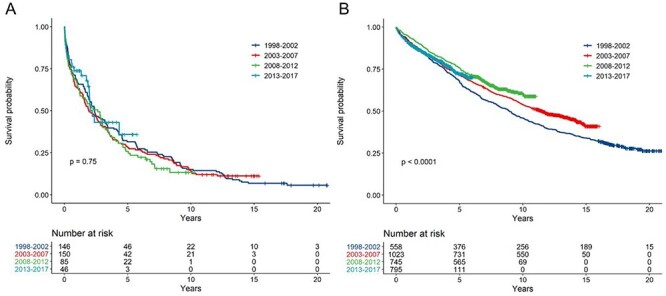
Over the 20-year period, survival improved for stroke survivors discharged to their own home (P < 0.001) but not for those discharged to care homes (P = 0.75). Care home residents were highly disabled (median Barthel index: 6/20, interquartile range: 2-10). Rates of secondary stroke prevention medications at 1-year follow-up increased over time for care home residents, including antiplatelets from 12.3 to 38.1%, although still lower than for those in their own homes (56.3%). Speech and language problems were common in the care home population (40.0%), but only 16% had received speech and language therapy.
Rates of secondary stroke prevention prescribing increased over 20 years but remained lower in care home residents. The lower levels of rehabilitation received by stroke survivors in care homes, despite their higher levels of disability, suggest a gap in care and urgent need for restorative and/or preventative rehabilitation.
居住在养老院的中风幸存者在日常生活中需要高水平的支持。本研究的目的是描述中风幸存者在中风后 1 年的生存、健康状况和接受的护理情况,将其与居住在自己家中的患者进行比较。
在南伦敦中风登记处(South London Stroke Register)中,共确定了 3548 名在 1998 年至 2017 年期间首次发生中风的中风幸存者,进行生存分析。共有 2272 名患者纳入 1 年随访分析。使用 Cox 回归和 Kaplan-Meier 图描述生存情况,并按四个 5 年队列分层。使用描述性统计比较中风后 1 年的健康状况、药物治疗和康复情况。
在 20 年期间,出院回家的中风幸存者的生存率有所提高(P<0.001),但出院到养老院的患者生存率没有提高(P=0.75)。养老院居民的残疾程度较高(中位数巴氏指数:6/20,四分位间距:2-10)。随着时间的推移,养老院居民的二级预防药物治疗率有所提高,包括抗血小板药物从 12.3%增加到 38.1%,尽管仍低于在家中的患者(56.3%)。语言问题在养老院患者中很常见(40.0%),但只有 16%接受了语言治疗。
二级预防药物治疗的比例在 20 年内有所增加,但养老院居民的比例仍然较低。尽管居住在养老院的中风幸存者的残疾程度更高,但他们接受的康复治疗水平较低,这表明在护理方面存在差距,迫切需要进行恢复性和/或预防性康复治疗。