
粗木质残体分解评估工具:模型验证与应用。
Coarse Woody Debris Decomposition Assessment Tool: Model validation and application.
机构信息
Center for Forested Wetlands Research, USDA Forest Service, Cordesville, SC, United States of America.
College of Forest Resources and Environmental Science, Michigan Technological University, Houghton, MI, United States of America.
出版信息
PLoS One. 2021 Jul 9;16(7):e0254408. doi: 10.1371/journal.pone.0254408. eCollection 2021.
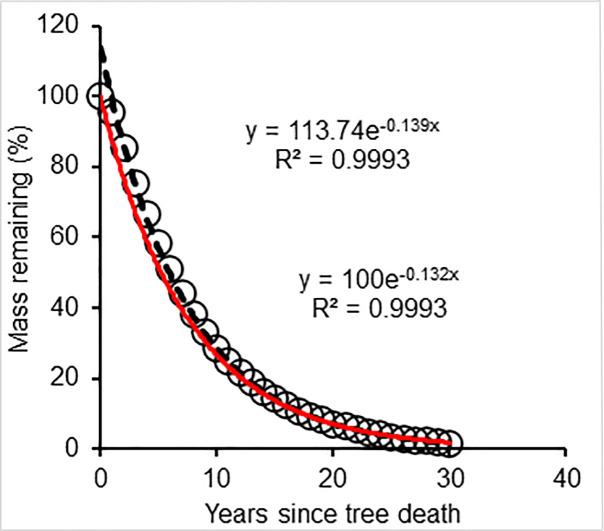
Coarse woody debris (CWD) is a significant component of the forest biomass pool; hence a model is warranted to predict CWD decomposition and its role in forest carbon (C) and nutrient cycling under varying management and climatic conditions. A process-based model, CWDDAT (Coarse Woody Debris Decomposition Assessment Tool) was calibrated and validated using data from the FACE (Free Air Carbon Dioxide Enrichment) Wood Decomposition Experiment utilizing pine (Pinus taeda), aspen (Populous tremuloides) and birch (Betula papyrifera) on nine Experimental Forests (EF) covering a range of climate, hydrology, and soil conditions across the continental USA. The model predictions were evaluated against measured FACE log mass loss over 6 years. Four widely applied metrics of model performance demonstrated that the CWDDAT model can accurately predict CWD decomposition. The R2 (squared Pearson's correlation coefficient) between the simulation and measurement was 0.80 for the model calibration and 0.82 for the model validation (P<0.01). The predicted mean mass loss from all logs was 5.4% lower than the measured mass loss and 1.4% lower than the calculated loss. The model was also used to assess the decomposition of mixed pine-hardwood CWD produced by Hurricane Hugo in 1989 on the Santee Experimental Forest in South Carolina, USA. The simulation reflected rapid CWD decomposition of the forest in this subtropical setting. The predicted dissolved organic carbon (DOC) derived from the CWD decomposition and incorporated into the mineral soil averaged 1.01 g C m-2 y-1 over the 30 years. The main agents for CWD mass loss were fungi (72.0%) and termites (24.5%), the remainder was attributed to a mix of other wood decomposers. These findings demonstrate the applicability of CWDDAT for large-scale assessments of CWD dynamics, and fine-scale considerations regarding the fate of CWD carbon.
粗木质残体(CWD)是森林生物量库的重要组成部分;因此,需要建立一个模型来预测 CWD 分解及其在不同管理和气候条件下在森林碳(C)和养分循环中的作用。一个基于过程的模型,CWDDAT(粗木质残体分解评估工具),利用在美国大陆九个实验林(EF)上利用松树(Pinus taeda)、白杨(Populous tremuloides)和桦树(Betula papyrifera)进行的 FACE(自由空气二氧化碳富集)木质残体分解实验的数据进行了校准和验证,这些实验林涵盖了一系列气候、水文学和土壤条件。使用四年的 FACE 日志质量损失数据对模型预测进行了评估。四个广泛应用的模型性能指标表明,CWDDAT 模型可以准确地预测 CWD 分解。模型校准和验证的模拟与测量之间的 R2(皮尔逊平方相关系数)分别为 0.80 和 0.82(P<0.01)。所有原木的预测平均质量损失比实测质量损失低 5.4%,比计算损失低 1.4%。该模型还用于评估 1989 年飓风雨果在南卡罗来纳州的 Santee 实验林产生的混合松树-硬木 CWD 的分解情况。该模拟反映了亚热带地区森林的快速 CWD 分解。从 CWD 分解中衍生并纳入矿物土壤的预测溶解性有机碳(DOC)平均每年为 1.01 g C m-2 y-1,持续 30 年。导致 CWD 质量损失的主要因素是真菌(72.0%)和白蚁(24.5%),其余部分归因于其他一些木质分解者的混合。这些发现证明了 CWDDAT 用于大规模评估 CWD 动态以及考虑 CWD 碳命运的细粒度的适用性。


 Zotero 插件