Pediatric Endocrinology, Children's Hospital of Eastern Switzerland, St. Gallen, Switzerland.
Adolescent Medicine, Children's Hospital of Eastern Switzerland, St. Gallen, Switzerland.
BMC Pediatr. 2021 Jul 9;21(1):308. doi: 10.1186/s12887-021-02781-2.
Less than 2% of overweight children and adolescents in Switzerland can participate in multi-component behaviour changing interventions (BCI), due to costs and lack of time. Stress often hinders positive health outcomes in youth with obesity. Digital health interventions, with fewer on-site visits, promise health care access in remote regions; however, evidence for their effectiveness is scarce.
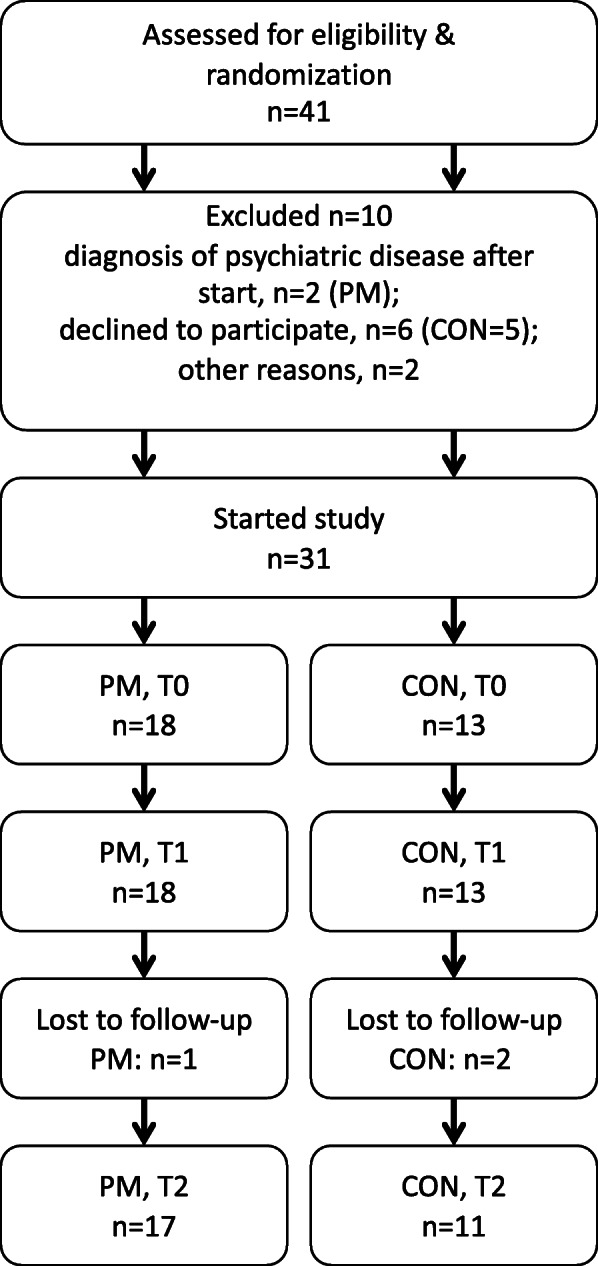
This randomized controlled not blinded trial (1:1) was conducted in a childhood obesity center in Switzerland. Forty-one youth aged 10-18 years with body mass index (BMI) > P.90 with risk factors or co-morbidities or BMI > P.97 were recruited. During 5.5 months, the PathMate2 group (PM) received daily conversational agent counselling via mobile app, combined with standardized counselling (4 on-site visits). Controls (CON) participated in a BCI (7 on-site visits). We compared the outcomes of both groups after 5.5 (T1) and 12 (T2) months. Primary outcome was reduction in BMI-SDS (BMI standard deviation score: BMI adjusted for age and sex). Secondary outcomes were changes in body fat and muscle mass (bioelectrical impedance analysis), waist-to-height ratio, physical capacities (modified Dordel-Koch-Test), blood pressure and pulse. Additionally, we hypothesized that less stressed children would lose more weight. Thus, children performed biofeedback relaxation exercises while stress parameters (plasma cortisol, stress questionnaires) were evaluated.
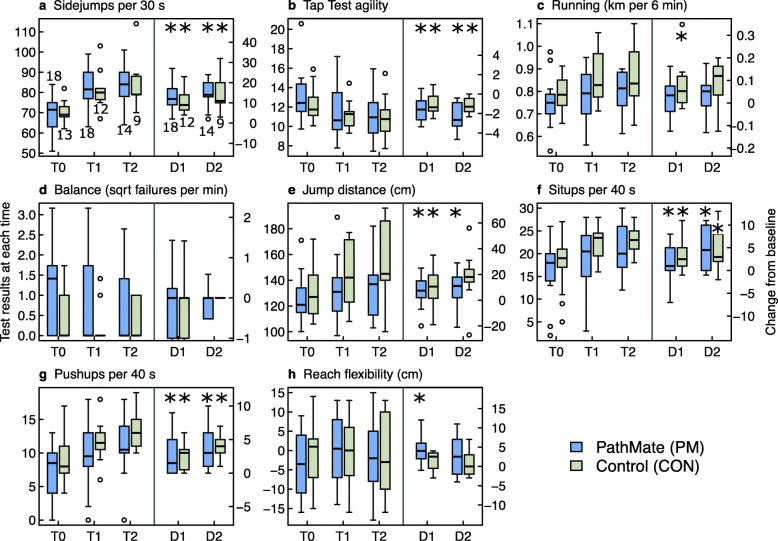
At intervention start median BMI-SDS of all patients (18 PM, 13 CON) was 2.61 (obesity > + 2SD). BMI-SDS decreased significantly in CON at T1, but not at T2, and did not decrease in PM during the study. Muscle mass, strength and agility improved significantly in both groups at T2; only PM reduced significantly their body fat at T1 and T2. Average daily PM app usage rate was 71.5%. Cortisol serum levels decreased significantly after biofeedback but with no association between stress parameters and BMI-SDS. No side effects were observed.
Equally to BCI, PathMate2 intervention resulted in significant and lasting improvements of physical capacities and body composition, but not in sustained BMI-SDS decrease. This youth-appealing mobile health intervention provides an interesting approach for youth with obesity who have limited access to health care. Biofeedback reduces acute stress and could be an innovative adjunct to usual care.
瑞士只有不到 2%的超重儿童和青少年能够参与多组分行为改变干预(BCI),这是由于成本和时间的限制。压力往往会阻碍肥胖青少年的健康结果。数字健康干预措施减少了现场访问次数,有望在偏远地区提供医疗服务;然而,其有效性的证据很少。
这是一项在瑞士儿童肥胖中心进行的随机对照非盲试验(1:1)。招募了 41 名年龄在 10-18 岁之间、BMI(体重指数)> P.90 伴有风险因素或合并症或 BMI > P.97 的肥胖青少年。在 5.5 个月的时间里,PathMate2 组(PM)通过移动应用程序接受日常对话代理咨询,同时结合标准化咨询(4 次现场访问)。对照组(CON)参加 BCI(7 次现场访问)。我们比较了两组在 5.5 个月(T1)和 12 个月(T2)时的结果。主要结果是 BMI-SDS(BMI 标准差评分:根据年龄和性别调整的 BMI)的降低。次要结果是体脂肪和肌肉质量的变化(生物电阻抗分析)、腰高比、身体能力(改良的 Dordel-Koch 测试)、血压和脉搏。此外,我们假设压力较小的儿童会减轻更多的体重。因此,在评估血浆皮质醇、压力问卷等压力参数的同时,让儿童进行生物反馈放松练习。
在干预开始时,所有患者(18 名 PM,13 名 CON)的 BMI-SDS 中位数为 2.61(肥胖> + 2SD)。CON 在 T1 时 BMI-SDS 显著降低,但在 T2 时没有降低,而 PM 在整个研究期间没有降低。两组的肌肉质量、力量和敏捷性在 T2 时均显著提高;只有 PM 在 T1 和 T2 时显著降低了体脂肪。PM 应用程序的平均日使用率为 71.5%。生物反馈后血清皮质醇水平显著降低,但压力参数与 BMI-SDS 之间没有关联。没有观察到副作用。
与 BCI 一样,PathMate2 干预也显著且持久地改善了身体能力和身体成分,但不能持续降低 BMI-SDS。这种受青少年欢迎的移动健康干预措施为那些难以获得医疗服务的肥胖青少年提供了一种有趣的方法。生物反馈可以减轻急性压力,并且可以作为常规护理的一种创新辅助手段。