Centre for Rheumatic Diseases, King's College London, London, UK.
School of Medicine, Keele University, Keele, UK.
Rheumatology (Oxford). 2021 Dec 24;61(1):90-102. doi: 10.1093/rheumatology/keab539.
Hospital admissions for gout flares have increased dramatically in recent years, despite widely available, effective medications for the treatment and prevention of flares. We conducted a systematic review to evaluate the effectiveness and implementation of interventions in patients hospitalized for gout flares.
A search was conducted in MEDLINE, Embase and the Cochrane library, from database inception to 8 April 2021, using the terms 'gout' and 'hospital' and their synonyms. Studies were included if they evaluated the effectiveness and/or implementation of interventions during hospital admissions or emergency department attendances for gout flares. Risk of bias assessments were performed for included studies.
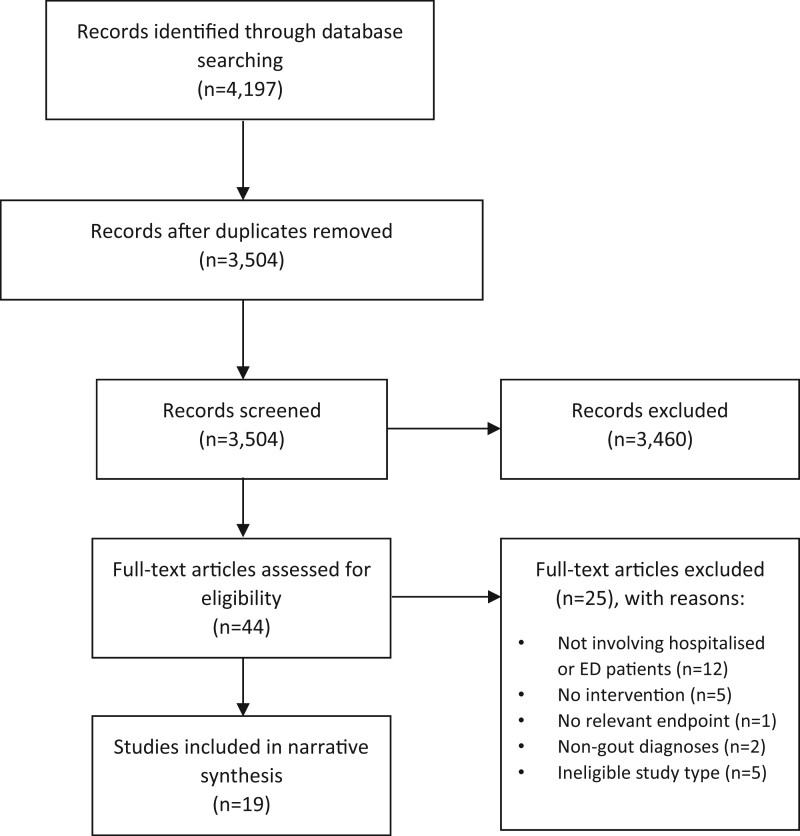
Nineteen articles were included. Most studies were small, retrospective analyses performed in single centres, with concerns for bias. Eleven studies (including five randomized controlled trials) reported improved patient outcomes following pharmacological interventions with known efficacy in gout, including allopurinol, prednisolone, NSAIDs and anakinra. Eight studies reported improved outcomes associated with non-pharmacological interventions: inpatient rheumatology consultation and a hospital gout management protocol. No studies to date have prospectively evaluated strategies designed to prevent re-admissions of patients hospitalized for gout flares.
There is an urgent need for high-quality, prospective studies of strategies for improving uptake of urate-lowering therapies in hospitalized patients, incorporating prophylaxis against flares and treat-to-target optimization of serum urate levels. Such studies are essential if the epidemic of hospital admissions from this treatable condition is to be countered.
尽管有广泛可用且有效的药物可用于治疗和预防痛风发作,但近年来痛风发作导致的住院人数却大幅增加。我们进行了一项系统评价,以评估干预措施在因痛风发作而住院的患者中的有效性和实施情况。
从数据库建立到 2021 年 4 月 8 日,我们在 MEDLINE、Embase 和 Cochrane 图书馆中使用“痛风”和“医院”及其同义词进行了搜索。如果研究评估了痛风发作期间或急诊科就诊期间干预措施的有效性和/或实施情况,则将其纳入研究。对纳入的研究进行了偏倚风险评估。
纳入了 19 篇文章。大多数研究是在单个中心进行的小型回顾性分析,存在偏倚的担忧。11 项研究(包括 5 项随机对照试验)报告了在痛风中具有已知疗效的药物干预后患者结局的改善,包括别嘌醇、泼尼松龙、非甾体抗炎药和阿那白滞素。8 项研究报告了与非药物干预相关的改善结局:住院风湿病会诊和医院痛风管理方案。迄今为止,尚无研究前瞻性评估旨在预防因痛风发作而住院的患者再次入院的策略。
迫切需要高质量、前瞻性的研究来改善住院患者降低尿酸治疗的应用,包括预防发作和将血清尿酸水平优化至治疗目标。如果要应对这种可治疗疾病导致的住院人数增加的流行,就必须进行此类研究。