Centre for Rheumatic Diseases, King's College London, London, UK.
School of Medicine, Keele University, Keele, UK.
Rheumatology (Oxford). 2023 Jul 5;62(7):2426-2434. doi: 10.1093/rheumatology/keac638.
To investigate associations between treat-to-target urate-lowering therapy (ULT) and hospitalizations for gout.
Using linked Clinical Practice Research Datalink and NHS Digital Hospital Episode Statistics data, we described the incidence and timing of hospitalizations for flares in people with index gout diagnoses in England from 2004-2020. Using Cox proportional hazards and propensity models, we investigated associations between ULT initiation, serum urate target attainment, colchicine prophylaxis, and the risk of hospitalizations for gout.
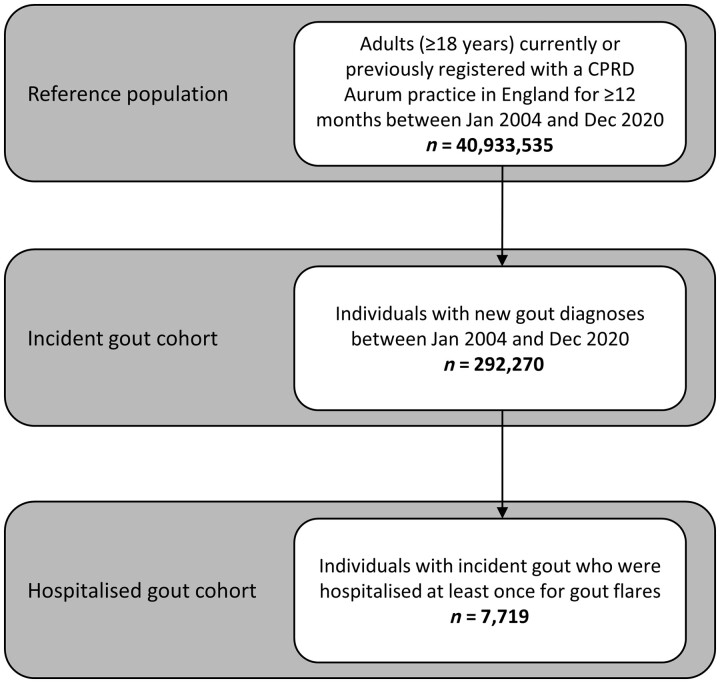
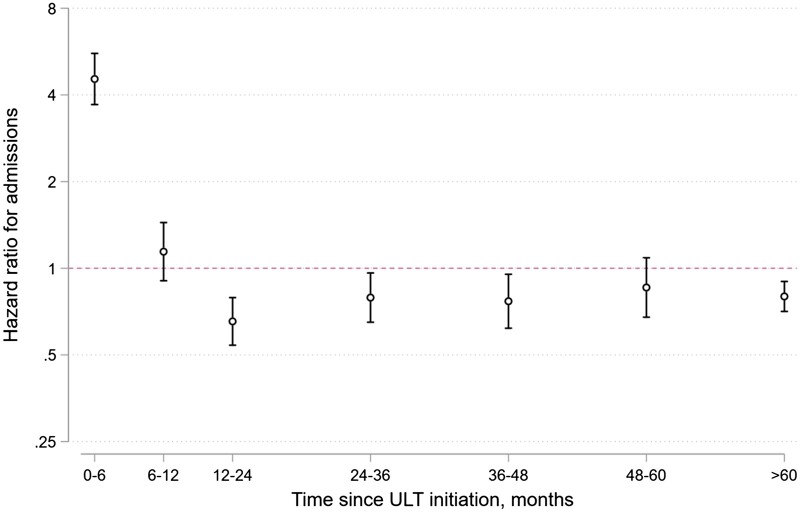
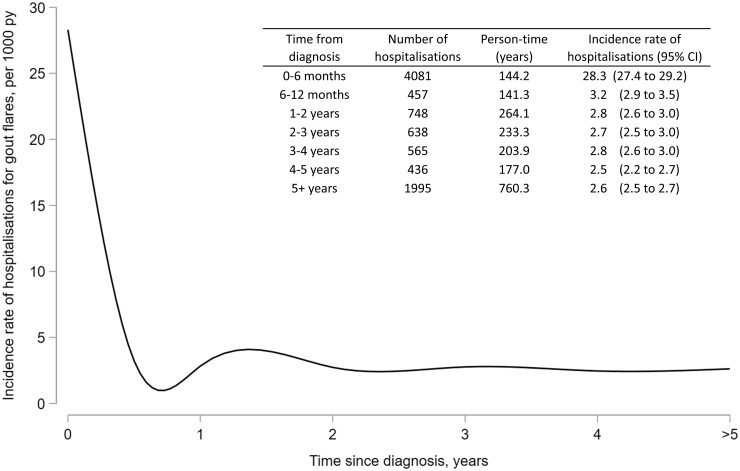
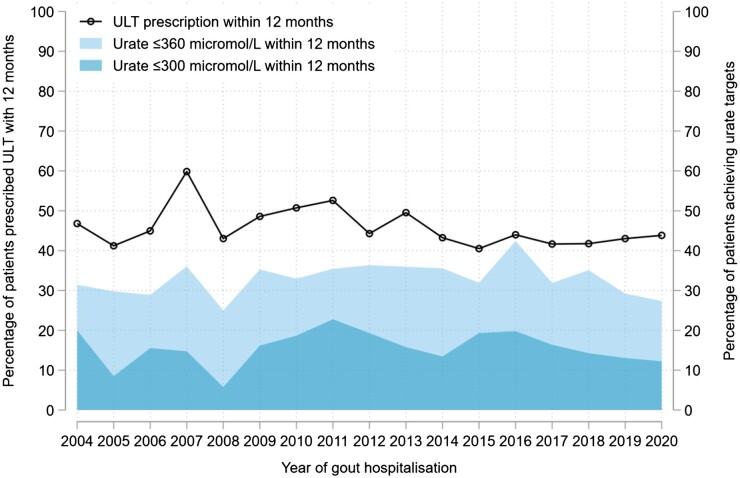
Of 292 270 people with incident gout, 7719 (2.64%) had one or more hospitalizations for gout, with an incidence rate of 4.64 hospitalizations per 1000 person-years (95% CI 4.54, 4.73). There was an associated increased risk of hospitalizations within the first 6 months after ULT initiation, when compared with people who did not initiate ULT [adjusted Hazard Ratio (aHR) 4.54; 95% CI 3.70, 5.58; P < 0.001]. Hospitalizations did not differ significantly between people prescribed vs not prescribed colchicine prophylaxis in fully adjusted models. From 12 months after initiation, ULT associated with a reduced risk of hospitalizations (aHR 0.77; 95% CI 0.71, 0.83; P < 0.001). In ULT initiators, attainment of a serum urate <360 micromol/l within 12 months of initiation associated with a reduced risk of hospitalizations (aHR 0.57; 95% CI 0.49, 0.67; P < 0.001) when compared with people initiating ULT but not attaining this target.
ULT associates with an increased risk of hospitalizations within the first 6 months of initiation but reduces hospitalizations in the long term, particularly when serum urate targets are achieved.
探讨达标降尿酸治疗(ULT)与痛风住院之间的关系。
利用临床实践研究数据链接和英国国家医疗服务体系数字医院入院统计数据,我们描述了 2004 年至 2020 年期间英格兰痛风指数诊断患者的痛风发作住院的发生率和时间。使用 Cox 比例风险和倾向模型,我们研究了 ULT 起始、血清尿酸目标达标、秋水仙碱预防和痛风住院风险之间的关系。
在 292270 例新发痛风患者中,7719 例(2.64%)有 1 次或多次痛风住院,发病率为每 1000 人年 4.64 例住院(95%CI 4.54,4.73)。与未开始 ULT 的患者相比,在 ULT 起始后的前 6 个月内,住院的风险增加[校正风险比(aHR)4.54;95%CI 3.70,5.58;P<0.001]。在完全调整的模型中,服用与未服用秋水仙碱预防的患者之间的住院情况无显著差异。从起始后 12 个月开始,ULT 与住院风险降低相关(aHR 0.77;95%CI 0.71,0.83;P<0.001)。在 ULT 起始者中,与起始后 12 个月内未达到血清尿酸<360μmol/L 的患者相比,达到该目标与住院风险降低相关(aHR 0.57;95%CI 0.49,0.67;P<0.001)。
ULT 在起始后的前 6 个月内与住院风险增加相关,但从长期来看会降低住院风险,特别是在达到血清尿酸目标时。