Pritzker School of Medicine, University of Chicago, Chicago, USA.
Department of Medicine, University of Chicago, Chicago, IL, USA.
BMC Health Serv Res. 2021 Jul 11;21(1):686. doi: 10.1186/s12913-021-06710-y.
Scribes have been proposed as an intervention to decrease physician electronic health record (EHR) workload and improve clinical quality. We aimed to assess the impact of a scribe on clinical efficiency and quality in an academic internal medicine practice.
Six faculty physicians worked with one scribe at an urban academic general internal medicine clinic April through June 2017. Patient visits during the 3 months prior to intervention (baseline, n = 789), unscribed visits during the intervention (concurrent control, n = 605), and scribed visits (n = 579) were included in the study. Clinical efficiency outcomes included time to close encounter, patient time in clinic, and number of visits per clinic session. Quality outcomes included EHR note quality, rates of medication and immunization review, population of patient instructions, reconciliation of outside information, and completion of preventative health recommendations.
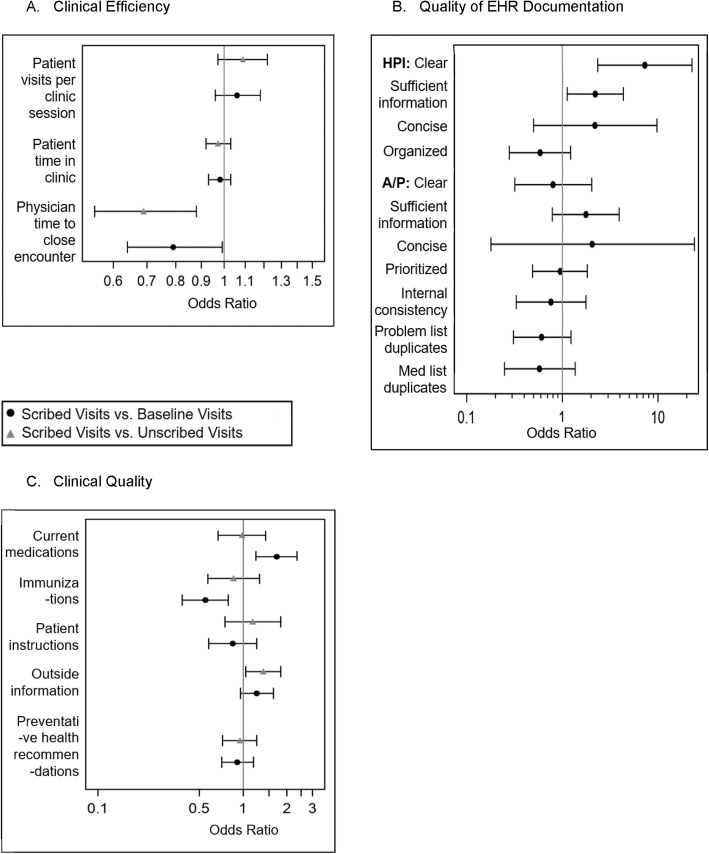
Median time to close encounter (IQR) was lower for scribed visits [0.4 (4.8) days] compared to baseline and unscribed visits [1.2 (5.9) and 2.9 (5.4) days, both p < 0.001]. Scribed notes were more likely to have a clear history of present illness (HPI) [OR = 7.30 (2.35-22.7), p = 0.001] and sufficient HPI information [OR = 2.21 (1.13-4.35), p = 0.02] compared to unscribed notes. Physicians were more likely to review the medication list during scribed vs. baseline visits [OR = 1.70 (1.22-2.35), p = 0.002]. No differences were found in the number of visits per clinic session, patient time in clinic, completion of preventative health recommendations, or other outcomes.
Working with a scribe in an academic internal medicine practice was associated with more timely documentation.
抄写员被提议作为一种干预措施,以减少医生电子健康记录 (EHR) 的工作量并提高临床质量。我们旨在评估在学术内科实践中抄写员对临床效率和质量的影响。
六名内科医生在 2017 年 4 月至 6 月期间与一名抄写员在城市综合内科诊所合作。研究包括干预前 3 个月的患者就诊(基线,n=789)、无抄写员就诊(同期对照,n=605)和有抄写员就诊(n=579)。临床效率结果包括结束就诊的时间、患者在诊所的时间和每个诊所就诊的就诊次数。质量结果包括 EHR 记录的质量、药物和免疫接种审查率、患者指导的人群、外部信息的协调以及预防保健建议的完成情况。
与基线和无抄写员就诊相比,有抄写员就诊的结束就诊时间中位数(IQR)较低[0.4(4.8)天] [1.2(5.9)和 2.9(5.4)天,均 p<0.001]。与无抄写员记录相比,有抄写员记录的 HPI(清晰病史)[OR=7.30(2.35-22.7),p=0.001]和足够的 HPI 信息[OR=2.21(1.13-4.35),p=0.02]更有可能。与基线就诊相比,医生更有可能在有抄写员就诊时审查药物清单[OR=1.70(1.22-2.35),p=0.002]。在每个诊所就诊的就诊次数、患者在诊所的时间、预防保健建议的完成情况或其他结果方面没有差异。
在学术内科实践中与抄写员合作与更及时的文档记录相关。