Beck-Hiestermann Franziska Marie Lea, Kästner Denise, Gumz Antje
Fachbereich Psychosomatik und Psychotherapie, Psychologische Hochschule Berlin, Am Köllnischen Park 2, 10179 Berlin, Deutschland.
Psychotherapeut (Berl). 2021;66(5):372-381. doi: 10.1007/s00278-021-00519-0. Epub 2021 Jul 5.
As a reaction to the coronavirus diseases 2019 (COVID-19) pandemic, in individual settings psychotherapy could be conducted online to an unlimited extent in Germany. The attitudes and experiences of psychotherapists with respect to online therapy (OT) have so far been generally poorly studied and particularly with a view to the situation during the pandemic.
The aim of the study was to examine 1) the frequency of utilization of OT during the first lockdown, 2) the satisfaction with OT versus face-to-face therapy and 3) the technology acceptance experience overall and with respect to the guideline procedures.
German psychotherapists licensed and in training, cognitive-behavioral (CB 45.6%), analytic (AP 14%), depth-psychological (DP 34.5%), systemic (SYS 5.8%), were invited to participate in an online survey on demographic and therapeutic data, use of OT, satisfaction with OT vs. face-to-face therapy (, ZUF-THERA) and technology acceptance (Unified Theory of Acceptance and Use of Technology 2 Questionnaire, UTAUT).
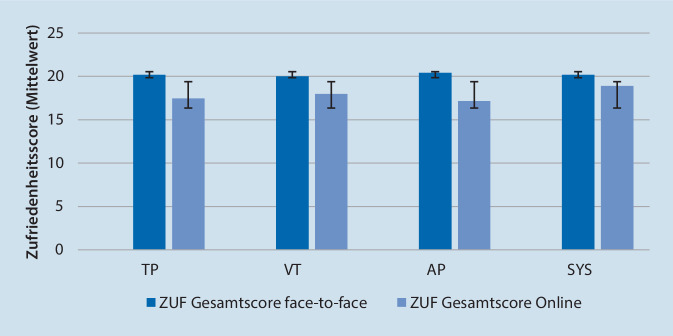
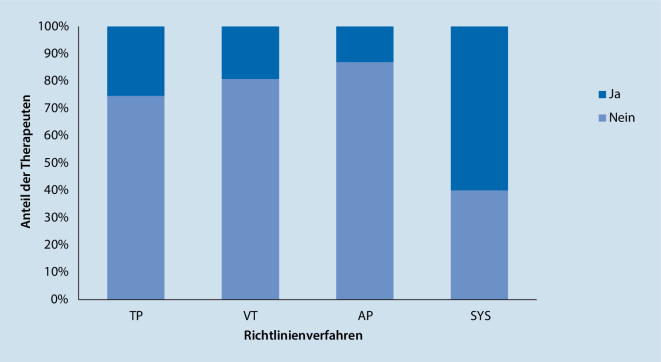
The 174 participating psychotherapists (mean age = 44.73 years, SD ± 12.79; female 81.6%) reported that the average proportion of OT in the total therapeutic activity during the lockdown was 43.09%, with significant differences between guideline procedures (DP, CB > AP). The satisfaction with OT proved to be significantly lower than with face-to-face therapy and did not differ between the procedures. Prior experience with OT was reported by 23.6% of therapists overall and was higher among those working systemically compared to CB or AP therapists. Therapists working in CB experienced more enjoyment with OT than those working in DP and AP as well as perceived a stronger social influence (e.g. through colleagues) in the use of OT than therapists working in DP.
The frequency of use of OT soared during the first lockdown (March-May 2020, 43% in comparison to the former limit covered by health insurances of 20%). In principle, therapists were highly satisfied with OT but significantly lower than with face-to-face therapy. Further studies analyzing the reasons for this in detail are urgently recommended.
作为对2019年冠状病毒病(COVID-19)大流行的一种应对措施,在德国的个别情况下,心理治疗可以不受限制地在线进行。到目前为止,心理治疗师对在线治疗(OT)的态度和体验总体上研究较少,尤其是考虑到大流行期间的情况。
本研究的目的是考察1)第一次封锁期间OT的使用频率,2)对OT与面对面治疗的满意度,以及3)总体上和关于指南程序的技术接受体验。
邀请德国有执照的在职和正在接受培训的心理治疗师参与一项在线调查,内容涉及人口统计学和治疗数据、OT的使用、对OT与面对面治疗的满意度(ZUF-THERA)以及技术接受情况(技术接受与使用统一理论2问卷,UTAUT)。这些心理治疗师包括认知行为治疗师(CB,45.6%)、分析治疗师(AP,14%)、深度心理治疗师(DP,34.5%)、系统治疗师(SYS,5.8%)。
174名参与调查的心理治疗师(平均年龄 = 44.73岁,标准差±12.79;女性占81.6%)报告称,封锁期间OT在总治疗活动中的平均比例为43.09%,不同指南程序之间存在显著差异(DP、CB > AP)。事实证明,对OT的满意度显著低于面对面治疗,且不同程序之间没有差异。总体而言,23.6%的治疗师报告有OT的先前经验,与CB或AP治疗师相比,系统治疗师中的这一比例更高。与DP和AP治疗师相比,从事CB治疗的治疗师在OT中体验到更多乐趣,并且在OT的使用中比从事DP治疗的治疗师感受到更强的社会影响(例如通过同事)。
在第一次封锁期间(2020年3月至5月),OT的使用频率飙升(相比之下,医疗保险之前涵盖的上限为20%,此次达到43%)。原则上,治疗师对OT高度满意,但显著低于面对面治疗。迫切建议进一步详细分析其原因的研究。