Grassi Elisa, Corbelli Jody, Papiani Giorgio, Barbera Maria Aurelia, Gazzaneo Federica, Tamberi Stefano
Department of Oncology, Infermi's Hospital, Azienda Unità Sanitaria Locale (AUSL) della Romagna, Faenza, Italy.
Front Oncol. 2021 Jun 23;11:601722. doi: 10.3389/fonc.2021.601722. eCollection 2021.
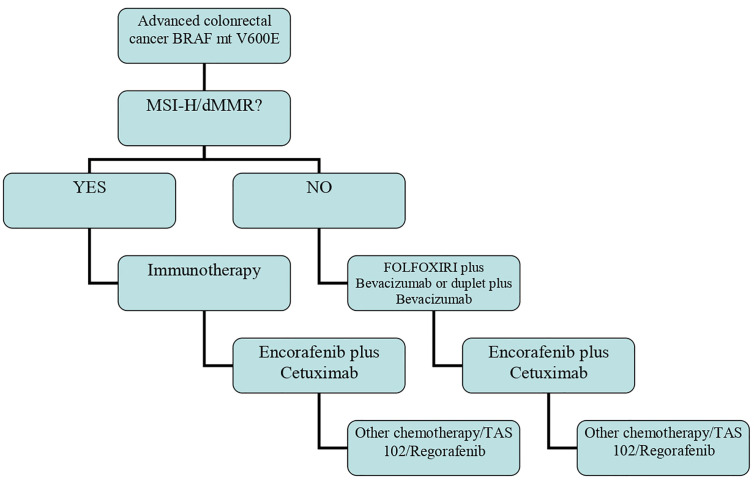
Around 8-12% of patients with advanced colon rectal cancer (CRC) present with BRAF alterations, in particular V600E mutation, which is associated with right-side, poorly differentiated and mucinous type tumors. The presence of BRAF mutation (BRAF-mt) has been identified as a hallmark of poor prognosis and treatment optimization in this patient subgroup is an important goal. Currently, the standard of care is an aggressive strategy involving triplet chemotherapy and anti-VEGF agents, but new therapeutic approaches are emerging. Very promising results have been obtained with targeted therapy combinations, such as anti-BRAF agents plus anti-EGFR agents. Furthermore, around 60% of BRAF-mt patients show a strong association with high microsatellite instability (MSI-H) and immune checkpoint inhibitors could represent the new standard of care for this subgroup. The focus of this review is to summarize current strategies for BRAF-mt CRC treatment and highlight new therapeutic options.
约8%-12%的晚期结直肠癌(CRC)患者存在BRAF改变,尤其是V600E突变,这与右侧、低分化和黏液型肿瘤相关。BRAF突变(BRAF-mt)的存在已被确定为预后不良的标志,优化该患者亚组的治疗是一个重要目标。目前,标准治疗方案是采用包括三联化疗和抗VEGF药物的积极策略,但新的治疗方法正在出现。靶向治疗联合方案,如抗BRAF药物加抗EGFR药物,已取得了非常有前景的结果。此外,约60%的BRAF-mt患者与高微卫星不稳定性(MSI-H)密切相关,免疫检查点抑制剂可能成为该亚组的新治疗标准。本综述的重点是总结BRAF-mt CRC的当前治疗策略,并突出新的治疗选择。