
TIPE2通过抑制TGFβ1介导的信号通路抑制胰腺癌的恶性发展。
TIPE2 Suppresses Malignancy of Pancreatic Cancer Through Inhibiting TGFβ1 Mediated Signaling Pathway.
作者信息
Feng Fang, Liu Chunliang, Bian Huahui, Cai Wei, Zhou Ying, Zhou Li, Zhuang Zhixiang
机构信息
Department of Oncology, The Second Affiliated Hospital of Soochow University, Medical College, Soochow University, Suzhou, China.
Department of Oncology, Suzhou Ninth People's Hospital, Soochow University, Suzhou, China.
出版信息
Front Oncol. 2021 Jun 23;11:680985. doi: 10.3389/fonc.2021.680985. eCollection 2021.
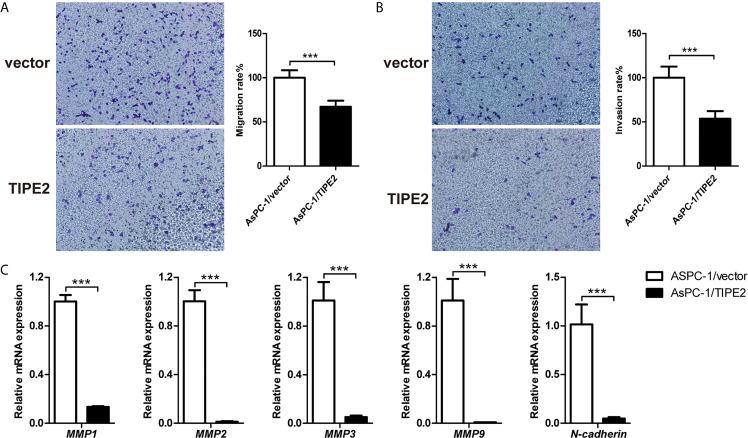
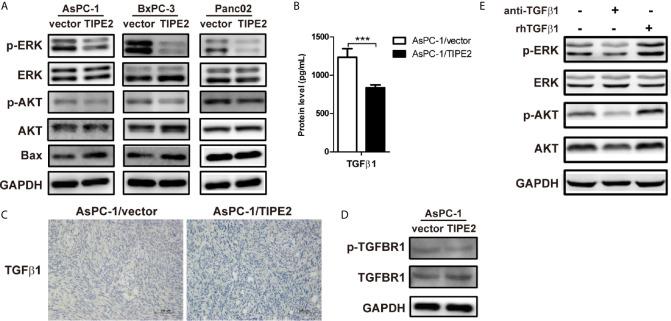
Pancreatic cancer is one of the major reasons of cancer-associated deaths due to poor diagnosis, high metastasis and drug resistance. Therefore, it is important to understand the cellular and molecular mechanisms of pancreatic cancer to identify new targets for the treatment. TIPE2 is an essential regulator of tumor apoptosis, inflammation and immune homeostasis. However, the role of TIPE2 is still not fully understood in pancreatic cancer. In this study, we found the expression of TIPE2 was decreased in pancreatic cancer tissues compare to paracancerous tissues, which was negatively correlated with tumor size in patients. Overexpression of TIPE2 significantly decreased cell proliferation, metastasis and increased apoptotic events in pancreatic cancer cell lines. Moreover, the results obtained from real time PCR and western blot revealed that TIPE2 was also involved in inhibiting and expression while increasing Bax expression in pancreatic cancer cells. Similarly, TIPE2 could inhibit tumor growth , decrease the expression of Ki-67 and N-Cadherin, and increase the expression of Bax by IHC analysis in tumor tissues isolated from tumor-bearing mice. Mechanistic studies exhibited that TIPE2 might suppress pancreatic cancer development through inhibiting PI3K/AKT and Raf/MEK/ERK signaling pathways triggered by TGFβ1. Moreover, the tumor-infiltrating lymphocytes from tumor-bearing mice were analyzed by flow cytometry, and showed that TIPE2 could promote T cell activation to exert an anti-tumor effect possibly through activation of DCs in a TGFβ1 dependent manner. In general, we described the multiple regulatory mechanisms of TIPE2 in pancreatic tumorigenesis and tumor microenvironment, which suggested TIPE2 may act as a potential therapeutic target in pancreatic cancer.
胰腺癌是癌症相关死亡的主要原因之一,因其诊断困难、高转移率和耐药性。因此,了解胰腺癌的细胞和分子机制以确定新的治疗靶点很重要。TIPE2是肿瘤细胞凋亡、炎症和免疫稳态的重要调节因子。然而,TIPE2在胰腺癌中的作用仍未完全明确。在本研究中,我们发现与癌旁组织相比,胰腺癌组织中TIPE2的表达降低,且与患者肿瘤大小呈负相关。TIPE2的过表达显著降低了胰腺癌细胞系的细胞增殖、转移并增加了凋亡事件。此外,实时PCR和蛋白质印迹结果显示,TIPE2还参与抑制胰腺癌细胞中的 表达,同时增加Bax表达。同样,通过免疫组化分析从荷瘤小鼠分离的肿瘤组织发现,TIPE2可抑制肿瘤生长,降低Ki-67和N-钙黏蛋白的表达,并增加Bax的表达。机制研究表明,TIPE2可能通过抑制TGFβ1触发的PI3K/AKT和Raf/MEK/ERK信号通路来抑制胰腺癌的发展。此外,通过流式细胞术分析荷瘤小鼠的肿瘤浸润淋巴细胞,结果显示TIPE2可能通过以TGFβ1依赖的方式激活树突状细胞来促进T细胞活化,从而发挥抗肿瘤作用。总的来说,我们描述了TIPE2在胰腺肿瘤发生和肿瘤微环境中的多种调节机制,这表明TIPE2可能是胰腺癌潜在的治疗靶点。 (注:原文中“inhibiting and expression”有缺失内容)




 Zotero 插件