Kelly Shayne R, Cutter Brendan M, Huish Eric G
San Joaquin General Hospital, French Camp, California, USA.
Valley Orthopedic Surgery Residency, Modesto, California, USA.
Orthop J Sports Med. 2021 Jun 24;9(6):23259671211009879. doi: 10.1177/23259671211009879. eCollection 2021 Jun.
Combined anterior cruciate ligament (ACL) reconstruction (ACLR) and anterolateral ligament reconstruction (ALLR) are performed with the intention to restore native knee kinematics after ACL tears. There continue to be varying results as to the difference in kinematics between combined and isolated procedures, including anterior tibial translation (ATT) and internal tibial rotation (IR).
To perform a systematic review and meta-analysis to evaluate the kinematic changes of a combined ACLR/ALLR versus isolated ACLR and to assess the effects of different fixation techniques.
Systematic review.
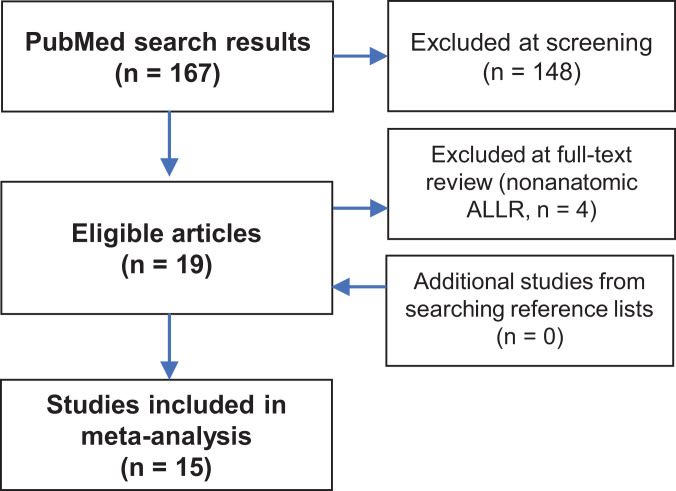
We conducted a systematic review and meta-analysis of 15 human cadaveric biomechanical studies evaluating combined ACLR/ALLR versus isolated ACLR and their effects on ATT and IR in 149 specimens. The primary outcomes were ATT and IR. Secondary outcomes included graft type and size as well as fixation methods such as type, angle, tension, and position of fixation. Meta-regression was used to examine the effect of various cofactors on the resulting measures.
Compared with isolated ACLR, combined ACLR/ALLR decreased ATT and IR by 0.01 mm (95% CI, -0.059 to 0.079 mm; = .777) and 1.64° (95% CI, 1.30°-1.98°; < .001), respectively. Regarding ACLR/ALLR, increasing the knee flexion angle and applied IR force led to a significant reduction in IR ( < .001 and = .044, respectively). There was also a significant reduction in IR in combined procedures with semitendinosus ALL graft, higher flexion fixation angles, and tension but no change in IR with differing femoral fixation points ( < .001, < .001, and = .268, respectively). Multivariate meta-regression showed that the use of tibial-sided suture anchor fixation significantly reduced IR ( < .001).
These results suggest that a combined ACLR/ALLR procedure significantly decreases IR compared with isolated ACLR, especially at higher knee flexion angles. Semitendinosus ALL graft, fixation at higher knee flexion, increased tensioning, and tibial-sided interference screw fixation in ALLR may help to further reduce IR.
联合前交叉韧带重建术(ACLR)和前外侧韧带重建术(ALLR)旨在恢复前交叉韧带撕裂后膝关节的自然运动学。联合手术与单独手术在运动学方面的差异,包括胫骨前移(ATT)和胫骨内旋(IR),仍存在不同结果。
进行系统评价和荟萃分析,以评估ACLR/ALLR联合手术与单独ACLR相比的运动学变化,并评估不同固定技术的效果。
系统评价。
我们对15项人体尸体生物力学研究进行了系统评价和荟萃分析,这些研究评估了ACLR/ALLR联合手术与单独ACLR及其对149个标本的ATT和IR的影响。主要结局指标为ATT和IR。次要结局指标包括移植物类型和尺寸以及固定方法,如固定类型、角度、张力和位置。采用Meta回归分析各种协变量对结果指标的影响。
与单独ACLR相比,ACLR/ALLR联合手术使ATT和IR分别降低了0.01mm(95%CI,-0.059至0.079mm;P = 0.777)和1.64°(95%CI,1.30°-1.98°;P < 0.001)。对于ACLR/ALLR联合手术,增加膝关节屈曲角度和施加的内旋力会导致IR显著降低(分别为P < 0.001和P = 0.044)。使用半腱肌ALL移植物、更高的屈曲固定角度和张力的联合手术中IR也显著降低,但不同股骨固定点对IR无影响(分别为P < 0.001、P < 0.001和P = 0.268)。多变量Meta回归分析显示,使用胫骨侧缝线锚钉固定可显著降低IR(P < 0.001)。
这些结果表明,与单独ACLR相比,ACLR/ALLR联合手术可显著降低IR,尤其是在较高膝关节屈曲角度时。半腱肌ALL移植物、在较高膝关节屈曲位固定、增加张力以及在ALLR中使用胫骨侧干涉螺钉固定可能有助于进一步降低IR。