MRC Centre for Global Infectious Disease Analysis; and the Abdul Latif Jameel Institute for Disease and Emergency Analytics (J-IDEA), School of Public Health, Imperial College London, London, United Kingdom.
London School of Hygiene and Tropical Medicine, London, United Kingdom.
Elife. 2021 Jul 13;10:e67635. doi: 10.7554/eLife.67635.
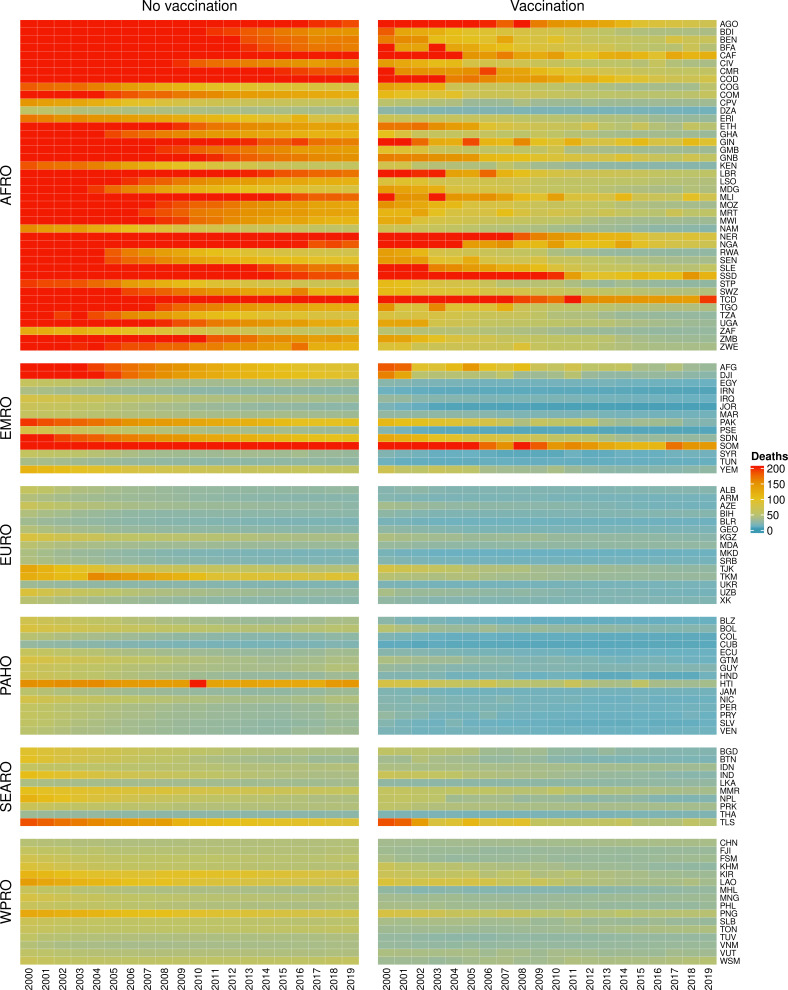
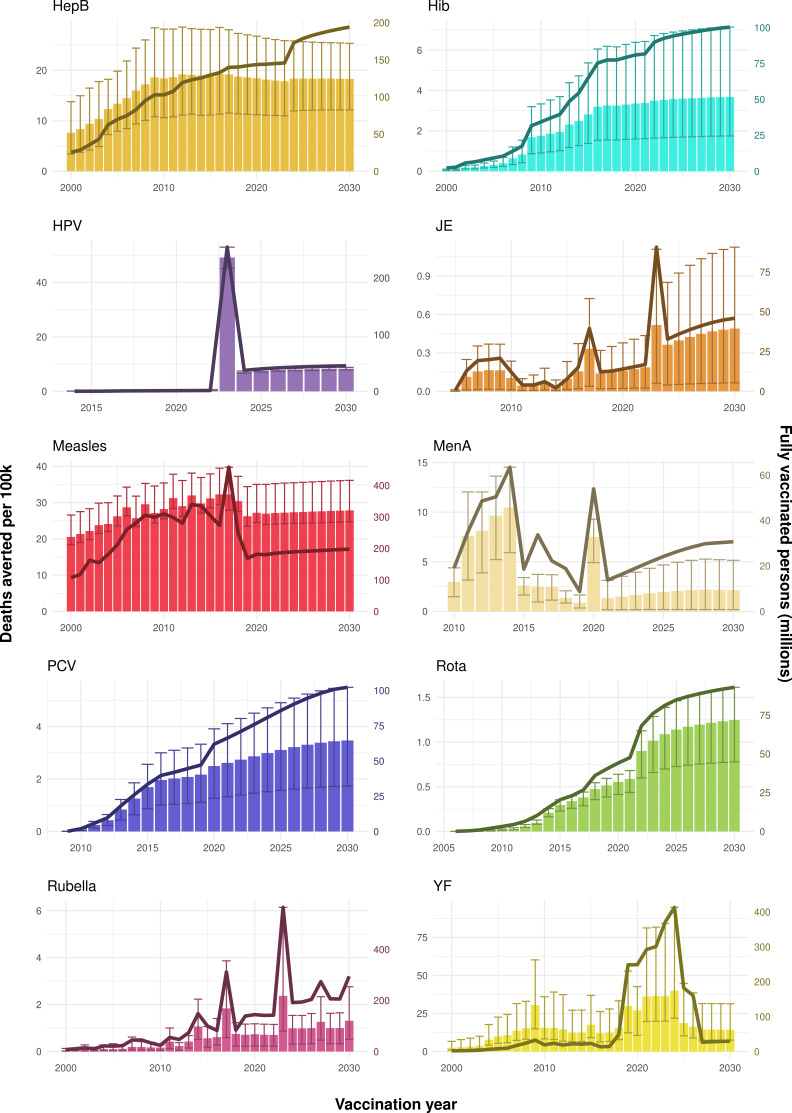
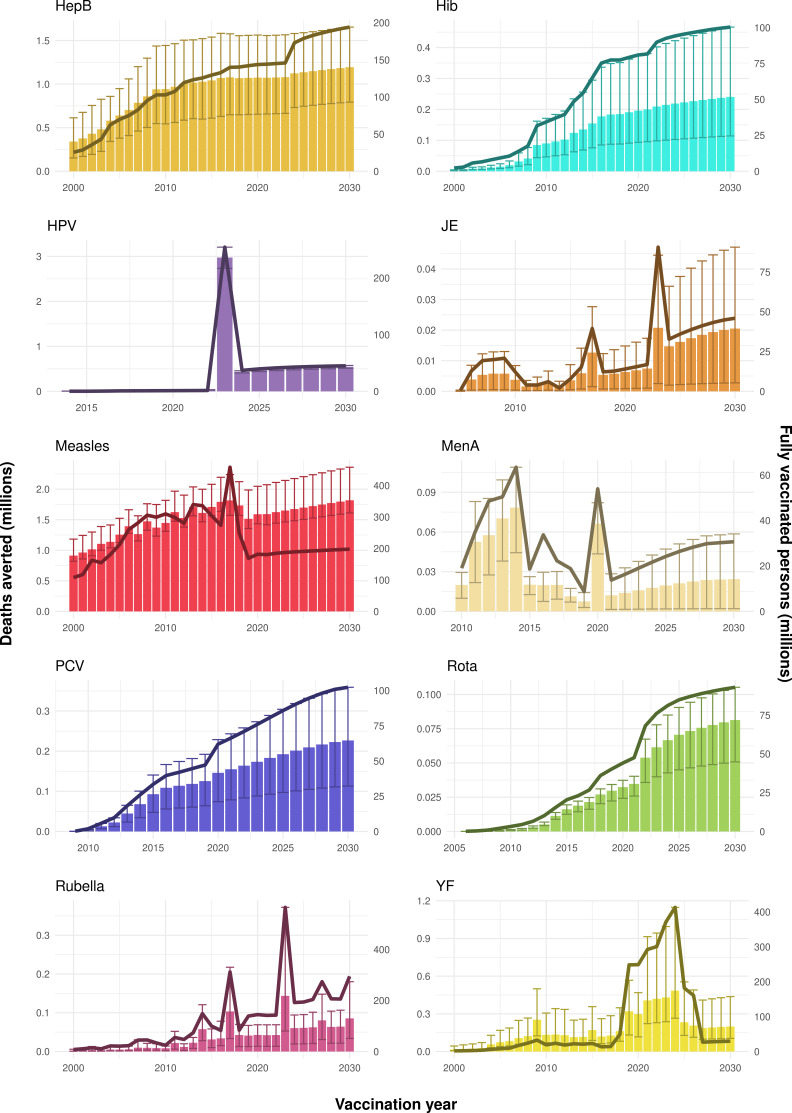
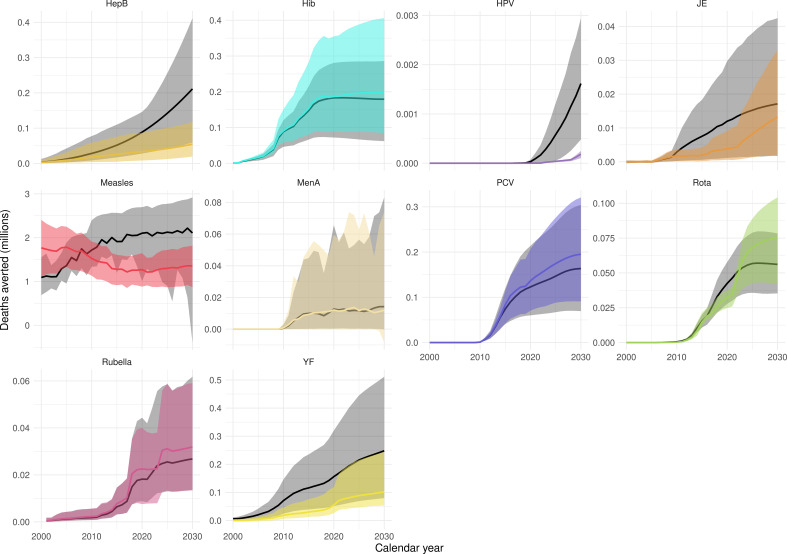
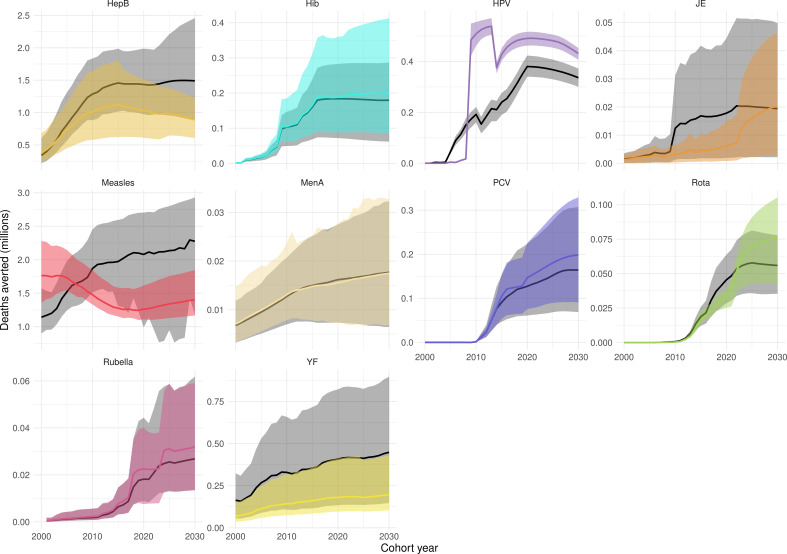
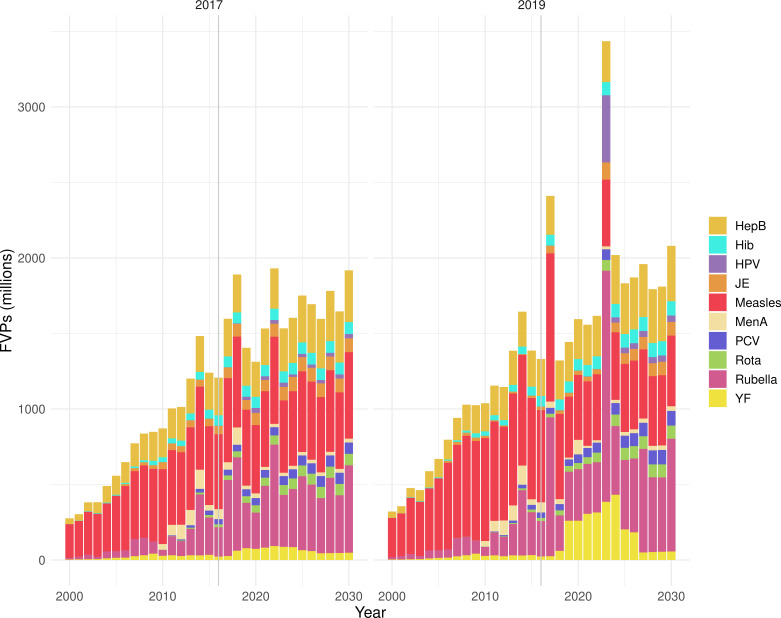
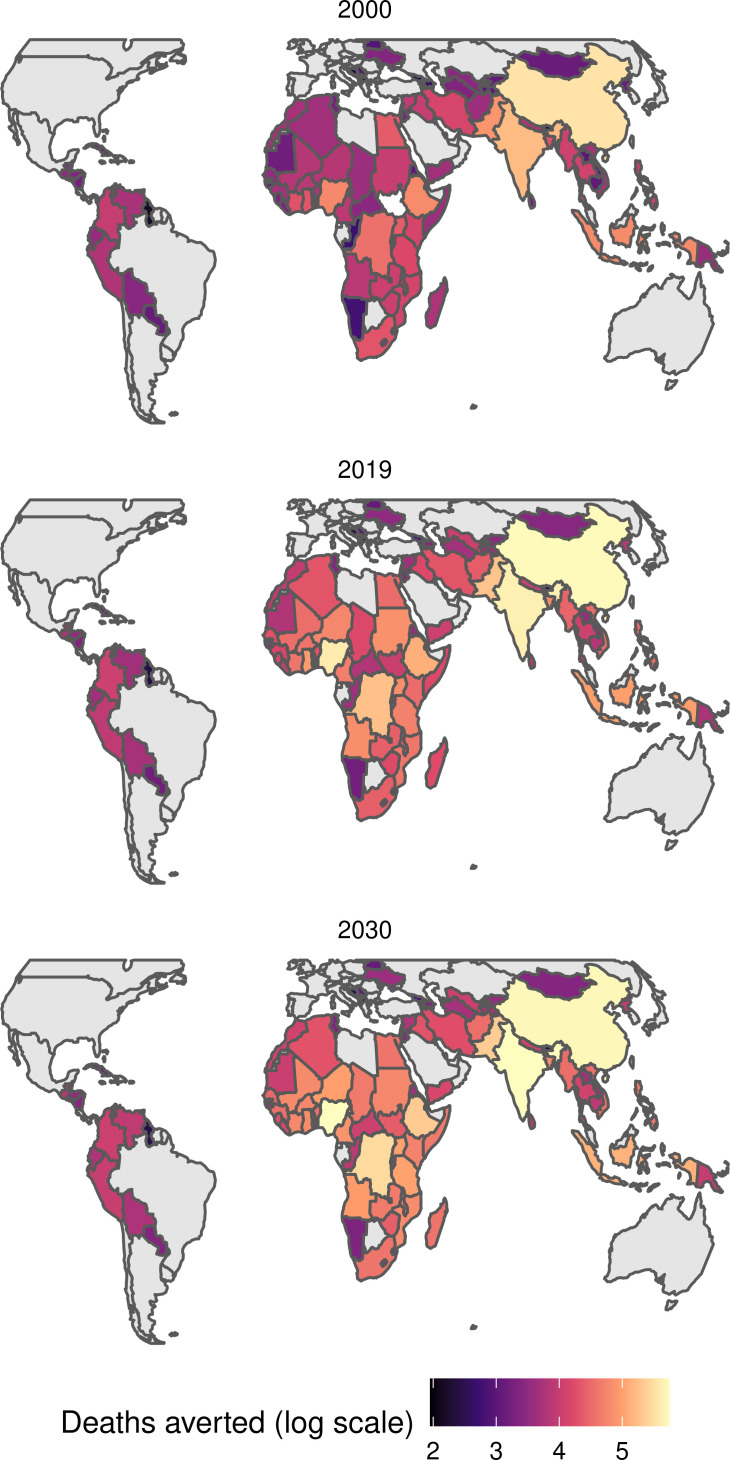
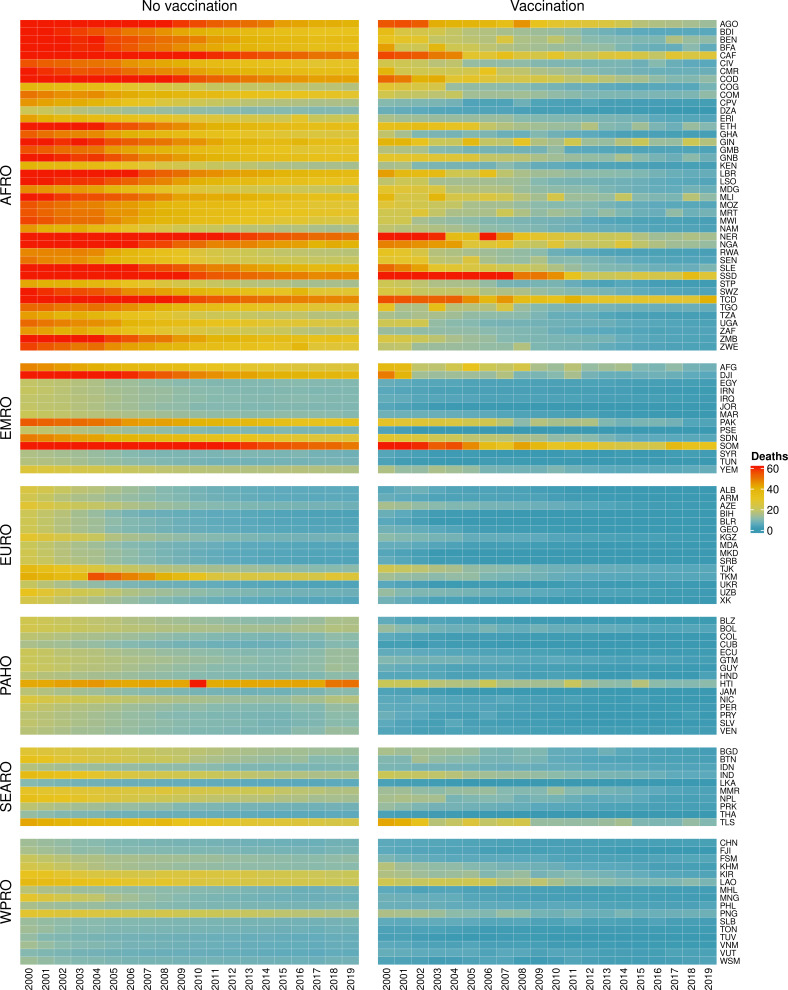
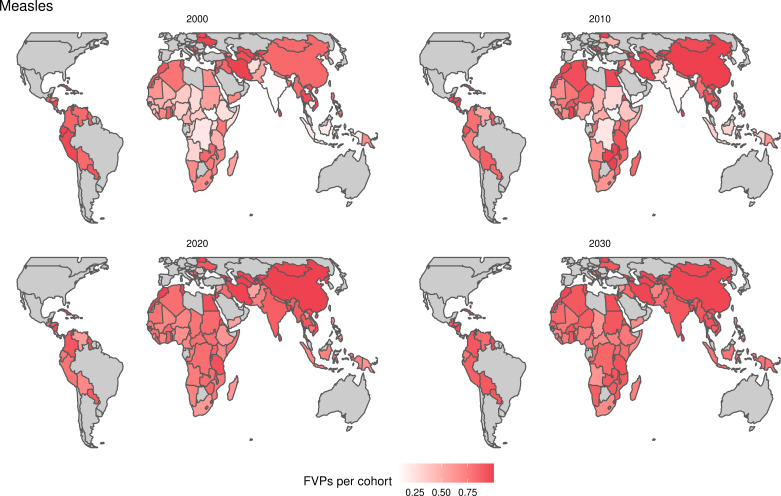
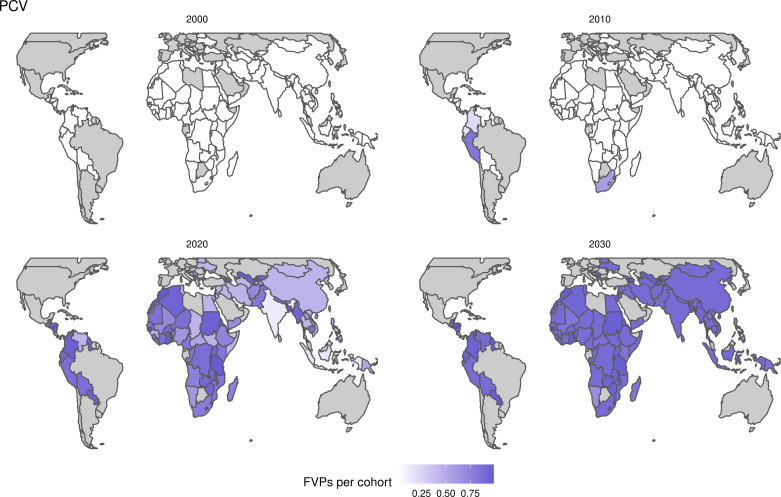
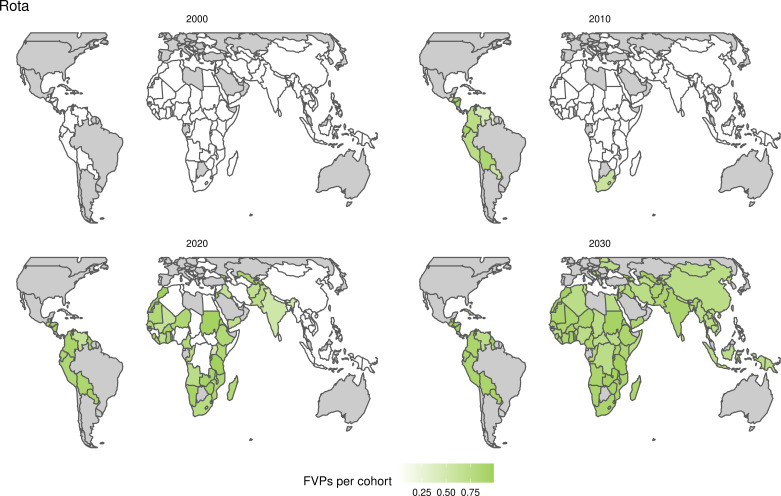
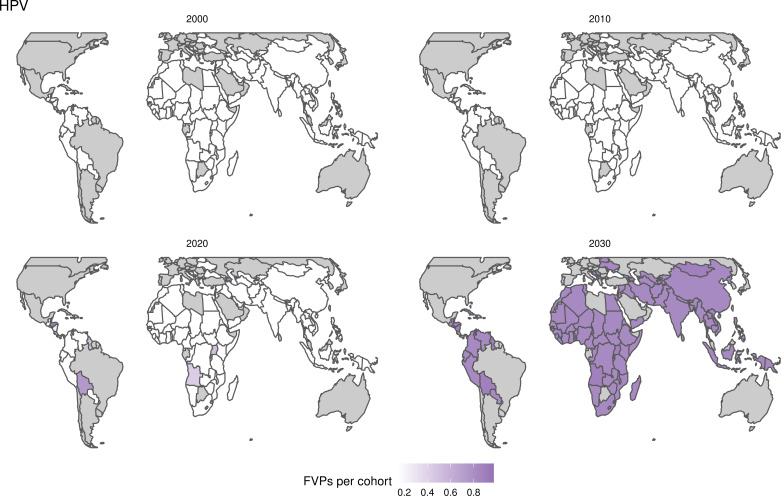
Vaccination is one of the most effective public health interventions. We investigate the impact of vaccination activities for type b, hepatitis B, human papillomavirus, Japanese encephalitis, measles, serogroup A, rotavirus, rubella, , and yellow fever over the years 2000-2030 across 112 countries.
Twenty-one mathematical models estimated disease burden using standardised demographic and immunisation data. Impact was attributed to the year of vaccination through vaccine-activity-stratified impact ratios.
We estimate 97 (95%CrI[80, 120]) million deaths would be averted due to vaccination activities over 2000-2030, with 50 (95%CrI[41, 62]) million deaths averted by activities between 2000 and 2019. For children under-5 born between 2000 and 2030, we estimate 52 (95%CrI[41, 69]) million more deaths would occur over their lifetimes without vaccination against these diseases.
This study represents the largest assessment of vaccine impact before COVID-19-related disruptions and provides motivation for sustaining and improving global vaccination coverage in the future.
VIMC is jointly funded by Gavi, the Vaccine Alliance, and the Bill and Melinda Gates Foundation (BMGF) (BMGF grant number: OPP1157270 / INV-009125). Funding from Gavi is channelled via VIMC to the Consortium's modelling groups (VIMC-funded institutions represented in this paper: Imperial College London, London School of Hygiene and Tropical Medicine, Oxford University Clinical Research Unit, Public Health England, Johns Hopkins University, The Pennsylvania State University, Center for Disease Analysis Foundation, Kaiser Permanente Washington, University of Cambridge, University of Notre Dame, Harvard University, Conservatoire National des Arts et Métiers, Emory University, National University of Singapore). Funding from BMGF was used for salaries of the Consortium secretariat (authors represented here: TBH, MJ, XL, SE-L, JT, KW, NMF, KAMG); and channelled via VIMC for travel and subsistence costs of all Consortium members (all authors). We also acknowledge funding from the UK Medical Research Council and Department for International Development, which supported aspects of VIMC's work (MRC grant number: MR/R015600/1).JHH acknowledges funding from National Science Foundation Graduate Research Fellowship; Richard and Peggy Notebaert Premier Fellowship from the University of Notre Dame. BAL acknowledges funding from NIH/NIGMS (grant number R01 GM124280) and NIH/NIAID (grant number R01 AI112970). The Lives Saved Tool (LiST) receives funding support from the Bill and Melinda Gates Foundation.This paper was compiled by all coauthors, including two coauthors from Gavi. Other funders had no role in study design, data collection, data analysis, data interpretation, or writing of the report. All authors had full access to all the data in the study and had final responsibility for the decision to submit for publication.
疫苗接种是最有效的公共卫生干预措施之一。我们研究了 2000 年至 2030 年期间在 112 个国家开展的乙型肝炎、乙型肝炎、人乳头瘤病毒、日本脑炎、麻疹、A 群、轮状病毒、风疹、黄热病疫苗接种活动对疾病负担的影响。
21 个数学模型使用标准化的人口统计学和免疫接种数据来估计疾病负担。通过疫苗活动分层影响比,将影响归因于接种疫苗的年份。
我们估计,在 2000 年至 2030 年期间,疫苗接种活动将避免 9700 万人(95%置信区间[8000 万,1.20 亿])死亡,其中 5000 万人(95%置信区间[4100 万,6200 万])死亡将在 2000 年至 2019 年期间避免。对于 2000 年至 2030 年期间出生的 5 岁以下儿童,如果不接种这些疾病的疫苗,我们估计他们一生中会多死亡 5200 万人(95%置信区间[4100 万,6900 万])。
本研究代表了在 COVID-19 相关干扰之前对疫苗影响的最大评估,并为未来维持和改善全球疫苗接种覆盖率提供了动力。
VIMC 由全球疫苗免疫联盟(Gavi)、疫苗联盟和比尔和梅琳达盖茨基金会(BMGF)共同资助(BMGF 赠款编号:OPP1157270/INV-009125)。Gavi 的资金通过 VIMC 流向联盟的建模小组(本文代表的 VIMC 资助机构:伦敦帝国理工学院、伦敦卫生与热带医学院、牛津大学临床研究单位、英国公共卫生部、约翰霍普金斯大学、宾夕法尼亚州立大学、疾病分析基金会、凯撒永久华盛顿、剑桥大学、圣母大学、哈佛大学、国立艺术与工艺学院、埃默里大学、新加坡国立大学)。BMGF 的资金用于支付联盟秘书处的工资(本文代表的作者:TBH、MJ、XL、SE-L、JT、KW、NMF、KAMG);并通过 VIMC 为所有联盟成员的差旅和生活费提供资金(所有作者)。我们还感谢英国医学研究理事会和国际发展部的资助,这些资助支持了 VIMC 工作的各个方面(MRC 赠款编号:MR/R015600/1)。JHH 感谢美国国立卫生研究院国家科学基金会研究生研究奖学金的支持;理查德和佩吉·诺特巴哈特名誉奖学金来自圣母大学。BAL 感谢美国国立卫生研究院国家过敏和传染病研究所(R01 GM124280)和美国国立卫生研究院国家老龄化研究所(R01 AI112970)的资助。挽救生命工具(LiST)得到了比尔和梅琳达盖茨基金会的资助。本文由所有合著者编写,其中包括两位来自 Gavi 的合著者。其他资助者在研究设计、数据收集、数据分析、数据解释或报告提交方面没有任何作用。所有作者都可以完全访问研究中的所有数据,并对提交报告的最终决定负责。