
估算 2020-2030 年期间 112 个国家因与 COVID-19 相关的免疫接种中断对健康产生的影响:建模研究。
Estimating the health effects of COVID-19-related immunisation disruptions in 112 countries during 2020-30: a modelling study.
机构信息
Medical Research Council Centre for Global Infectious Disease Analysis, Jameel Institute School of Public Health, Imperial College London, London, UK; Centre for Artificial Intelligence in Public Health Research, Robert Koch Institute, Wildau, Germany.
Medical Research Council Centre for Global Infectious Disease Analysis, Jameel Institute School of Public Health, Imperial College London, London, UK.
出版信息
Lancet Glob Health. 2024 Apr;12(4):e563-e571. doi: 10.1016/S2214-109X(23)00603-4.
BACKGROUND
There have been declines in global immunisation coverage due to the COVID-19 pandemic. Recovery has begun but is geographically variable. This disruption has led to under-immunised cohorts and interrupted progress in reducing vaccine-preventable disease burden. There have, so far, been few studies of the effects of coverage disruption on vaccine effects. We aimed to quantify the effects of vaccine-coverage disruption on routine and campaign immunisation services, identify cohorts and regions that could particularly benefit from catch-up activities, and establish if losses in effect could be recovered.
METHODS
For this modelling study, we used modelling groups from the Vaccine Impact Modelling Consortium from 112 low-income and middle-income countries to estimate vaccine effect for 14 pathogens. One set of modelling estimates used vaccine-coverage data from 1937 to 2021 for a subset of vaccine-preventable, outbreak-prone or priority diseases (ie, measles, rubella, hepatitis B, human papillomavirus [HPV], meningitis A, and yellow fever) to examine mitigation measures, hereafter referred to as recovery runs. The second set of estimates were conducted with vaccine-coverage data from 1937 to 2020, used to calculate effect ratios (ie, the burden averted per dose) for all 14 included vaccines and diseases, hereafter referred to as full runs. Both runs were modelled from Jan 1, 2000, to Dec 31, 2100. Countries were included if they were in the Gavi, the Vaccine Alliance portfolio; had notable burden; or had notable strategic vaccination activities. These countries represented the majority of global vaccine-preventable disease burden. Vaccine coverage was informed by historical estimates from WHO-UNICEF Estimates of National Immunization Coverage and the immunisation repository of WHO for data up to and including 2021. From 2022 onwards, we estimated coverage on the basis of guidance about campaign frequency, non-linear assumptions about the recovery of routine immunisation to pre-disruption magnitude, and 2030 endpoints informed by the WHO Immunization Agenda 2030 aims and expert consultation. We examined three main scenarios: no disruption, baseline recovery, and baseline recovery and catch-up.
FINDINGS
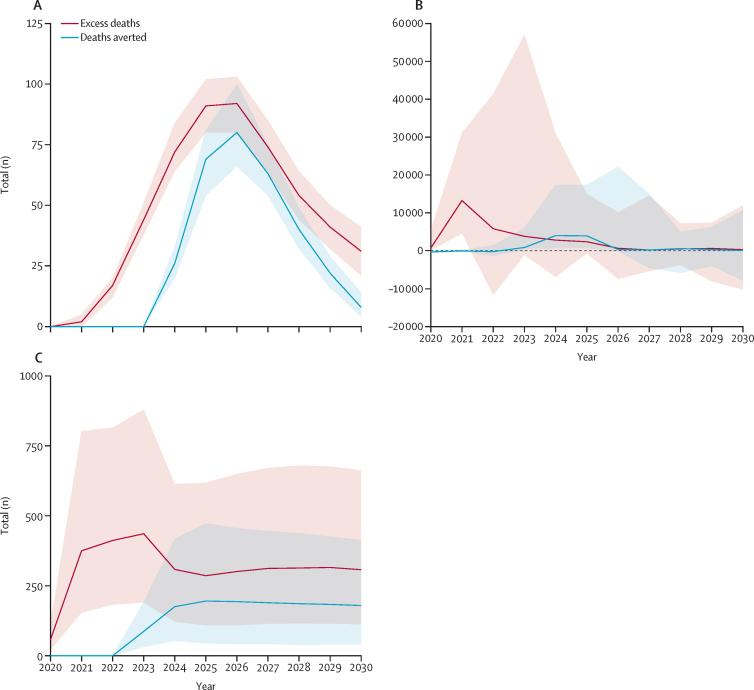
We estimated that disruption to measles, rubella, HPV, hepatitis B, meningitis A, and yellow fever vaccination could lead to 49 119 additional deaths (95% credible interval [CrI] 17 248-134 941) during calendar years 2020-30, largely due to measles. For years of vaccination 2020-30 for all 14 pathogens, disruption could lead to a 2·66% (95% CrI 2·52-2·81) reduction in long-term effect from 37 378 194 deaths averted (34 450 249-40 241 202) to 36 410 559 deaths averted (33 515 397-39 241 799). We estimated that catch-up activities could avert 78·9% (40·4-151·4) of excess deaths between calendar years 2023 and 2030 (ie, 18 900 [7037-60 223] of 25 356 [9859-75 073]).
INTERPRETATION
Our results highlight the importance of the timing of catch-up activities, considering estimated burden to improve vaccine coverage in affected cohorts. We estimated that mitigation measures for measles and yellow fever were particularly effective at reducing excess burden in the short term. Additionally, the high long-term effect of HPV vaccine as an important cervical-cancer prevention tool warrants continued immunisation efforts after disruption.
FUNDING
The Vaccine Impact Modelling Consortium, funded by Gavi, the Vaccine Alliance and the Bill & Melinda Gates Foundation.
TRANSLATIONS
For the Arabic, Chinese, French, Portguese and Spanish translations of the abstract see Supplementary Materials section.
背景
由于 COVID-19 大流行, 全球免疫覆盖率有所下降。 但复苏已经开始, 但具有地域差异。 这种中断导致免疫不足的人群出现, 并中断了降低疫苗可预防疾病负担的进展。 到目前为止, 很少有研究关注疫苗覆盖率中断对疫苗效果的影响。 我们旨在量化疫苗覆盖中断对常规和疫苗接种服务的影响, 确定可能特别受益于补种活动的人群和地区, 并确定是否可以恢复效果损失。
方法
在这项建模研究中, 我们使用了来自 112 个低收入和中等收入国家的疫苗影响建模联盟的建模小组, 以估计 14 种病原体的疫苗效果。 一组建模估计使用了针对一组疫苗可预防、 易爆发或优先疾病(即麻疹、 风疹、 乙型肝炎、 人乳头瘤病毒 [HPV]、 脑膜炎 A 和黄热病) 的疫苗覆盖率数据, 以检查缓解措施, 以下简称恢复运行。 第二组估计是使用从 1937 年到 2020 年的疫苗覆盖率数据进行的, 用于计算所有 14 种包括的疫苗和疾病的效果比(即每剂疫苗预防的疾病负担) , 以下简称全面运行。 这两种运行都从 2000 年 1 月 1 日至 2100 年 12 月 31 日进行建模。 如果一个国家属于 Gavi, 疫苗联盟计划; 具有显著负担; 或具有显著的战略疫苗接种活动, 则将其包括在内。 这些国家占全球疫苗可预防疾病负担的大部分。 疫苗覆盖率由世卫组织-联合国儿童基金会国家免疫覆盖估计和世卫组织免疫库提供的数据告知, 这些数据截至 2021 年。 从 2022 年起, 我们根据关于运动频率的指导意见、 对常规免疫恢复到中断前规模的非线性假设以及世卫组织免疫议程 2030 目标和专家咨询的 2030 年终点, 估计了覆盖率。 我们研究了三种主要情况: 没有中断、 基线恢复和基线恢复加补种。
结果
我们估计, 麻疹、 风疹、 HPV、 乙型肝炎、 脑膜炎 A 和黄热病疫苗接种的中断可能导致 2020-30 年日历年内额外死亡 49119 人(95%可信区间 [CrI] 17248-134941) , 主要是由于麻疹。 对于所有 14 种病原体的 2020-30 年疫苗接种年, 中断可能导致长期效果降低 2.66%(95% CrI 2.52-2.81) , 从 37378194 人死亡(34450249-40241202) 减少到 36410559 人死亡(33515397-39241799) 。 我们估计, 补种活动可以避免 2023 年至 2030 年期间(即 25356 人[9859-75073] 中的 18900 人[7037-60223] ) 超过 78.9%(40.4-151.4) 的超额死亡。
解释
我们的结果强调了补种活动时间的重要性, 同时考虑到提高受影响人群疫苗覆盖率的估计负担。 我们估计, 麻疹和黄热病的缓解措施在短期内特别有效地降低了超额负担。 此外, HPV 疫苗作为一种重要的宫颈癌预防工具, 其长期效果很高, 因此在中断后仍需继续进行免疫接种。
资金
疫苗影响建模联盟, 由 Gavi、 疫苗联盟和比尔及梅琳达·盖茨基金会资助。


 Zotero 插件