Liu Jun, Zhang Shan-Qiang, Chen Jing, Li Zhi-Bin, Chen Jia-Xi, Lu Qi-Qi, Han Yu-Shuai, Dai Wenjie, Xie Chongwei, Li Ji-Cheng
Medical Research Center, The Affiliated Yue Bei People's Hospital, Shantou University Medical College, Shaoguan 512025, China.
Institute of Cell Biology, Zhejiang University, Hangzhou 310058, China.
J Oncol. 2021 Jun 28;2021:5574150. doi: 10.1155/2021/5574150. eCollection 2021.
Hepatocellular carcinoma (HCC) is a highly malignant disease, and it is characterized by rapid progression and low five-year survival rate. At present, there are no effective methods for monitoring the treatment and prognosis of HCC.
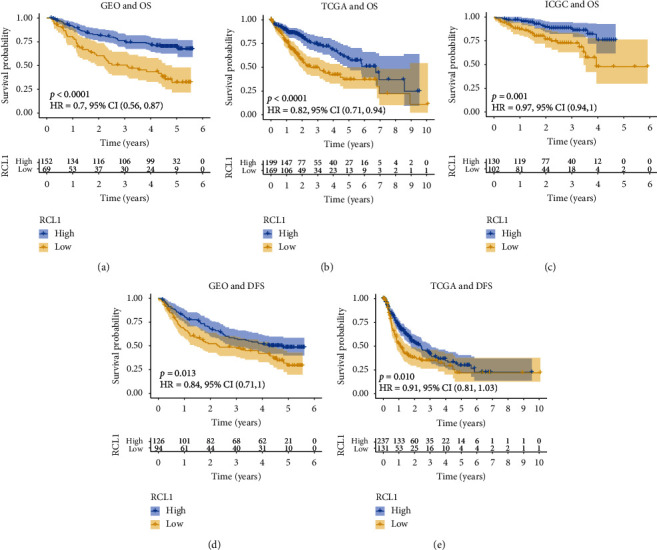
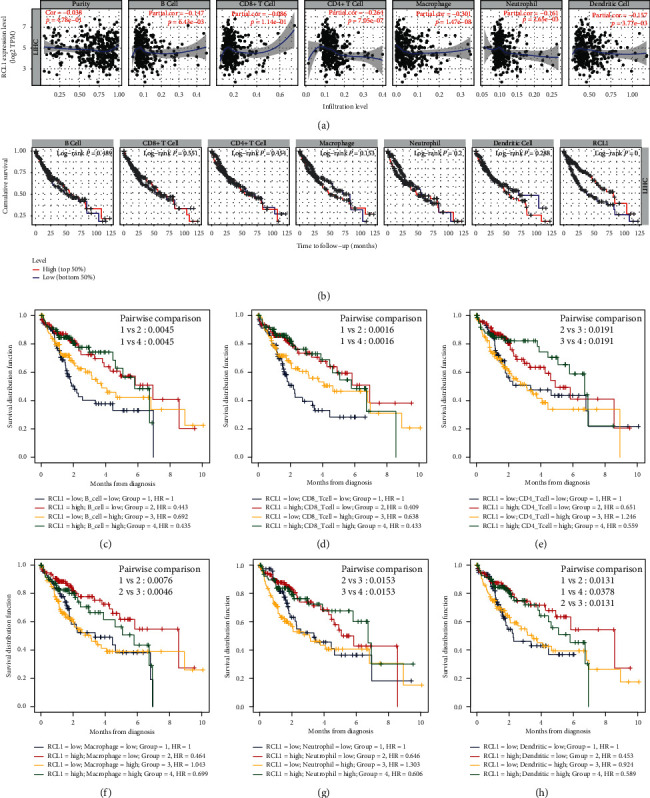
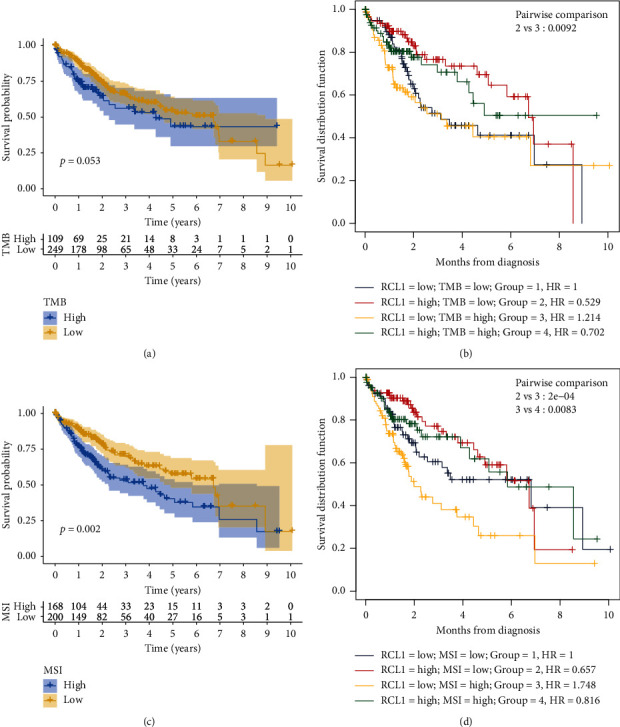
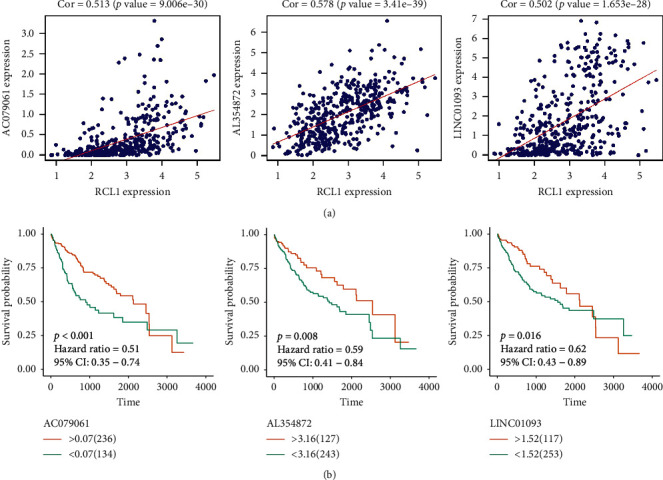
The transcriptome and gene expression profiles of HCC were obtained from the Cancer Genome Atlas (TCGA) program, International Cancer Genome Consortium (ICGC), and Gene Expression Omnibus (GEO) databases. The random forest method was applied to construct a four-gene prognostic model based on RNA terminal phosphate cyclase like 1 (RCL1) expression. The Kaplan-Meier method was performed to evaluate the prognostic value of RCL1, long noncoding RNAs (AC079061, AL354872, and LINC01093), and four-gene signature (, and ). We examined the relationship between RCL1 expression and immune cells infiltration, tumor mutation burden (TMB), and microsatellite instability (MSI).
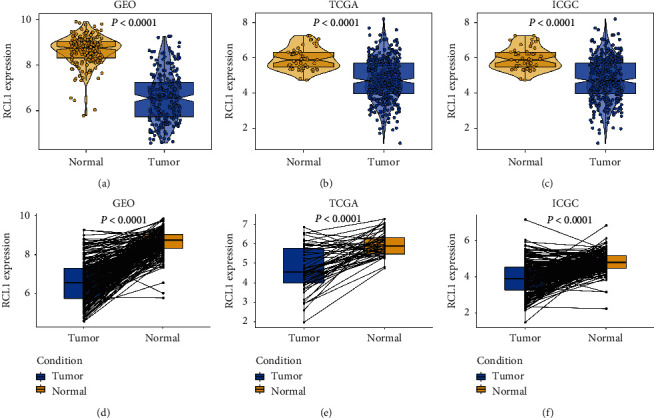
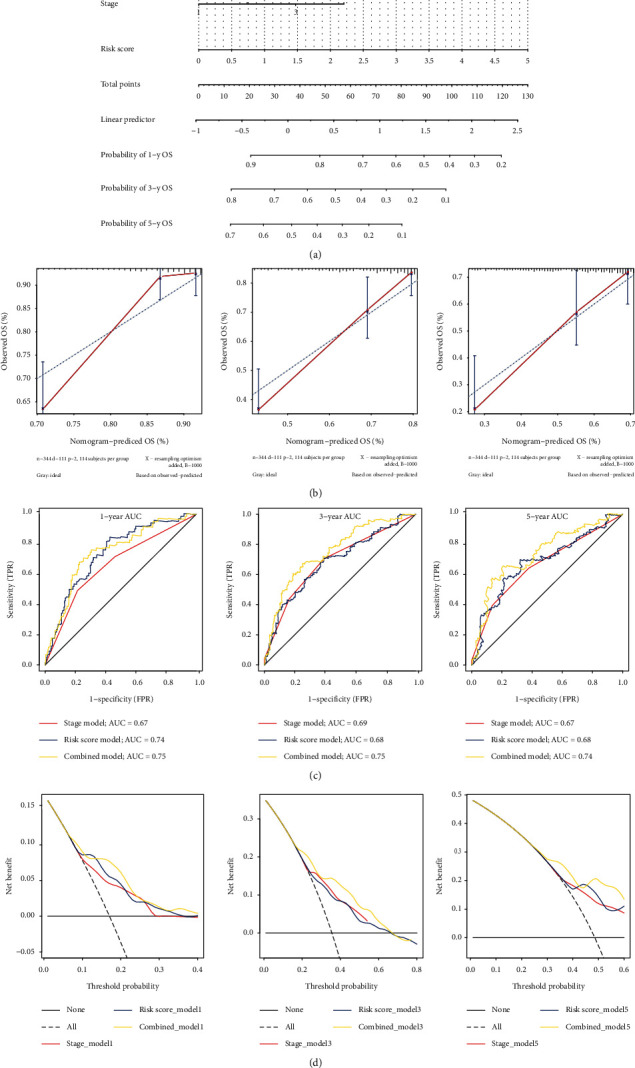
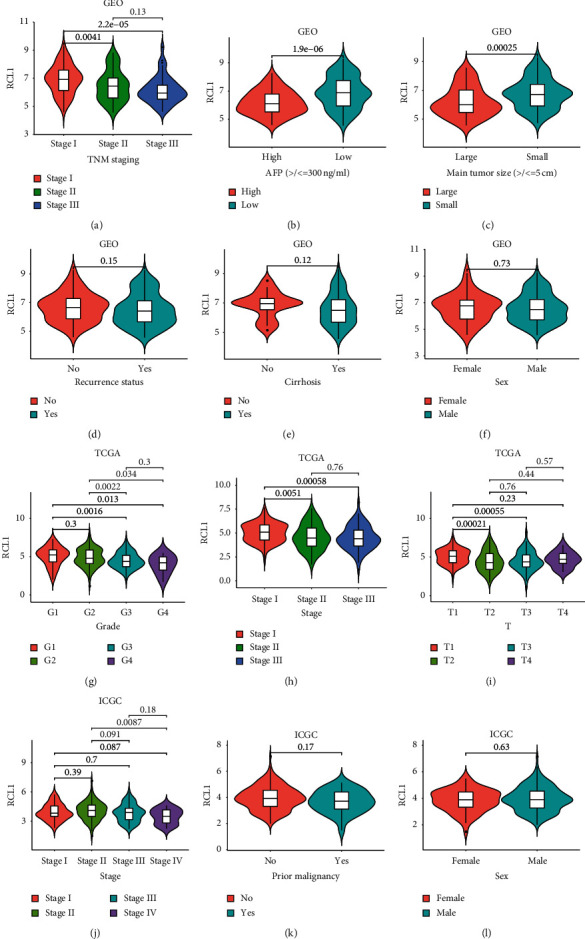
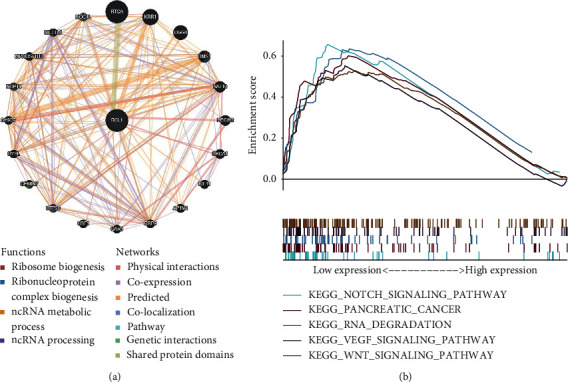
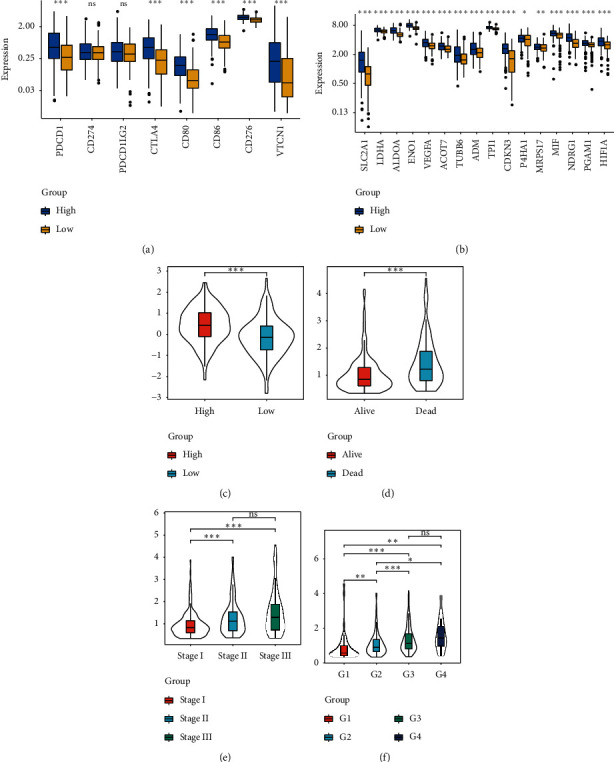
The results of multiple databases indicated that the aberrant expression of RCL1 was associated with clinical outcome, immune cells infiltration, TMB, and MSI in HCC patients. Meanwhile, we found that long noncoding RNAs (AC079061, AL354872, and LINC01093) and RCL1 were significantly coexpressed in HCC patients. We also confirmed that the four-gene signature was an independent prognostic factor for HCC patients. Ferroptosis potential index, immune checkpoint molecules, and clinical feature were found to have obvious correlations with risk score. The area under the receiver operating characteristic curve values for the model were 0.7-0.8 in the training set and the validation set, suggesting high robustness of the four-gene signature. We then built a nomogram for facilitating the use in clinical practice.
Our study demonstrated that RCL1 and a novel four-gene signature can be used as prognostic biomarkers for predicting clinical outcome in HCC patients; and this model may assist in individualized treatment monitoring of HCC patients in clinical practice.
肝细胞癌(HCC)是一种高度恶性的疾病,其特点是进展迅速且五年生存率低。目前,尚无有效的方法来监测HCC的治疗和预后。
从癌症基因组图谱(TCGA)项目、国际癌症基因组联盟(ICGC)和基因表达综合数据库(GEO)中获取HCC的转录组和基因表达谱。应用随机森林方法基于RNA末端磷酸环化酶样1(RCL1)表达构建一个四基因预后模型。采用Kaplan-Meier方法评估RCL1、长链非编码RNA(AC079061、AL354872和LINC01093)以及四基因特征(,和)的预后价值。我们研究了RCL1表达与免疫细胞浸润、肿瘤突变负荷(TMB)和微卫星不稳定性(MSI)之间的关系。
多个数据库的结果表明,RCL1的异常表达与HCC患者的临床结局、免疫细胞浸润、TMB和MSI相关。同时,我们发现长链非编码RNA(AC079061、AL354872和LINC01093)与RCL1在HCC患者中显著共表达。我们还证实四基因特征是HCC患者的独立预后因素。发现铁死亡潜能指数、免疫检查点分子和临床特征与风险评分有明显相关性。该模型在训练集和验证集的受试者操作特征曲线下面积值为0.7 - 0.8,表明四基因特征具有较高的稳健性。然后我们构建了一个列线图以便于临床应用。
我们的研究表明,RCL1和一种新的四基因特征可作为预测HCC患者临床结局的预后生物标志物;并且该模型可能有助于临床实践中对HCC患者进行个体化治疗监测。