Anda Liss, Johnsen Erik, Kroken Rune A, Joa Inge, Rettenbacher Maria, Løberg Else-Marie
TIPS Network for Clinical Psychosis Research, Division of Psychiatry, Stavanger University Hospital, Stavanger, Norway.
Institute of biological and medical psychology, Faculty of psychology, University of Bergen, Bergen, Norway.
Schizophr Res Cogn. 2021 Jun 28;26:100204. doi: 10.1016/j.scog.2021.100204. eCollection 2021 Dec.
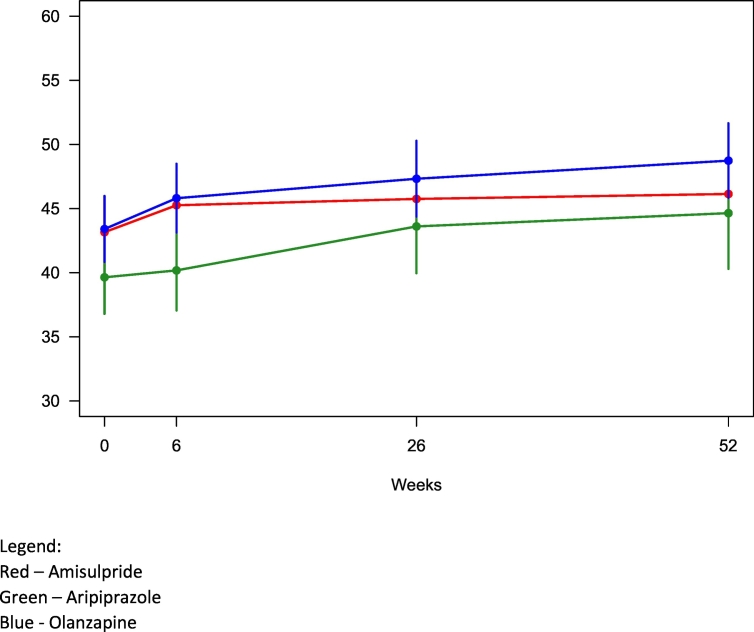
Cognitive impairment is a core aspect of psychotic disorders and difficult to treat. Atypical antipsychotics (AAs) might have differential effects on cognitive impairment, but rigid study designs and selective sampling limit the generalizability of existing findings. This pragmatic, semi-randomized, industry-independent study aimed to investigate and compare the effect of amisulpride, aripiprazole and olanzapine on cognitive performance in psychosis over a 12-month period controlling for diagnostic group. This sub study of the BeSt InTro study recruited adults with ongoing psychosis in the schizophrenia spectrum of disorders (ICD-10 diagnoses F20-F23, F25, F28 or F29; = 104) from Bergen and Stavanger, Norway; and Innsbruck, Austria. Participants were randomized to amisulpride, aripiprazole, or olanzapine and they completed neuropsychological assessments at baseline, 6 weeks, 6 and 12 months. The test battery targeted working memory, verbal ability, and processing speed. We used Longitudinal mixed effect (LME) models to assess cognitive change for intention to treat (ITT) and per protocol (PP) medication groups, as well as comparing cognitive performance between F20 and non-F20 participants. The sample baseline global cognitive performance t-score was 42.20. Global performance improved significantly to every follow-up, including for the F20 group. There were however no significant differences in cognitive change over time between neither ITT nor PP medication groups.
认知障碍是精神疾病的一个核心方面且难以治疗。非典型抗精神病药物(AAs)可能对认知障碍有不同的影响,但严格的研究设计和选择性抽样限制了现有研究结果的普遍性。这项务实、半随机、独立于行业的研究旨在调查和比较氨磺必利、阿立哌唑和奥氮平在12个月期间对精神病患者认知表现的影响,并对诊断组进行控制。这项“最佳入门”研究的子研究招募了来自挪威卑尔根和斯塔万格以及奥地利因斯布鲁克的患有精神分裂症谱系障碍(国际疾病分类第10版诊断为F20 - F23、F25、F28或F29;n = 104)的持续性精神病成年患者。参与者被随机分配到氨磺必利、阿立哌唑或奥氮平组,并在基线、6周、6个月和12个月时完成神经心理学评估。测试组合针对工作记忆、语言能力和处理速度。我们使用纵向混合效应(LME)模型来评估意向性治疗(ITT)和符合方案(PP)药物治疗组的认知变化,以及比较F20和非F20参与者之间的认知表现。样本基线总体认知表现t分数为42.20。包括F20组在内,每次随访时总体表现均显著改善。然而,ITT和PP药物治疗组之间随时间的认知变化均无显著差异。