From the Research Group Social Stress and Family Health (Puhlmann, Vrtička, Linz, Engert), Max Planck Institute for Human Cognitive and Brain Sciences, Leipzig; Leibniz Institute for Resilience Research (Puhlmann), Mainz, Germany; Centre for Brain Science, Department of Psychology (Vrtička), University of Essex, Colchester, United Kingdom; Department of Clinical Psychology (Stalder), University of Siegen, Siegen; Department of Biological Psychology (Kirschbaum), Technische Universität Dresden, Dresden; Institute of Psychosocial Medicine, Psychotherapy and Psychooncology (Engert), Jena University Hospital, Friedrich-Schiller University, Jena; and Social Neuroscience Lab (Singer), Max Planck Society, Berlin, Germany.
Psychosom Med. 2021 Oct 1;83(8):894-905. doi: 10.1097/PSY.0000000000000970.
This study aimed to investigate the effect of regular contemplative mental training on endocrine and psychological indices of long-term stress.
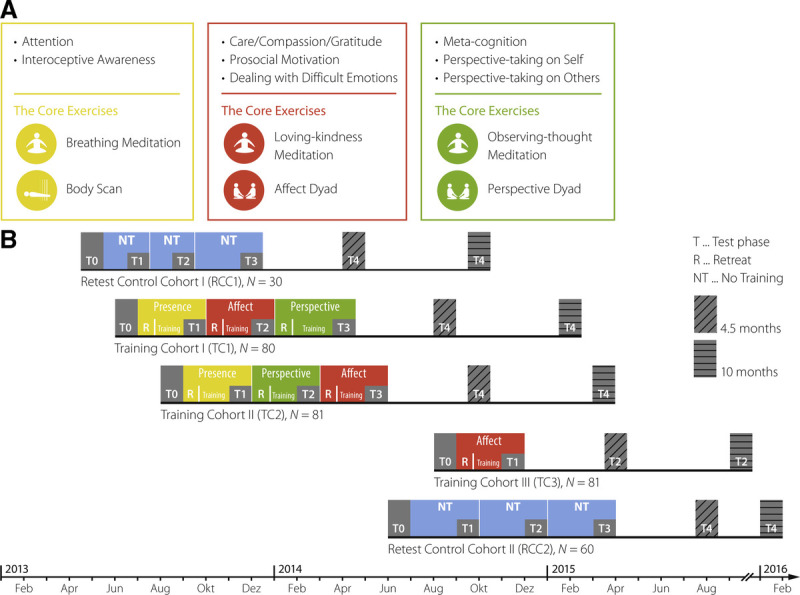
An open-label efficacy trial that comprised three distinct 3-month long modules targeting attention and interoception, socioaffective, or sociocognitive abilities through dyadic exercises and secularized meditation practices was conducted with healthy adults. Participants underwent the training for 3 or 9 months, or were assigned to a retest control cohort. Chronic stress indices were assayed at four time points: pretraining and after 3, 6, and 9 months. The main outcome measures were cortisol (HC) and cortisone (HE) concentration in hair and self-reported long-term stress.
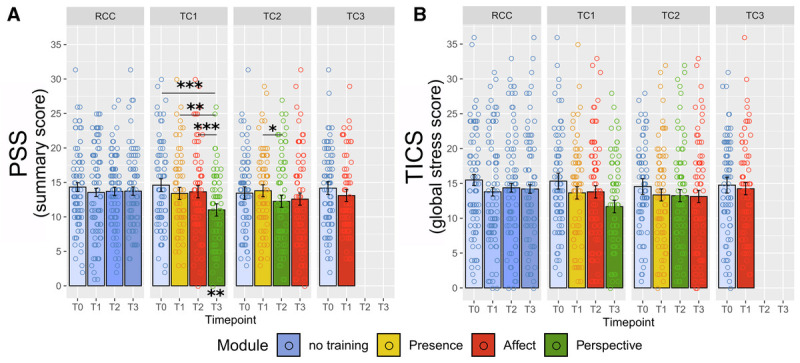
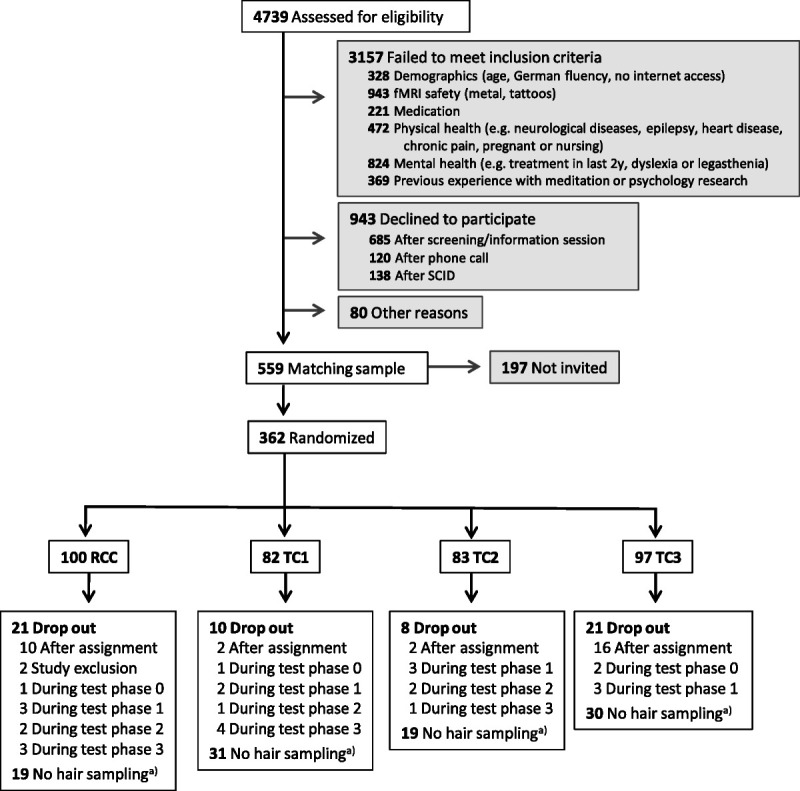
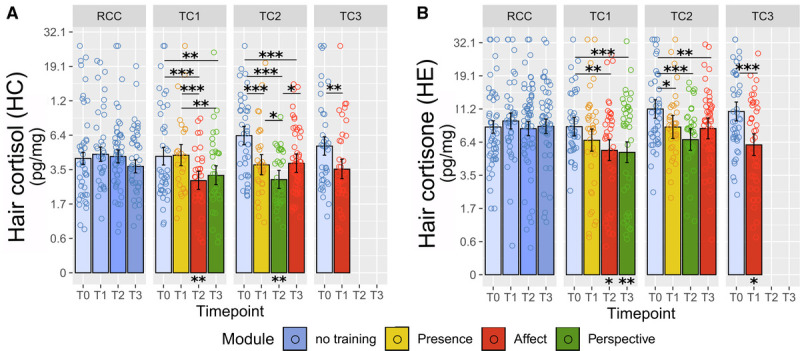
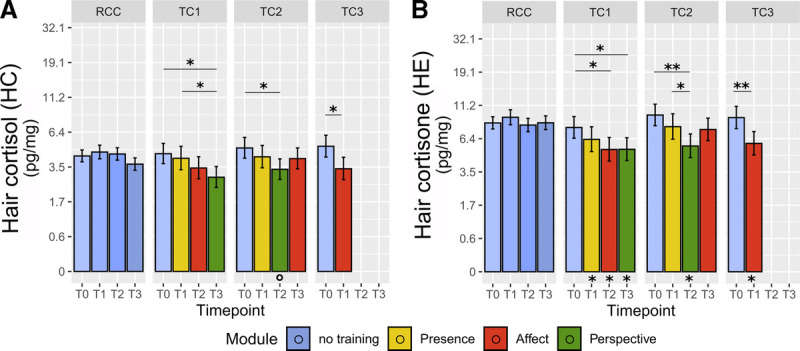
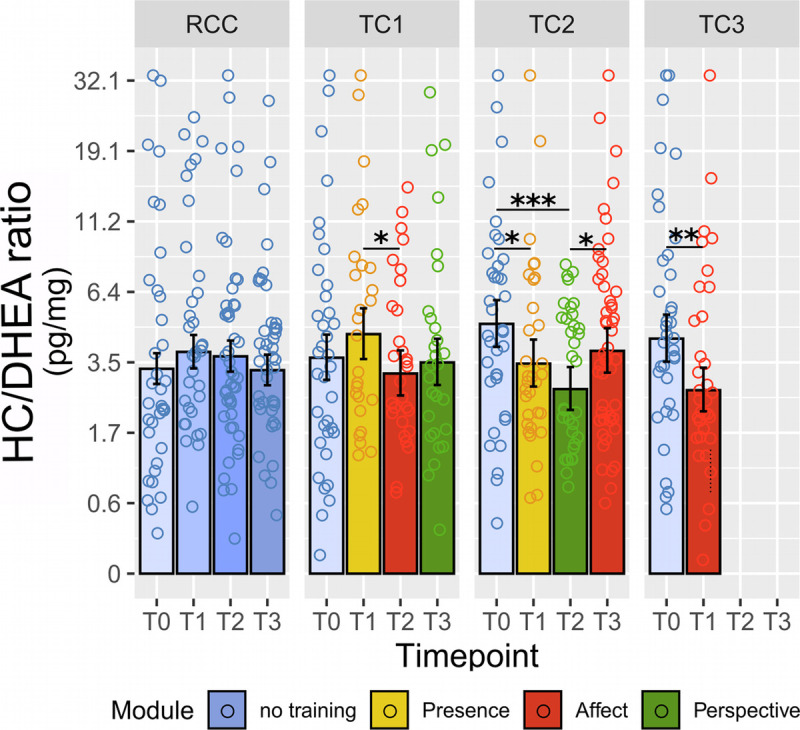
Of 362 initially randomized individuals, 30 dropped out before study initiation (n = 332; mean [SD] age = 40.7 [9.2] years; 197 women). Hair-based glucocorticoid assays were available from n = 227, and questionnaire data from n = 326. Results from three separate training cohorts (TC1-3) revealed consistent decreases in HC and HE levels over the first three (TC3) to 6 months (TC1 and TC2) of training, with no further reduction at the final 9-month mark (baseline to end of training differences, HC, TC1: t(355) = 2.59, p = .010, contrast estimate (est.) [SE] = 0.35 [0.14]; HC, TC2: t(363) = 4.06, p < .001, est. = 0.48 [0.12]; HC, TC3: t(368) = 3.18, p = .002, est. = 0.41 [0.13]; HE, TC1: t(435) = 3.23, p = .001, est. = 0.45 [0.14]; HE, TC2: t(442) = 2.60, p = .010, est. = 0.33 [0.13]; HE, TC3: t(446) = 4.18, p < .001, est. = 0.57 [0.14]). Training effects on HC increased with individual compliance (practice frequency), and effects on both HC and HE were independent of training content and unrelated to change in self-reported chronic stress. Self-reported stress, and cortisol-to-dehydroepiandrosterone ratios as an exploratory endpoint, were also reduced, albeit less consistently.
Our results point to the reduction of long-term cortisol exposure as a mechanism through which meditation-based mental training may exert positive effects on practitioners' health.Trial Registration: ClinicalTrials.gov identifier: NCT01833104.
本研究旨在探讨定期冥想训练对长期应激的内分泌和心理指标的影响。
采用开放性疗效试验,该试验包括三个不同的 3 个月模块,通过对偶练习和世俗化的冥想实践,分别针对注意力和内感受、社会情感或社会认知能力进行训练。研究对象为健康成年人。参与者接受 3 或 9 个月的训练,或被分配到重测对照组。在四个时间点检测慢性应激指标:训练前和 3、6 和 9 个月后。主要观察指标为头发中皮质醇(HC)和皮质酮(HE)浓度以及自我报告的长期压力。
在最初随机分配的 362 人中,有 30 人在研究开始前退出(n=332;平均[标准差]年龄=40.7[9.2]岁;197 名女性)。有 n=227 人提供了基于毛发的糖皮质激素检测结果,n=326 人提供了问卷调查数据。来自三个独立训练组(TC1-3)的结果显示,HC 和 HE 水平在最初的 3(TC3)至 6 个月(TC1 和 TC2)的训练中持续下降,在最终的 9 个月标记(从基线到训练结束的差异,HC,TC1:t(355)=2.59,p=.010,估计值(est.)[SE]=0.35[0.14];HC,TC2:t(363)=4.06,p<.001,est.=0.48[0.12];HC,TC3:t(368)=3.18,p=.002,est.=0.41[0.13];HE,TC1:t(435)=3.23,p=.001,est.=0.45[0.14];HE,TC2:t(442)=2.60,p=.010,est.=0.33[0.13];HE,TC3:t(446)=4.18,p<.001,est.=0.57[0.14])。HC 的训练效果与个体依从性(练习频率)有关,且对 HC 和 HE 的影响独立于训练内容,与自我报告的慢性应激变化无关。自我报告的压力以及作为探索性终点的皮质醇与脱氢表雄酮比值也有所降低,但一致性较差。
我们的结果表明,长期皮质醇暴露的减少可能是冥想训练对从业者健康产生积极影响的机制。
ClinicalTrials.gov 标识符:NCT01833104。