
通过活性阳离子聚合与其他聚合方法相结合合成嵌段共聚物。
Block Copolymer Synthesis by the Combination of Living Cationic Polymerization and Other Polymerization Methods.
作者信息
Dey Asmita, Haldar Ujjal, De Priyadarsi
机构信息
Polymer Research Centre and Centre for Advanced Functional Materials, Department of Chemical Sciences, Indian Institute of Science Education and Research Kolkata, Kolkata, India.
出版信息
Front Chem. 2021 Jun 28;9:644547. doi: 10.3389/fchem.2021.644547. eCollection 2021.
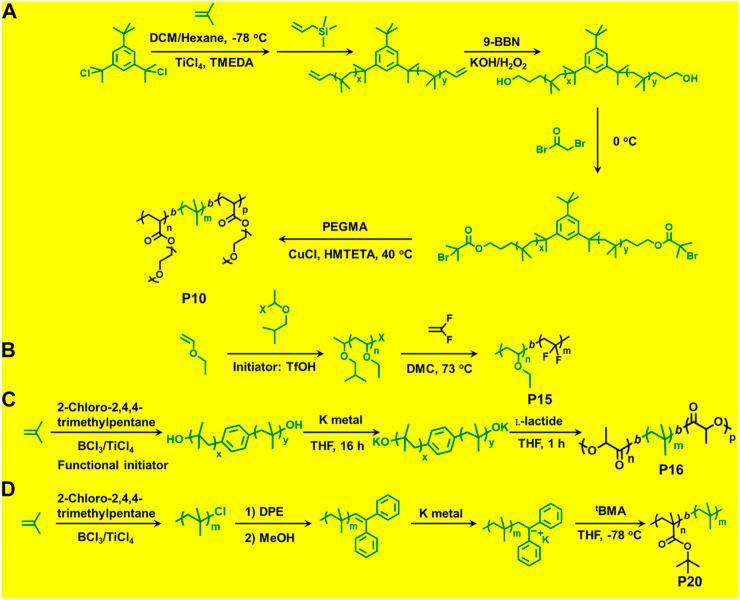
The foremost limitation of block copolymer synthesis is to polymerize two or more different types of monomers with different reactivity profiles using a single polymerization technique. Controlled living polymerization techniques play a vital role in the preparation of wide range of block copolymers, thus are revolutionary techniques for polymer industry. Polymers with good control over molecular weight, molecular weight distribution, chain-end functionality and architectures can be prepared by these processes. In order to improve the existing applications and create new opportunities to design a new block copolymer system with improved physical and chemical properties, the combination of two different polymerization techniques have tremendous scope. Such kinds of macromolecules may be attended by combination of homopolymerization of different monomers by post-modification techniques using a macroinitiator or by using a dual initiator which allows the combination of two mechanistically distinct techniques. This review focuses on recent advances in synthesis of block copolymers by combination of living cationic polymerization with other polymerization techniques and click chemistry.
嵌段共聚物合成的首要限制在于,使用单一聚合技术使两种或更多具有不同反应活性的不同类型单体进行聚合。可控活性聚合技术在制备多种嵌段共聚物方面发挥着至关重要的作用,因此是聚合物工业的革命性技术。通过这些方法可以制备出对分子量、分子量分布、链端官能团和结构具有良好控制的聚合物。为了改进现有应用并创造新机会来设计具有改善物理和化学性质的新型嵌段共聚物体系,两种不同聚合技术的结合具有巨大潜力。这类大分子可通过使用大分子引发剂的后修饰技术使不同单体进行均聚,或通过使用双引发剂(其允许两种机理不同的技术相结合)来实现。本综述聚焦于通过活性阳离子聚合与其他聚合技术及点击化学相结合来合成嵌段共聚物的最新进展。


 Zotero 插件