Department of Psychology.
Alameda County Behavioral Health Care Services.
J Consult Clin Psychol. 2021 Jun;89(6):537-550. doi: 10.1037/ccp0000650.
To determine if the Transdiagnostic Intervention for Sleep and Circadian Dysfunction (TranS-C) improves functional impairment, psychiatric symptoms, and sleep and circadian functioning.
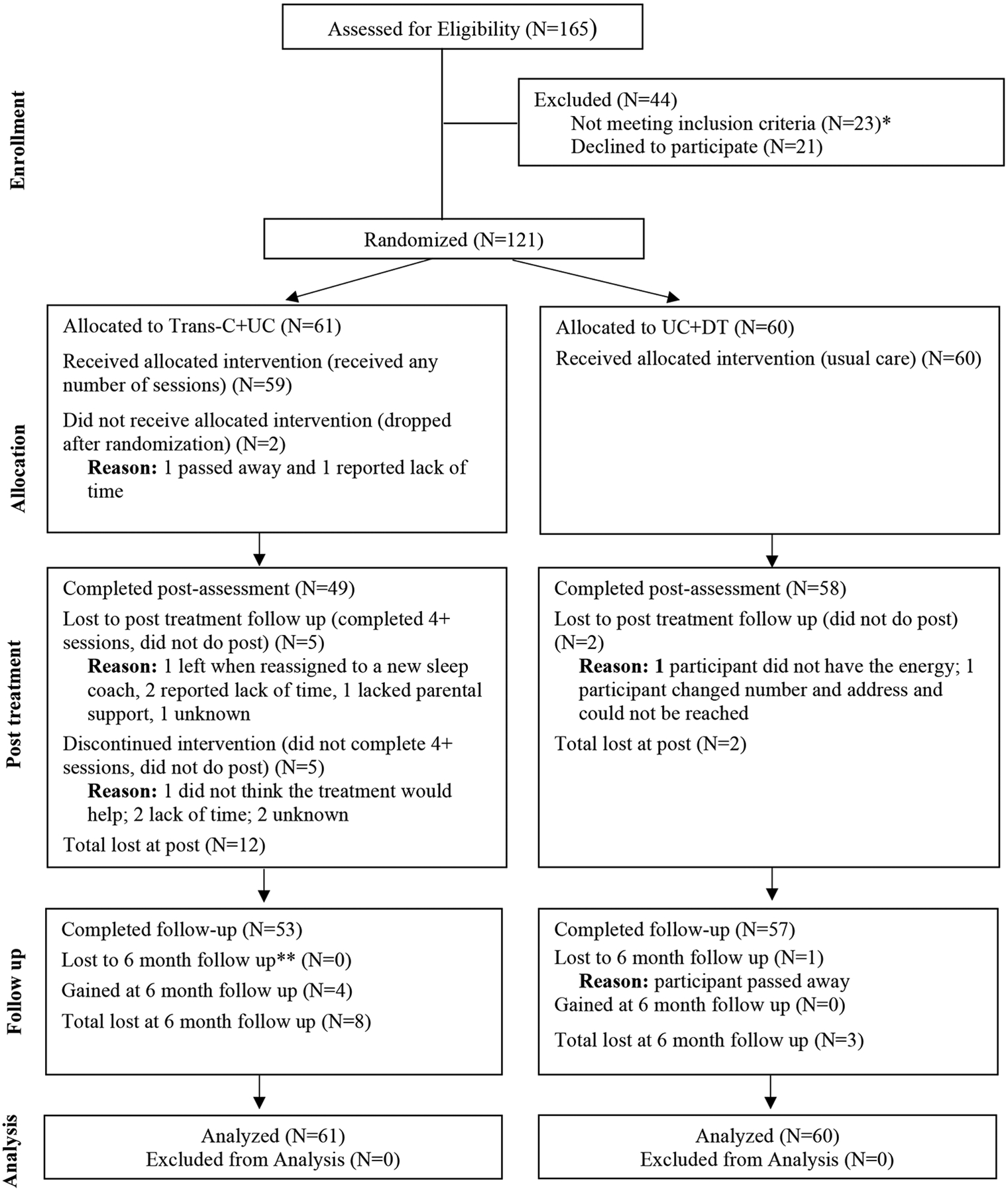
Adults diagnosed with serious mental illness (SMI) and sleep and circadian dysfunction (N = 121) were randomly allocated to TranS-C plus usual care (TranS-C + UC; n = 61; 8 individual weekly sessions) or 6 months of Usual Care followed by Delayed Treatment with TranS-C (UC-DT; n = 60). Schizophrenia (45%) and anxiety disorders (47%) were common. Blind assessments were conducted pre-treatment, post-treatment, and 6 months later (6FU). The latter two were the post-randomization points of interest. The location was Alameda County Behavioral Health Care Services (ACBHCS), a Community Mental Health Center (CMHC) in California.
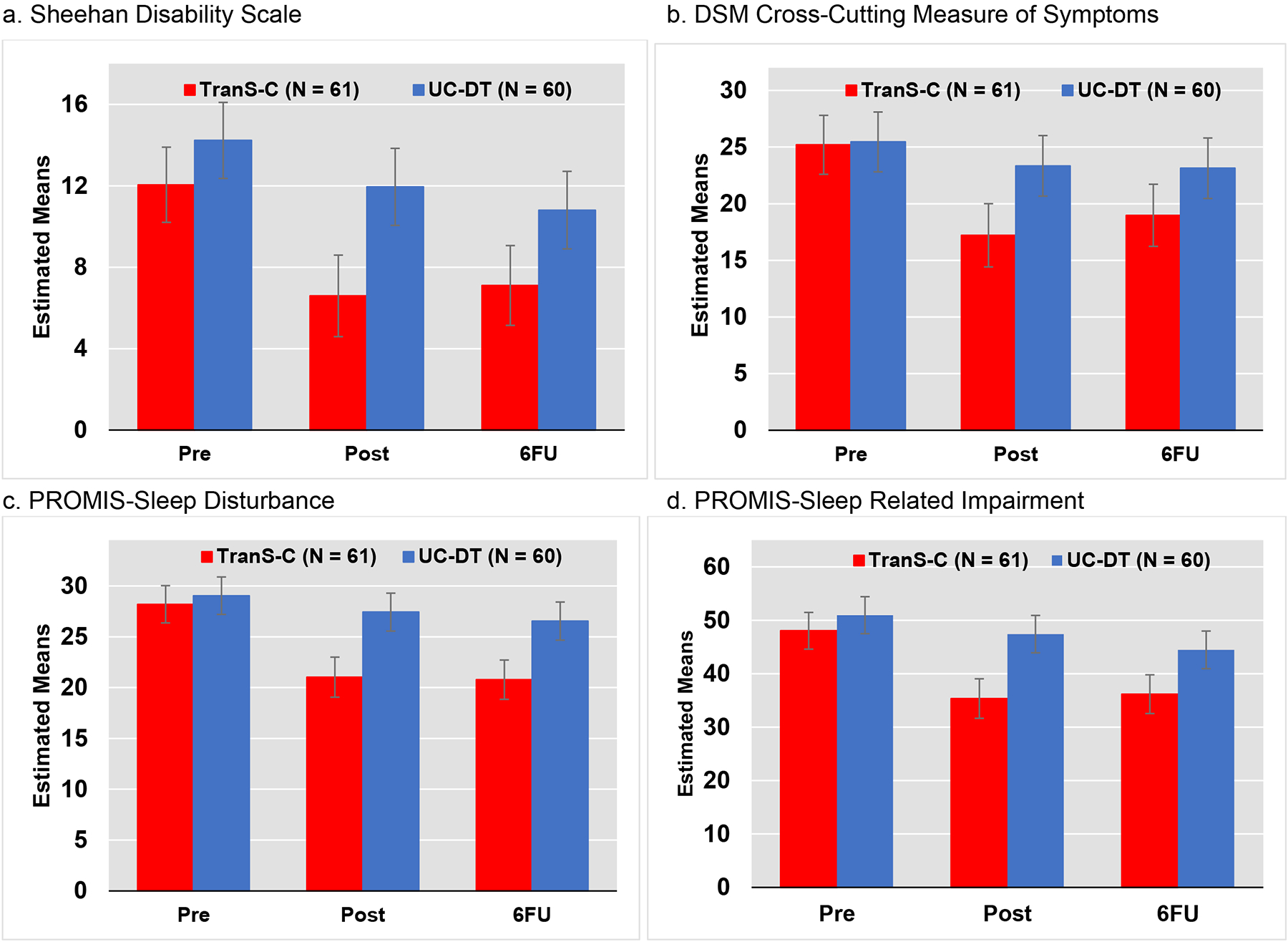
For the primary outcomes, relative to UC-DT, TranS-C + UC was associated with reduction in functional impairment (b = -3.18, p = 0.025, d = -0.58), general psychiatric symptoms (b = -5.88, p = 0.001, d = -0.64), sleep disturbance (b = -5.55, p < .0001, d = -0.96), and sleep-related impairment (b = -9.14, p < .0001, d = -0.81) from pre-treatment to post-treatment. These effects were maintained to 6-month follow-up (6FU; d = -0.42 to -0.82), except functional impairment (d = -0.37). For the secondary outcomes, relative to UC-DT, TranS-C + UC was associated with improvement in sleep efficiency and on the Sleep Health Composite score from pre-treatment to 6FU. TranS-C + UC was also associated with reduced total wake time and wake time variability from pre-treatment to post-treatment, as well as reduced hallucinations and delusions, bedtime variability, and actigraphy measured waking activity count variability from pre-treatment to 6FU.
A novel transdiagnostic treatment, delivered within a CMHC setting, improves selected measures of functioning, symptoms of comorbid disorders, and sleep and circadian outcomes. (PsycInfo Database Record (c) 2021 APA, all rights reserved).
确定跨诊断睡眠和昼夜节律障碍干预(TranS-C)是否能改善功能障碍、精神症状以及睡眠和昼夜节律功能。
患有严重精神疾病(SMI)和睡眠及昼夜节律障碍的成年人(N=121)被随机分配到 TranS-C 加常规护理(TranS-C+UC;n=61;每周 8 次个体治疗)或 6 个月的常规护理后延迟接受 TranS-C 治疗(UC-DT;n=60)。常见的诊断包括精神分裂症(45%)和焦虑障碍(47%)。在治疗前、治疗后和 6 个月后(6FU)进行盲法评估。后两个是随机分组后的关注时间点。研究地点是加利福尼亚州阿拉米达县行为健康护理服务(ACBHCS),这是一个社区心理健康中心(CMHC)。
对于主要结局,与 UC-DT 相比,TranS-C+UC 与功能障碍(b=-3.18,p=0.025,d=-0.58)、一般精神症状(b=-5.88,p=0.001,d=-0.64)、睡眠障碍(b=-5.55,p<0.0001,d=-0.96)和与睡眠相关的障碍(b=-9.14,p<0.0001,d=-0.81)的改善相关,这些改善从治疗前持续到治疗后。这些效果在 6 个月随访(6FU)时仍然存在(d=-0.42 至-0.82),除了功能障碍(d=-0.37)。对于次要结局,与 UC-DT 相比,TranS-C+UC 与睡眠效率和睡眠健康综合评分的改善相关,这些改善从治疗前到 6FU 时一直存在。TranS-C+UC 还与治疗前到治疗后总清醒时间和清醒时间变异性的减少,以及治疗前到 6FU 时幻觉和妄想、就寝时间变异性和活动记录仪测量的清醒活动计数变异性的减少相关。
在社区心理健康中心环境中提供的一种新的跨诊断治疗方法可以改善特定的功能、共病障碍的症状以及睡眠和昼夜节律结果。(PsycInfo 数据库记录(c)2021 APA,保留所有权利)。