Division of Adolescent/Young Adult Medicine, Boston Children's Hospital, Boston, Massachusetts; Department of Pediatrics, Harvard Medical School, Boston, Massachusetts.
Division of Adolescent/Young Adult Medicine, Boston Children's Hospital, Boston, Massachusetts; Department of Pediatrics, Harvard Medical School, Boston, Massachusetts.
J Adolesc Health. 2021 Oct;69(4):660-663. doi: 10.1016/j.jadohealth.2021.05.019. Epub 2021 Jul 12.
The COVID-19 pandemic has led to the development and worsening of eating disorder (ED) symptoms in adolescents and young adults. In order to examine COVID-19-related trends in ED care-seeking at our institution.
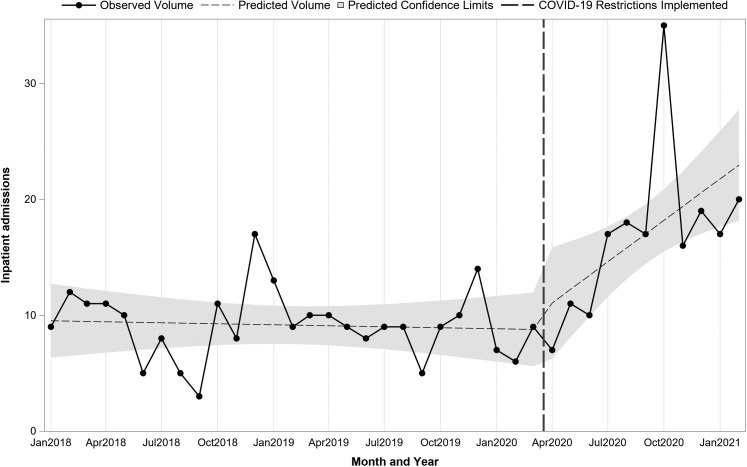
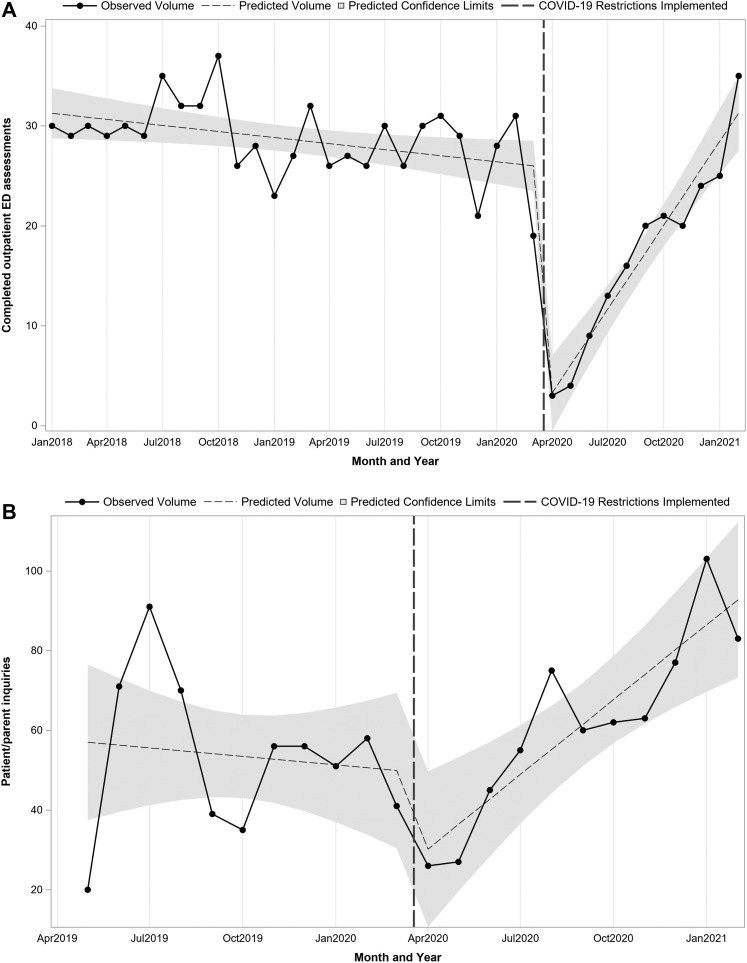
We used interrupted time series regression to examine pre- and postpandemic monthly summary data of the following: (1) ED-related inpatient admissions for medical stabilization; (2) ED-related hospital bed-days; (3) completed outpatient ED assessments; and (4) ED outpatient care-related inquiries at a children's hospital in Boston, MA.
Inpatient admissions, hospital bed-days, and outpatient care-related inquiries increased on average over time postpandemic compared to stable volume over time prepandemic (p < .01). Outpatient assessments decreased precipitously initially following COVID-19-related limitations, and rose quickly back to baseline.
These results indicate increased need for ED-related care during the pandemic. Bolstering resources to meet the needs of these vulnerable patients is critical as the effects of the pandemic continue to be felt.
COVID-19 大流行导致青少年和年轻人的饮食障碍(ED)症状发展和恶化。为了研究我们机构中与 COVID-19 相关的 ED 治疗寻求趋势。
我们使用中断时间序列回归分析了以下方面的流行前后每月总结数据:(1)ED 相关的住院治疗以进行医疗稳定;(2)ED 相关的住院天数;(3)完成的 ED 门诊评估;以及(4)马萨诸塞州波士顿一家儿童医院的 ED 门诊护理相关咨询。
与流行前稳定时期相比,住院治疗、住院天数和 ED 门诊护理相关咨询在流行后平均随时间增加(p <.01)。在 COVID-19 相关限制之后,门诊评估最初急剧下降,然后迅速恢复到基线。
这些结果表明,在大流行期间需要更多的 ED 相关护理。随着大流行的持续影响,为满足这些脆弱患者的需求提供支持资源至关重要。