Department of Pharmacology, Sahlgrenska Academy, University of Gothenburg, Gothenburg, Sweden.
HTA-Centrum, Sahlgrenska University Hospital, Gothenburg, Sweden.
Eur J Clin Pharmacol. 2021 Dec;77(12):1875-1885. doi: 10.1007/s00228-021-03182-1. Epub 2021 Jul 16.
As a substantial proportion of bariatric surgery patients use psychotropic/antiepileptic drugs, we investigated the impact of this procedure on serum concentrations.
In a naturalistic, longitudinal, prospective case series, we compared dose-adjusted trough concentrations of antidepressants, antipsychotics, or antiepileptics in consecutive patients before and after bariatric surgery. Adherence to treatment over 2 weeks preceding each sampling was considered.
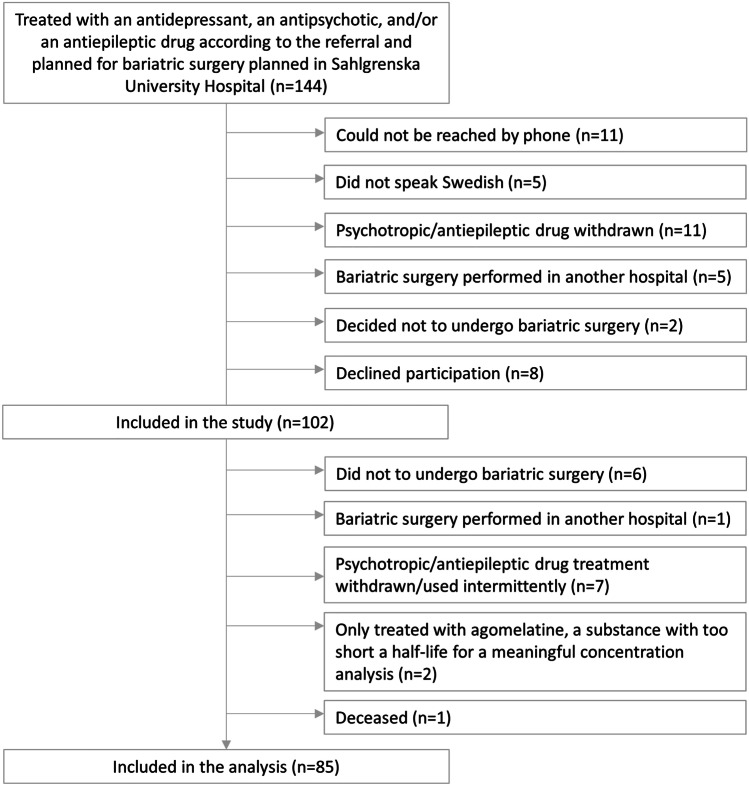
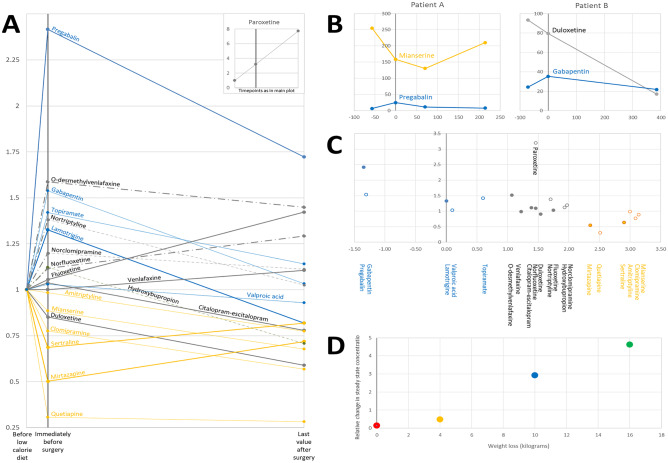
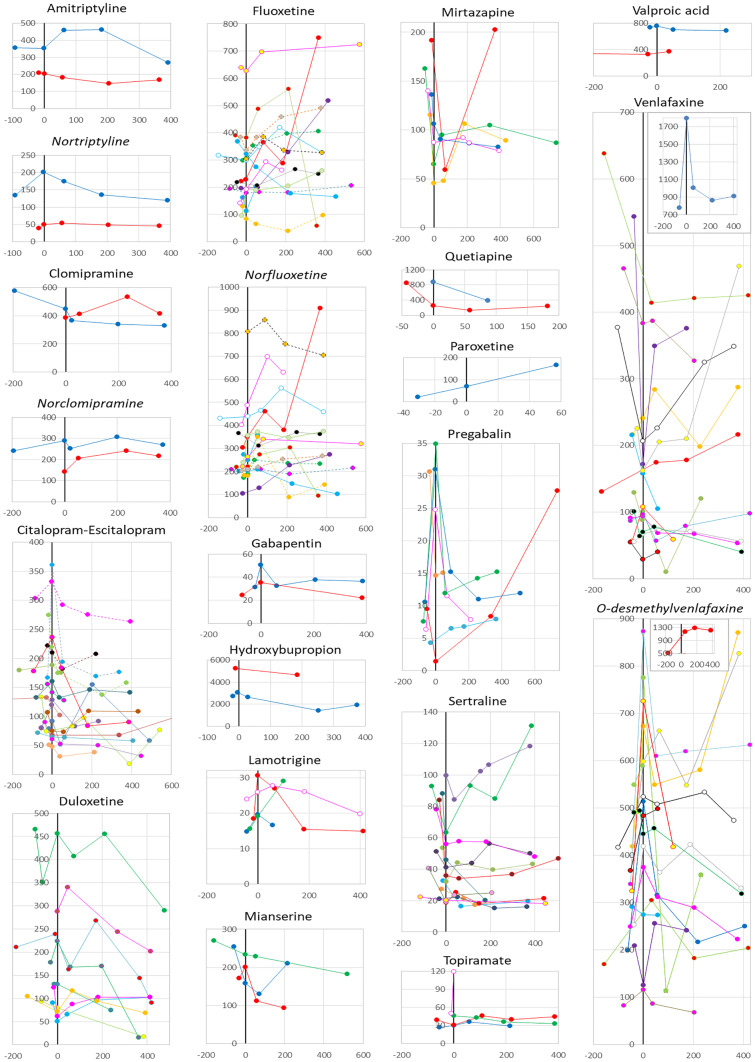
In all, 85 participants were included (86% female, median age 45 years, median body mass index 42 kg/m). They were being treated with 18 different psychotropic/antiepileptic drugs (7 substances: 6-17 individuals, 11 substances: 1-4 individuals) and contributed 237 samples over a median of 379 days after surgery. For four out of seven substances with pre-/post-surgery samples available from six or more individuals, the dose-adjusted concentration was reduced (sertraline: 51%, mirtazapine: 41%, duloxetine: 35%, citalopram: 19%). For sertraline and mirtazapine, the low-calorie-diet before surgery entirely explained this reduction. A consistent finding, irrespective of drug, was the association between the mean ratio of the post-/pre-diet dose-adjusted concentration and the lipophilicity of the drug (logD; correlation coefficient: -0.69, P = 0.0005), the low-calorie diet often affecting serum concentration more than the surgery itself.
Serum concentrations of psychotropic/antiepileptic drugs vary after bariatric surgery and can be hard to predict in individual patients, suggesting that therapeutic drug monitoring is of value. Conversely, effects of the pre-surgery, low-calorie diet appear generalizable, with decreased concentrations of highly lipophilic drugs and increased concentrations of highly hydrophilic drugs. Interaction effects (surgery/dose/concentration) were not evident but cannot be excluded.
由于相当一部分减重手术患者使用精神类药物/抗癫痫药物,我们研究了该手术对血清浓度的影响。
在一项自然主义、纵向、前瞻性病例系列研究中,我们比较了连续患者在减重手术前后,经过剂量调整的抗抑郁药、抗精神病药或抗癫痫药的谷浓度。在每次采样前的 2 周内,我们考虑了药物的治疗依从性。
共有 85 名患者入选(86%为女性,中位年龄 45 岁,中位体重指数 42kg/m²)。他们正在接受 18 种不同的精神类药物/抗癫痫药物治疗(7 种药物:6-17 人,11 种药物:1-4 人),在手术后中位数 379 天内共提供了 237 个样本。对于有 6 个或更多个体术前/术后样本的七种药物中的四种,经剂量调整的浓度降低(舍曲林:51%,米氮平:41%,度洛西汀:35%,西酞普兰:19%)。对于舍曲林和米氮平,术前的低热量饮食完全解释了这种降低。无论药物如何,一个一致的发现是术后/术前饮食调整后药物浓度的平均值与药物亲脂性(logD)的比值(相关系数:-0.69,P=0.0005)之间存在关联,低热量饮食通常比手术本身更能影响血清浓度。
减重手术后精神类药物/抗癫痫药物的血清浓度发生变化,在个体患者中难以预测,提示治疗药物监测具有价值。相反,术前低热量饮食的影响似乎具有普遍性,高度亲脂性药物的浓度降低,高度亲水性药物的浓度升高。未观察到但不能排除相互作用(手术/剂量/浓度)的影响。